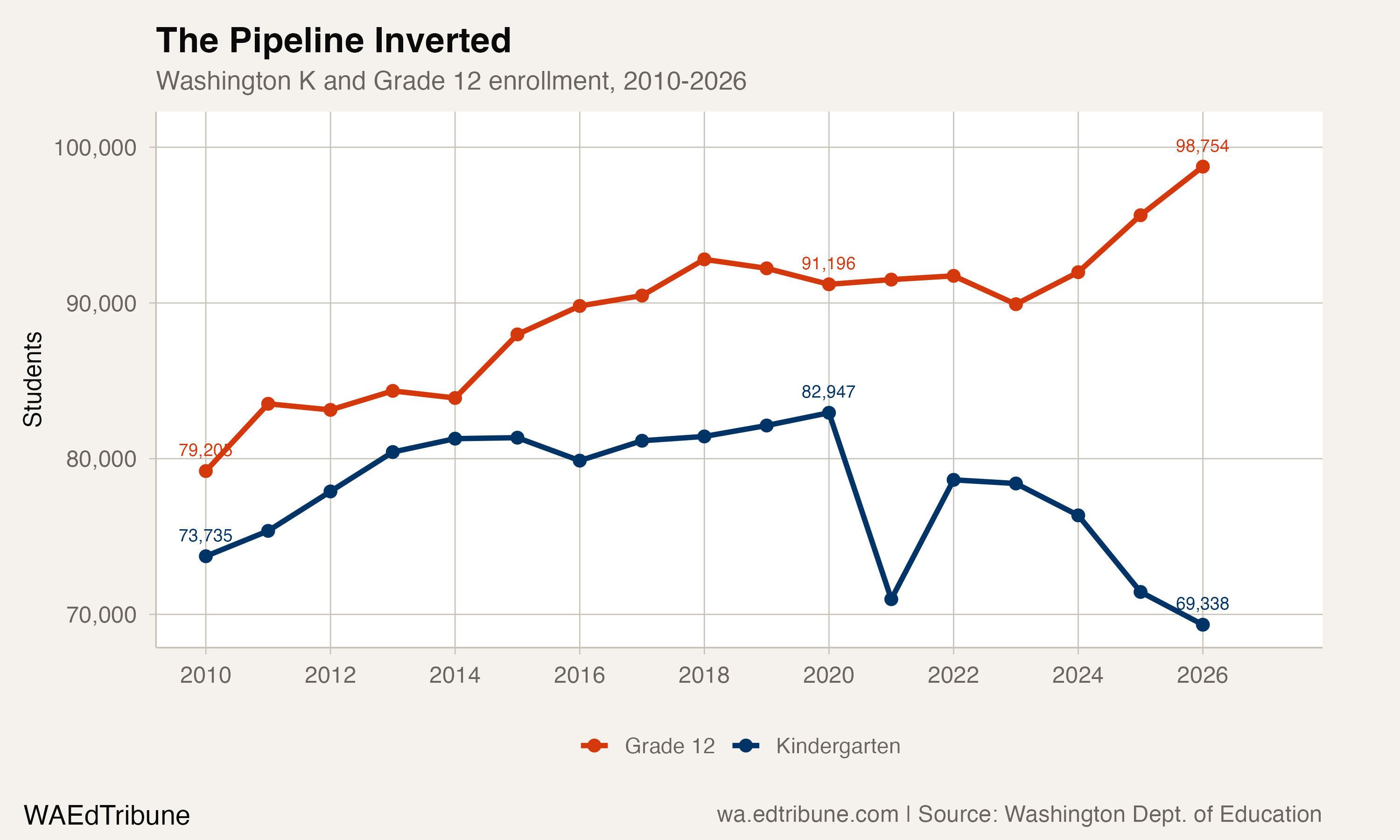
In Bellevue, the first grade class is 67.2% the size of the senior class. In Seattle, kindergarten enrollment has fallen 25% from its peak. Across Washington, 69,338 children entered kindergarten in 2025-26, the lowest count in 17 years of data and 13,609 fewer than the 82,947 who enrolled just six years earlier.
At the other end of the building, 98,754 students are in 12th grade, an all-time high. Grade 12 now exceeds kindergarten by 29,416 students, a gap that did not exist a decade ago. Washington's K-12 system is operating two school systems simultaneously: one that is growing and one that is shrinking. The shrinking side is the future.
Six years of smaller kindergarten classes
The COVID dip in 2020-21, when kindergarten plunged by 11,970 students in a single year, gets the most attention. But what happened next is the real story. Kindergarten bounced back to 78,640 in 2021-22 as families returned. Then it resumed falling: down 234, then 2,047, then 4,916, then 2,105, for a cumulative loss of 9,302 students (11.8%) over just four years.
The post-bounce decline is not pandemic behavior. It is demographic. Washington's birth rate dropped 22% between 2007 and 2022, from 13.77 to 10.70 births per 1,000 residents. The fertility rate fell to 51.4 per 1,000 women ages 15-44 in 2023. Children born in 2019 and 2020, when births continued their long slide, are the kindergartners of 2025-26. Children born in 2021, when Washington recorded its lowest birth totals in years, will arrive in 2026-27.
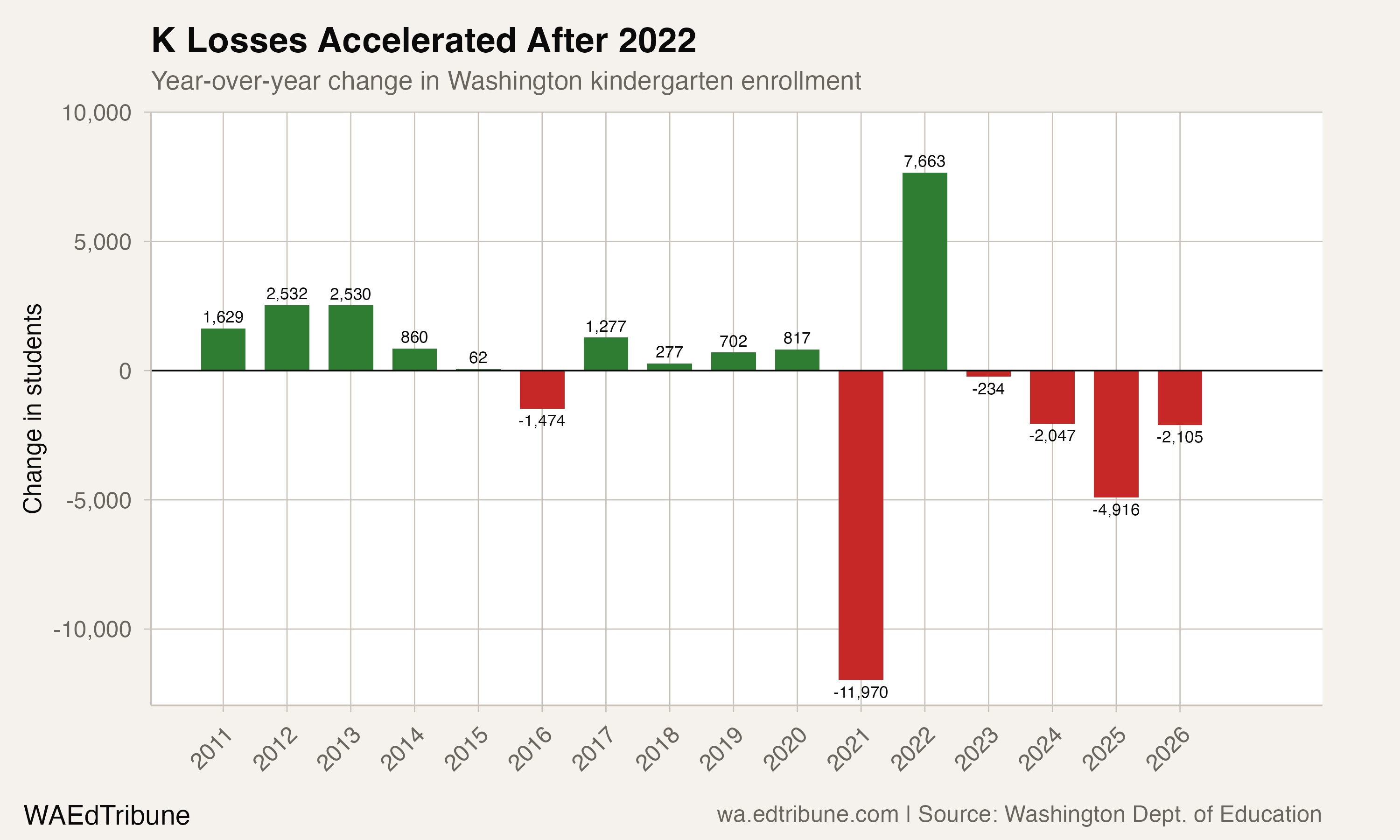
The six kindergarten cohorts from 2021 through 2026 totaled 445,163 students. The six cohorts from 2015 through 2020 totaled 488,878. That is a deficit of 43,715 children who never entered the front door of a Washington elementary school. Each of those smaller classes will move through the system for 13 years, shrinking every grade it passes through.
The bulge at the top
Grade 12 enrollment tells a different story. It hit 98,754 in 2025-26, up 24.7% from 79,205 in 2009-10. Part of this reflects larger cohorts born before the birth rate decline accelerated. But another factor inflates the count: the Grade 11-to-Grade 12 ratio has consistently run between 108% and 112% since 2015, meaning roughly one in ten 12th graders is spending a fifth year in high school. The 89,157 students counted as 11th graders in 2024-25 became 98,754 12th graders in 2025-26, a ratio of 110.8%.
This is not unique to Washington. Extended high school enrollment is common in states that offer Running Start dual-enrollment programs or that have raised graduation requirements. But it means the Grade 12 count overstates the size of the underlying birth cohort. The top of the pipeline is genuinely larger than the bottom, but not quite as much as the raw numbers suggest.
A gradient of decline
The shrinkage is not limited to kindergarten. Every grade from K through 5 is below its all-time peak, with the losses tapering as you move up the grades, a clear signature of smaller cohorts rippling through the system year by year.
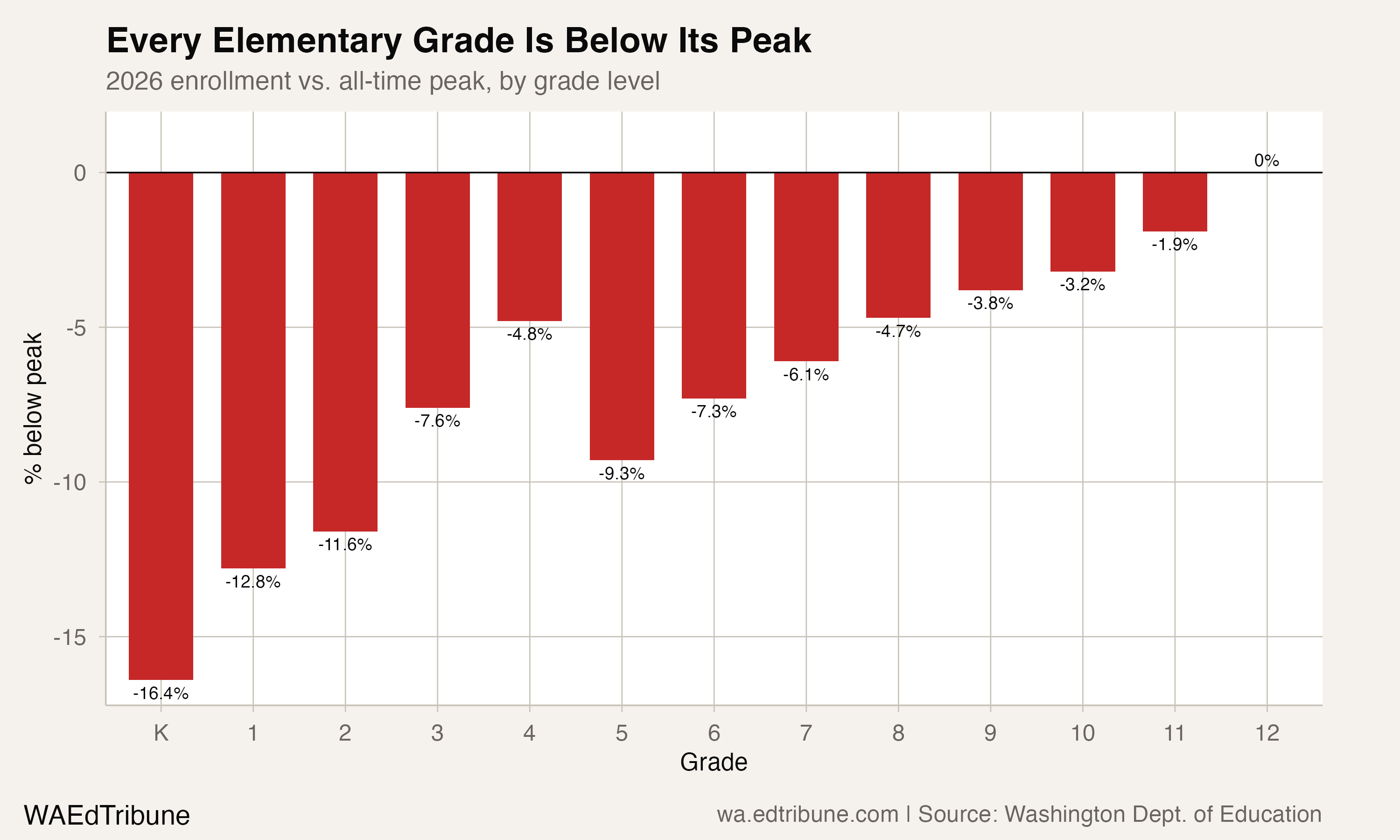
Kindergarten sits 16.4% below peak. First grade is down 12.8%. Second grade, 11.6%. By fourth grade, the deficit narrows to 4.8%. This pattern is precisely what birth-rate-driven decline looks like: the youngest grades are hit first, and the wave moves upward one year at a time. Grade 6 through 8 are now 4.7% to 7.3% below their peaks as the first small post-recession cohorts arrive in middle school. Only Grade 12 is at its all-time high.
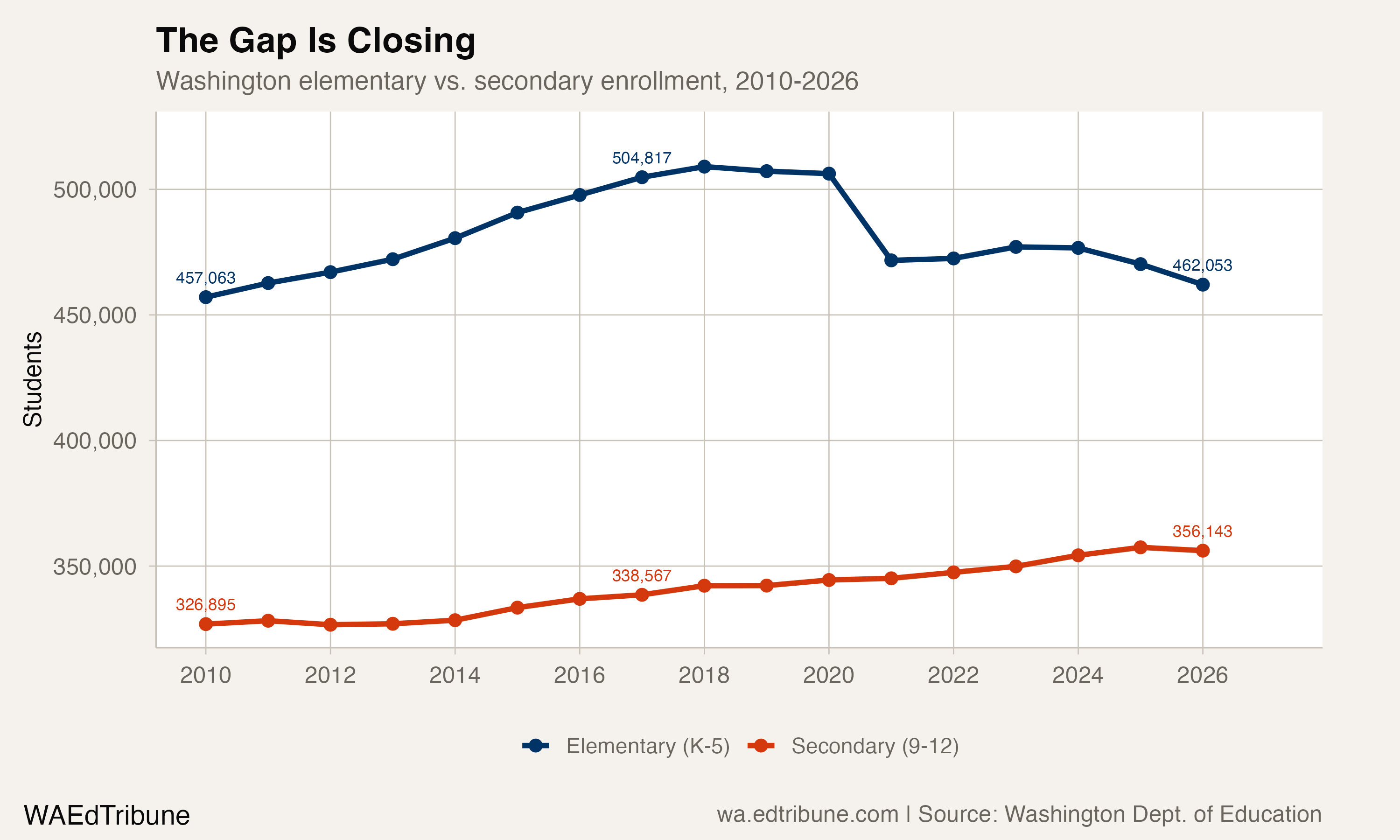
The aggregate picture is equally stark. In 2017, Washington had 504,817 elementary students (K-5) and 338,567 secondary students (9-12), a ratio of 149.1%. By 2026, that ratio has compressed to 129.7%, with 462,053 elementary students and 356,143 secondary students. The elementary feeder system has shrunk by 42,764 students while the secondary system grew by 17,576.
Where the smallest classes are
The losses are not evenly distributed. Seattle lost 917 kindergartners between 2020 and 2026, a 19.6% decline, the largest absolute drop in the state. Lake Washington lost 592 (25.2%), Issaquah lost 426 (29.2%), and Spokane lost 457 (18.7%). The Eastside suburbs, where housing costs have pushed young families outward, saw some of the steepest percentage declines. Olympia's kindergarten class shrank 31.9%.
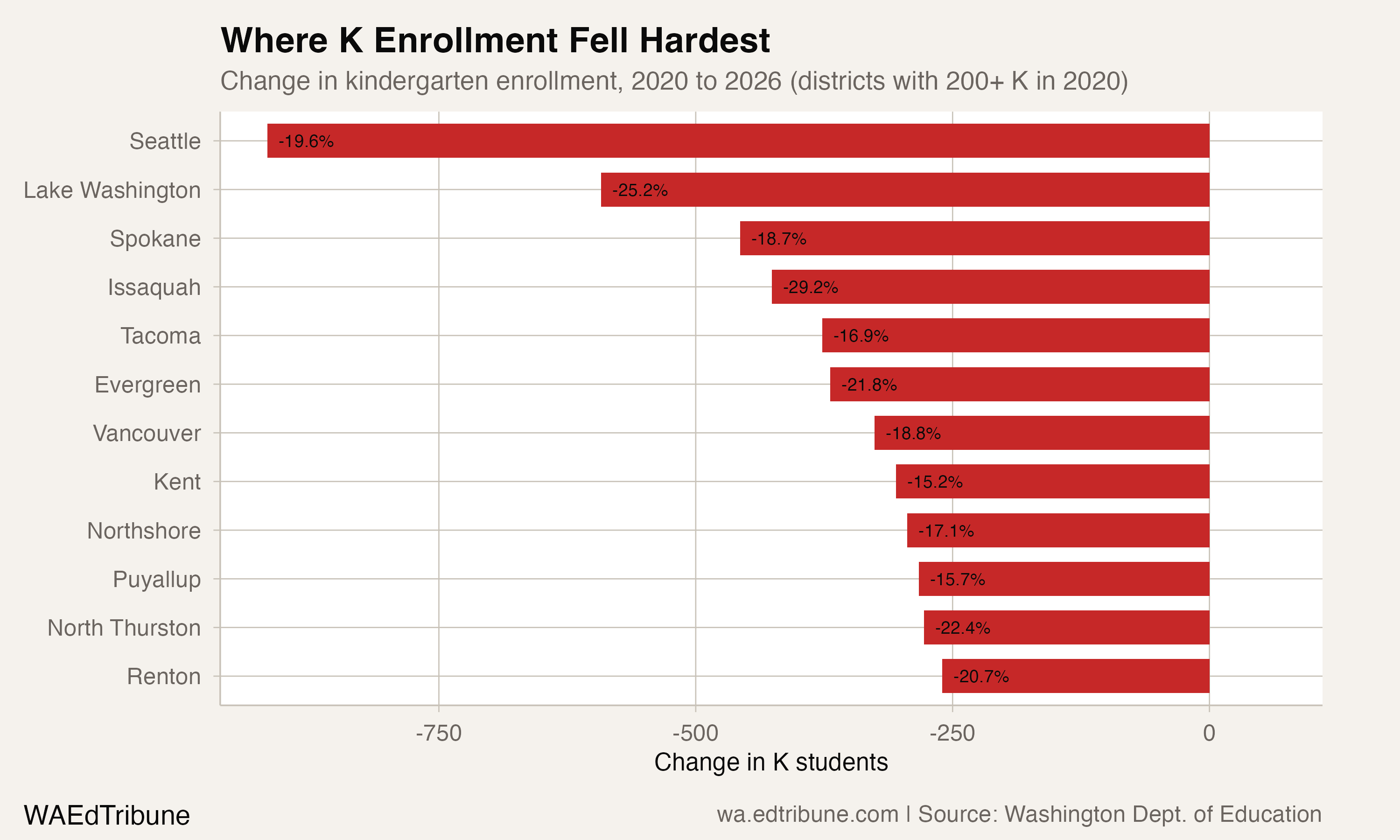
Nearly every district with 200 or more kindergartners in 2020 lost ground. Ridgefield, a fast-growing suburb near Vancouver, was the only mid-sized district to gain, adding 26 kindergartners over six years.
Closing schools that children no longer fill
The operational consequences are already arriving. Bellingham Public Schools has lost roughly 600 students since 2019-20 and is studying whether to close one or more elementary schools. A district demographer projects enrollment declines through 2035. Chief Operations Officer Jessica Sankey framed the scale:
"If in the next five years, the district is down another 600 elementary students across the district, that's about two elementary schools' worth of students." — Cascadia Daily News, Feb. 2026
State Superintendent Chris Reykdal has acknowledged the structural mismatch publicly: "We have roughly 85,000 kids who are in their junior year and senior year each year. We have far fewer five-year-olds coming into the system."
The fiscal pressure is immediate. Washington's prototypical school funding model allocates resources based on enrollment. As Reykdal has noted, state funding formulas "immediately drive money away from districts as enrollments go down." Districts with half-empty elementary buildings still carry the same maintenance, utility, and administrative costs. Bellevue closed Wilburton and Eastgate elementaries in 2023-24 after its first grade class fell to 70% the size of its 12th grade class. Seattle Public Schools proposed closing roughly 20 elementary schools before ultimately pulling back. Marysville faces a $25 million budget shortfall.
Increased homeschooling compounds the enrollment picture. Washington had roughly 29,467 registered homeschool students in 2024, up 76% from 16,722 in 2012. While the pandemic peak of 39,000 has receded, the settled level is still significantly above pre-pandemic norms of around 20,000.
What a 69,338-student kindergarten class means for 2032
The 2025-26 kindergarten class of 69,338 will, if historical retention patterns hold, produce a 6th grade class of roughly 68,000-69,000 in 2031-32 and a graduating class around 2037-38. Compare that to the current 6th grade class of 82,046 or the current 12th grade class of 98,754. The buildings, staffing models, and transportation routes built for the larger cohorts will have to be restructured for classes that are 15% to 30% smaller.
The question for Washington superintendents is not whether to consolidate elementary schools. It is whether to do it now, while the fiscal cushion from larger high school cohorts still exists, or later, after the small cohorts reach high school and shrink every building in the system at once. The 2020 kindergarten class of 82,947 will graduate in 2033. The class of 69,338 behind it will not.
Detailed code that reproduces the analysis and figures in this article is available exclusively to EdTribune subscribers.
Discussion
Sign in to join the discussion.
Loading comments...