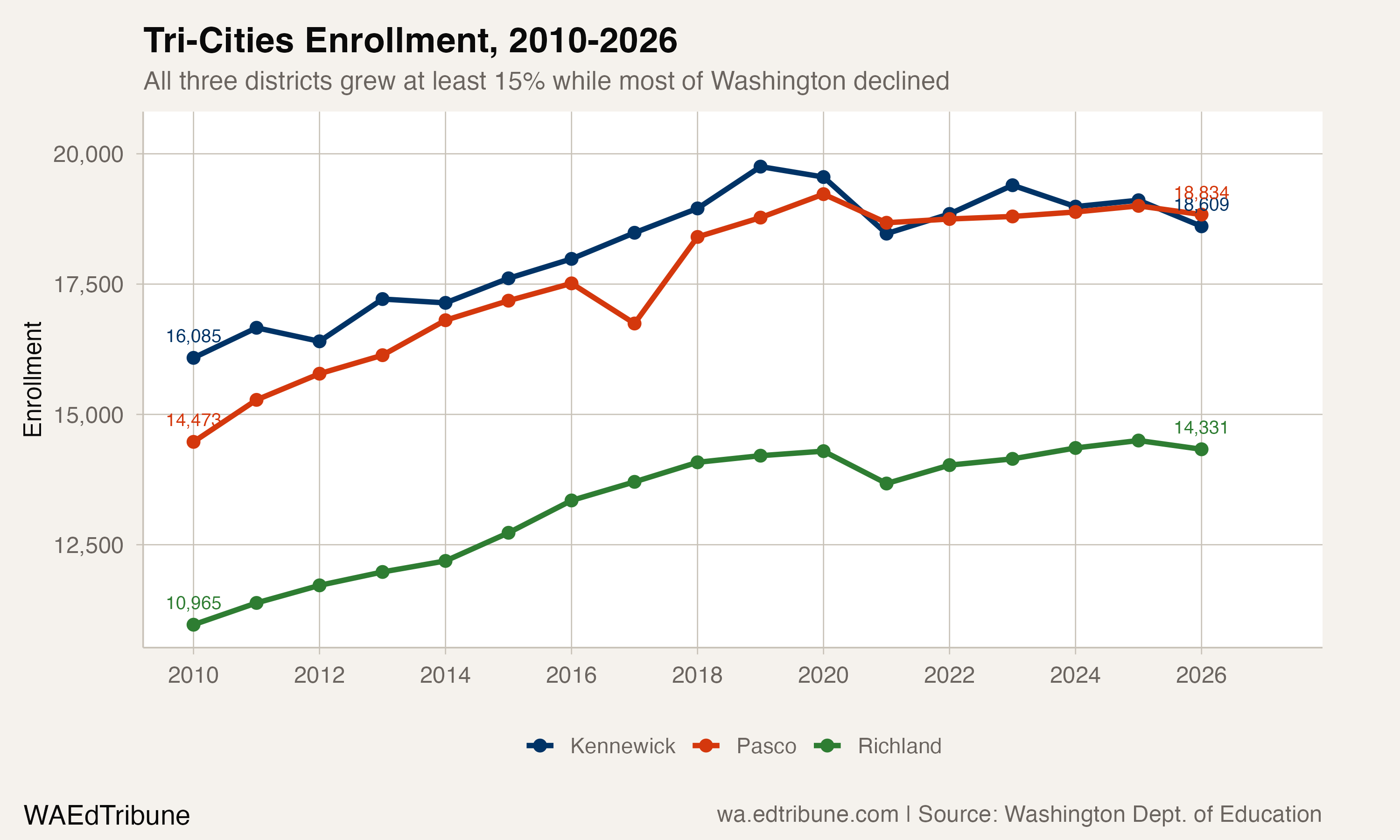
For 16 years, the Tri-Cities defied the gravitational pull dragging down school enrollment across Washington. While 152 of the state's 294 districts lost students between 2010 and 2026, the three districts anchoring Benton and Franklin counties added a combined 10,251, a 24.7% increase that outpaced statewide growth by a factor of four.
Then, in 2025-26, all three declined in the same year for the first time since the pandemic.
The federal paycheck pipeline
The engine behind the Tri-Cities boom is not a mystery. The Hanford nuclear site and Pacific Northwest National Laboratory together employ roughly 19,000 workers, most of them in the metro area. One in 10 Tri-Cities residents holds a federally funded job, and the average salary for those positions is $125,000, more than double the regional average of $61,058. PNNL alone added 1,000 jobs over the past four years.
That employment base creates a multiplier effect. Federal cleanup and research dollars, totaling roughly $3.2 billion for Hanford and $1.5 billion for PNNL in the most recent fiscal year, flow through contractors and subcontractors into housing, retail, and school construction. The Tri-Cities' population reached an estimated 320,150 in 2024, growing at roughly 1.8% annually over the past five years, the fastest rate among Washington's major metro areas.
Housing affordability amplifies the draw. Tri-Cities homes remain the least expensive in any of Washington's major metros, pulling families priced out of the Puget Sound corridor.
Three districts, three different stories
The aggregate 24.7% growth masks sharply different trajectories.
Richland↗ posted the steadiest growth in the state: 10 consecutive years of gains from 2010 through 2020, rising from 10,965 to 14,295 students. COVID interrupted the streak for one year, then Richland recovered fully, the only Tri-Cities district to do so. By 2024-25, enrollment hit 14,499, an all-time high. Richland's growth tracks the PNNL professional class. Its student body is 65.0% white and 23.6% Hispanic, the most affluent demographic profile of the three.
Pasco↗ grew by nearly the same percentage, 30.1%, but through an entirely different mechanism. Three out of four Pasco students are Hispanic, up from 68.4% in 2010 to 74.3% in 2026. More than a third of the student body, 35.8%, is classified as English learners. The district operates a dual-language program offering Spanish-English instruction across 17 elementary schools. Pasco's growth is immigration-driven and young-family-driven, concentrated in the early grades, and heavily shaped by the agricultural and food processing economy of Franklin County.
Kennewick↗, the largest of the three, grew more modestly at 15.7%. But its internal demographic shift is the most striking story in the region.
A crossover 16 years in the making
In 2009-10, Kennewick enrolled 9,770 white students and 4,817 Hispanic students, a gap of nearly 5,000. By 2024-25, that gap had narrowed to 29. In 2025-26, Hispanic enrollment overtook white enrollment for the first time: 8,482 to 8,304, a margin of 178 students.
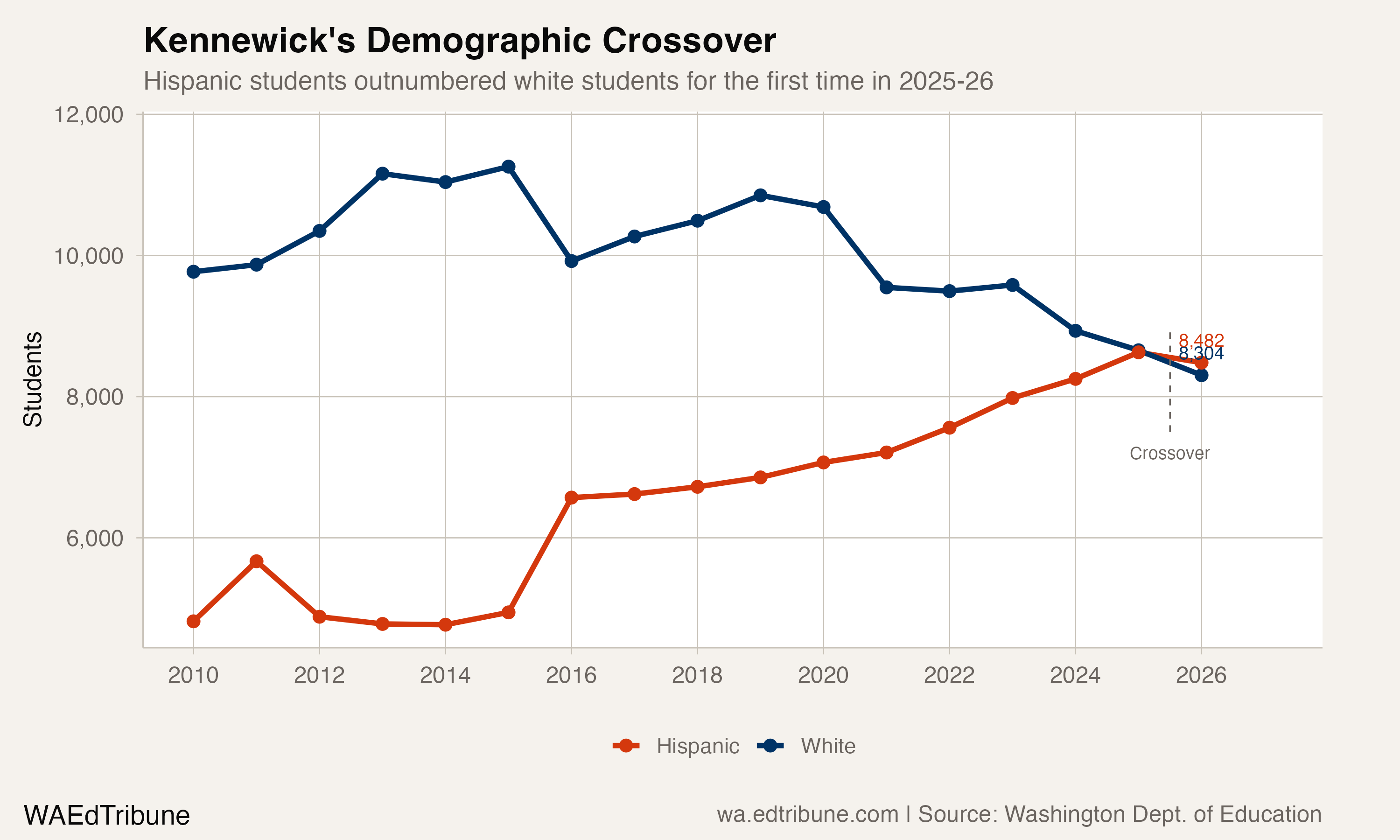
The crossover was driven by both sides of the ledger. White enrollment fell by 1,466 students since 2010, a 15.0% decline. Hispanic enrollment gained 3,665, a 76.1% increase. Kennewick's English learner population more than doubled over the same period, from 1,568 to 3,491.
This is not a Kennewick-only phenomenon. Across the Tri-Cities, Hispanic enrollment grew in all three districts while white enrollment declined or barely held steady. In Richland, the Hispanic share nearly tripled from 8.8% to 23.6%. The combined region was 53.9% white in 2010. It is now majority-minority in two of its three districts.
Gaining ground on the state
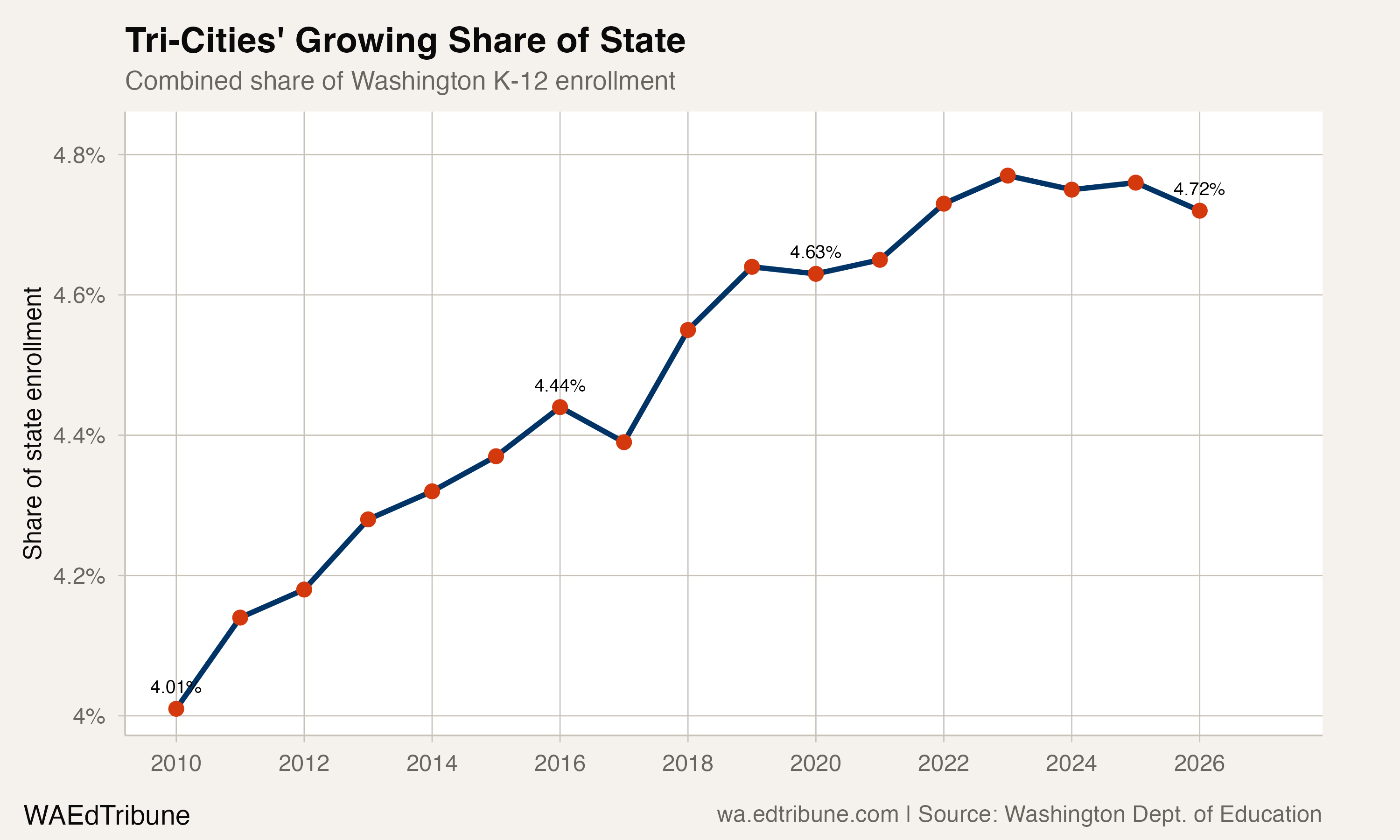
The Tri-Cities' combined enrollment grew from 4.01% to 4.72% of Washington's K-12 total between 2010 and 2026. That 0.71 percentage-point gain may sound modest, but it represents a region that is pulling ahead while the state's largest districts stall or shrink.
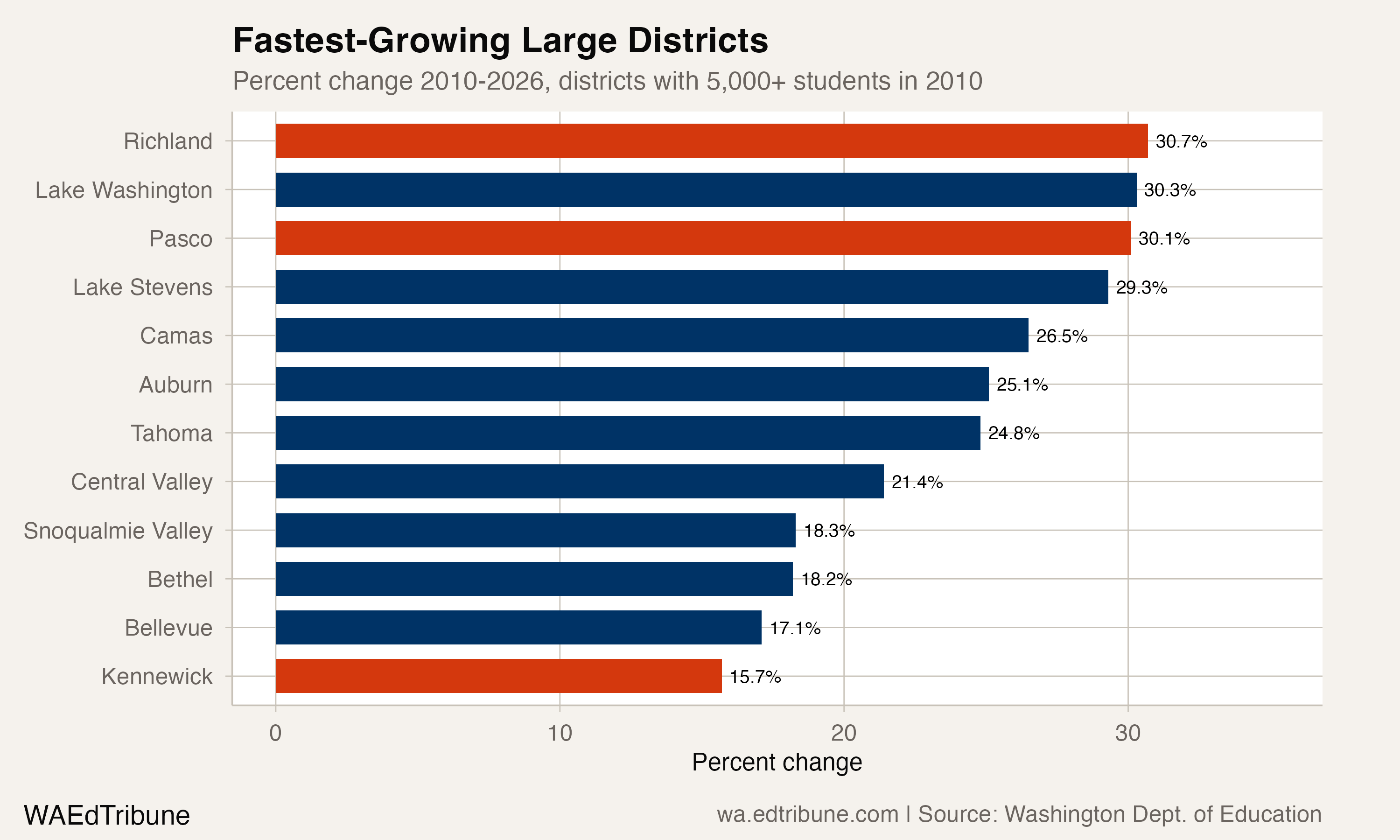
Among Washington districts with at least 5,000 students in 2010, Richland and Pasco rank first and third in growth rate, at 30.7% and 30.1% respectively. Only Lake Washington, on Seattle's affluent Eastside, grew at a comparable pace.
The 2026 dip
After a decade and a half of near-continuous growth, all three Tri-Cities districts lost students in 2025-26. Kennewick dropped 500 students, its largest single-year loss outside of COVID. Richland lost 168. Pasco lost 167. The combined decline of 835 students is the region's worst non-pandemic year since the dataset begins.
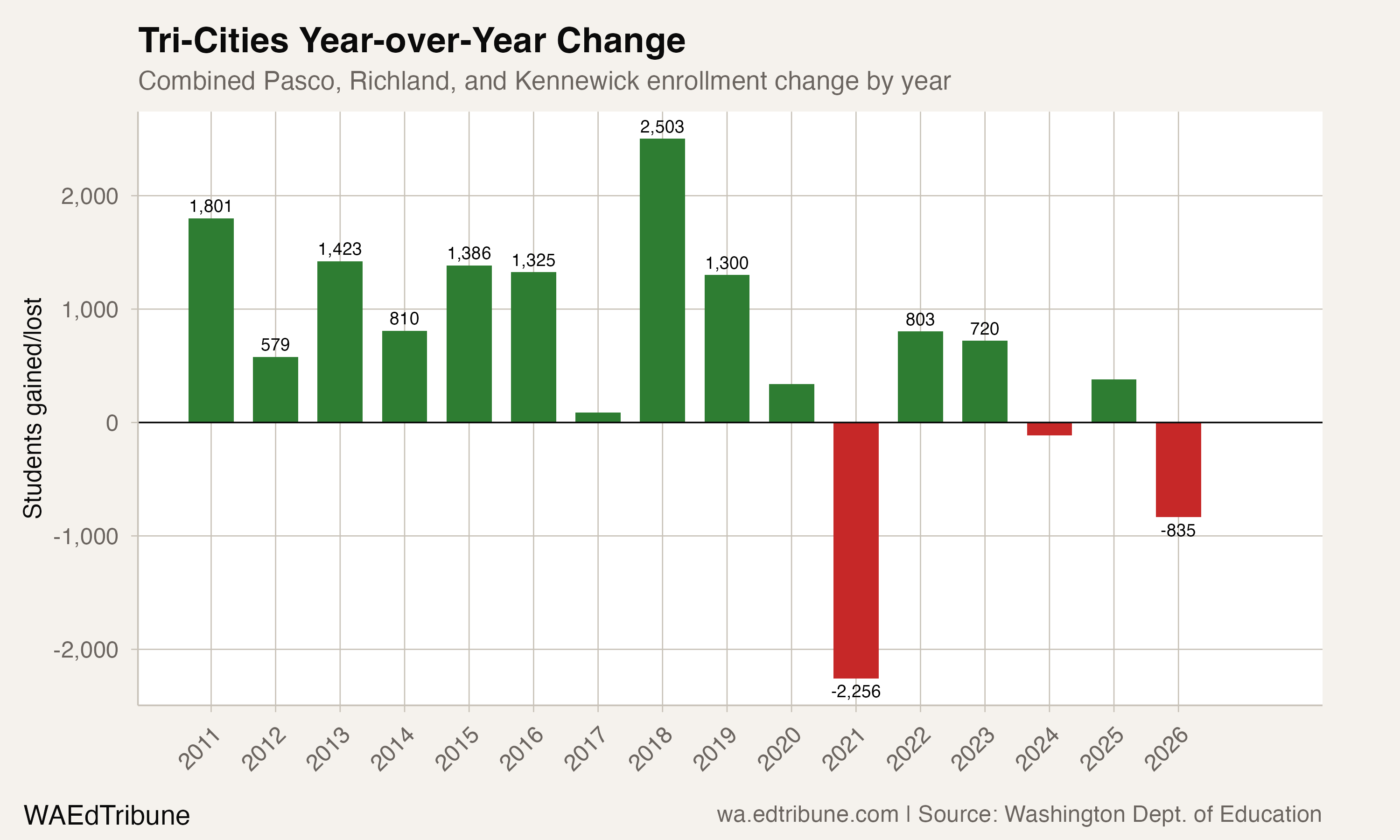
The timing coincides with a period of federal workforce uncertainty. In early 2025, layoffs hit Hanford and PNNL as part of broader federal workforce reductions, with hundreds of positions eliminated at the Bonneville Power Administration and DOE offices across eastern Washington. Whether these cuts contributed to the enrollment dip or whether it reflects a broader demographic cooling is not yet clear from one year of data.
"One out of every 10 people in the Tri-Cities is employed by a job connected to federal funding, whether through the Hanford site, Pacific Northwest National Laboratory or with a subcontractor." -- Tri-Cities Area Journal of Business, Oct. 2024
That concentration of federal dependence is both the region's greatest asset and its most exposed vulnerability. A sustained reduction in Hanford cleanup funding or PNNL research budgets would ripple directly into school enrollment. The proposed fiscal year 2026 White House budget included $34 million less for Hanford than 2024 levels, though Congress has so far appropriated record funding instead.
What one year cannot answer
A single year of decline does not end a 16-year boom. Richland still sits near its all-time high. Pasco has added more students since 2010 than most Washington districts enroll in total. The demographic transformation underway in Kennewick, with its growing English learner population and newly majority-Hispanic student body, will reshape the district's instructional needs regardless of whether total enrollment rises or falls.
Hanford's $3 billion annual cleanup mission has insulated these districts from the demographic forces battering the rest of the state. If that federal pipeline holds, the Tri-Cities will likely resume growing. If it does not, the 2025-26 dip will look less like a blip and more like an inflection point.
Detailed code that reproduces the analysis and figures in this article is available exclusively to EdTribune subscribers.
Discussion
Sign in to join the discussion.
Loading comments...