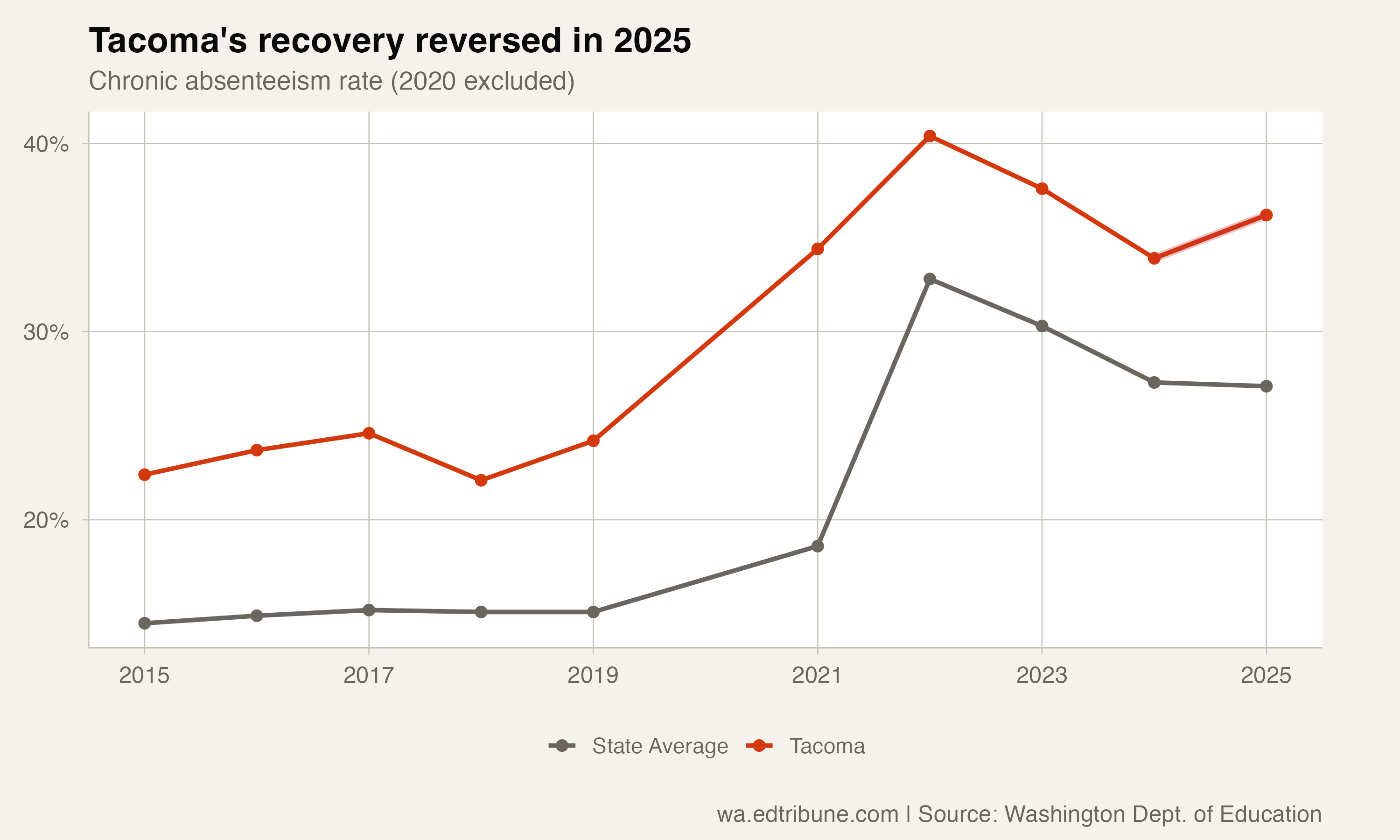
For three years, Tacoma↗ Public Schools was one of Washington's attendance recovery stories. The chronic absenteeism rate dropped from a catastrophic 40.4% in 2021-22 to 37.6%, then 33.9% — a steady, encouraging trajectory that suggested the state's third-largest district was finding its way back.
In 2024-25, that trajectory broke. Tacoma's chronic rate rose to 36.2%, a 2.3-point jump that erased more than a year's worth of progress. Roughly 10,448 of the district's 28,840 students are now chronically absent — 872 more than the year before.
The largest reversal among top districts
The 2.3-point increase is the largest reversal among Washington's 10 biggest school districts. Kent (+1.0 points) and Vancouver (+1.6) also worsened, but Tacoma's reversal is the most significant both in magnitude and because it interrupted what had been consistent progress.
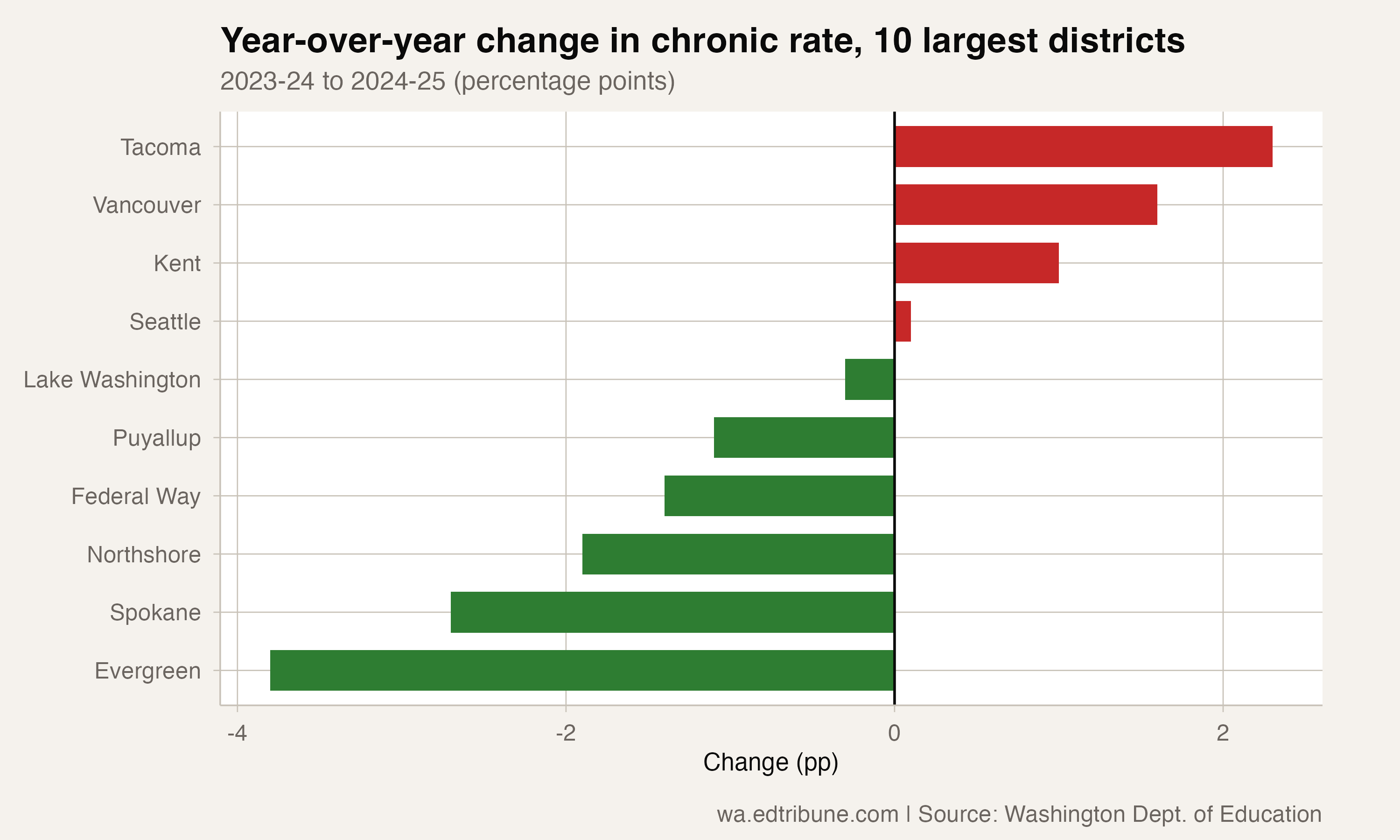
Other large districts continued improving. Spokane↗ dropped 2.7 points to 29.6%. Evergreen-Clark fell 3.8 points to 34.4%. Puyallup shed 1.1 points. The split among large districts — some still improving, others reversing — suggests that the statewide stall is not a uniform phenomenon but the result of gains in some places being offset by losses in others.
Who got worse
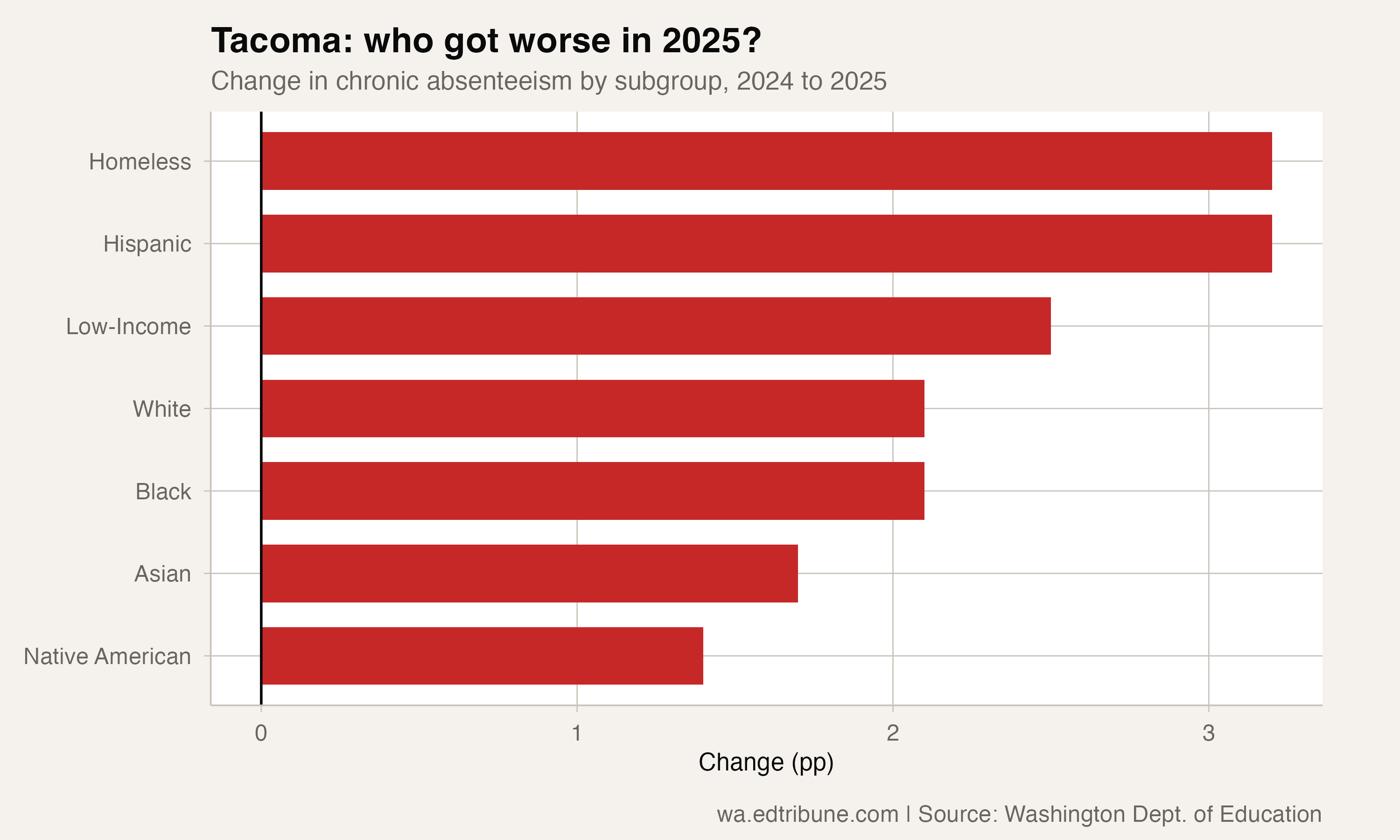
The reversal in Tacoma was broad-based. Every major subgroup saw its chronic rate increase. Hispanic students experienced the largest jump: from 39.6% to 42.8%, a 3.2-point increase. Homeless students rose by the same margin, from 53.0% to 56.2%. Low-income students went from 40.9% to 43.4% (+2.5 points).
White students and Black students saw identical 2.1-point increases, landing at 29.2% and 39.4% respectively. Asian students, typically the lowest-rate racial group, rose from 24.4% to 26.1%.
The across-the-board nature of the reversal suggests this was not driven by a single demographic shock. Whatever caused Tacoma's attendance to worsen, it affected every student group.
Still 12 points above pre-pandemic
Even before the reversal, Tacoma was far from recovered. The district's 2024-25 rate of 36.2% is 12.0 points above the pre-pandemic rate of 24.2% — itself not a low number. Tacoma had elevated chronic absenteeism before COVID, consistently running 7-10 points above the state average through the 2010s.
The pandemic pushed Tacoma from a district with a significant attendance problem to one where more than a third of students miss a month of school. The brief recovery period brought the rate down but never approached the pre-pandemic baseline, and now the direction has reversed.
At the current rate, roughly 10,448 Tacoma students — enough to fill every seat in four large high schools — are missing 18 or more days per year. That represents an educational crisis that compounds year after year: students who are chronically absent in one year are far more likely to be chronically absent the next, and their academic outcomes deteriorate accordingly.
The question of why
Tacoma's reversal does not yet have a clear single cause. The district serves a diverse, relatively high-poverty population — 59% of students are economically disadvantaged — in a mid-size city grappling with housing costs, homelessness, and the ongoing effects of pandemic disruption.
The fact that the reversal was spread across all subgroups argues against a targeted cause like an immigration-related enrollment shift or a change in how one population group engages with school. It is more consistent with a systemic factor: a housing-cost spike that destabilized families, a transportation disruption, a staffing shortage that affected school climate, or simply the exhaustion of the "easy" attendance recoveries.
Vancouver↗ School District (22,075 students) showed a similar pattern, with its rate rising 1.6 points to 35.8%. Both districts are in regions of Washington where housing costs have risen sharply, and both serve high proportions of low-income families. Whether the housing connection is causal or correlational remains an open question.
Data source
Data from the Washington Office of Superintendent of Public Instruction via waschooldata. Analysis covers 2014-15 through 2024-25. The 2019-20 school year excluded due to COVID-related attendance tracking anomalies.
Detailed code that reproduces the analysis and figures in this article is available exclusively to EdTribune subscribers.
Discussion
Sign in to join the discussion.
Loading comments...