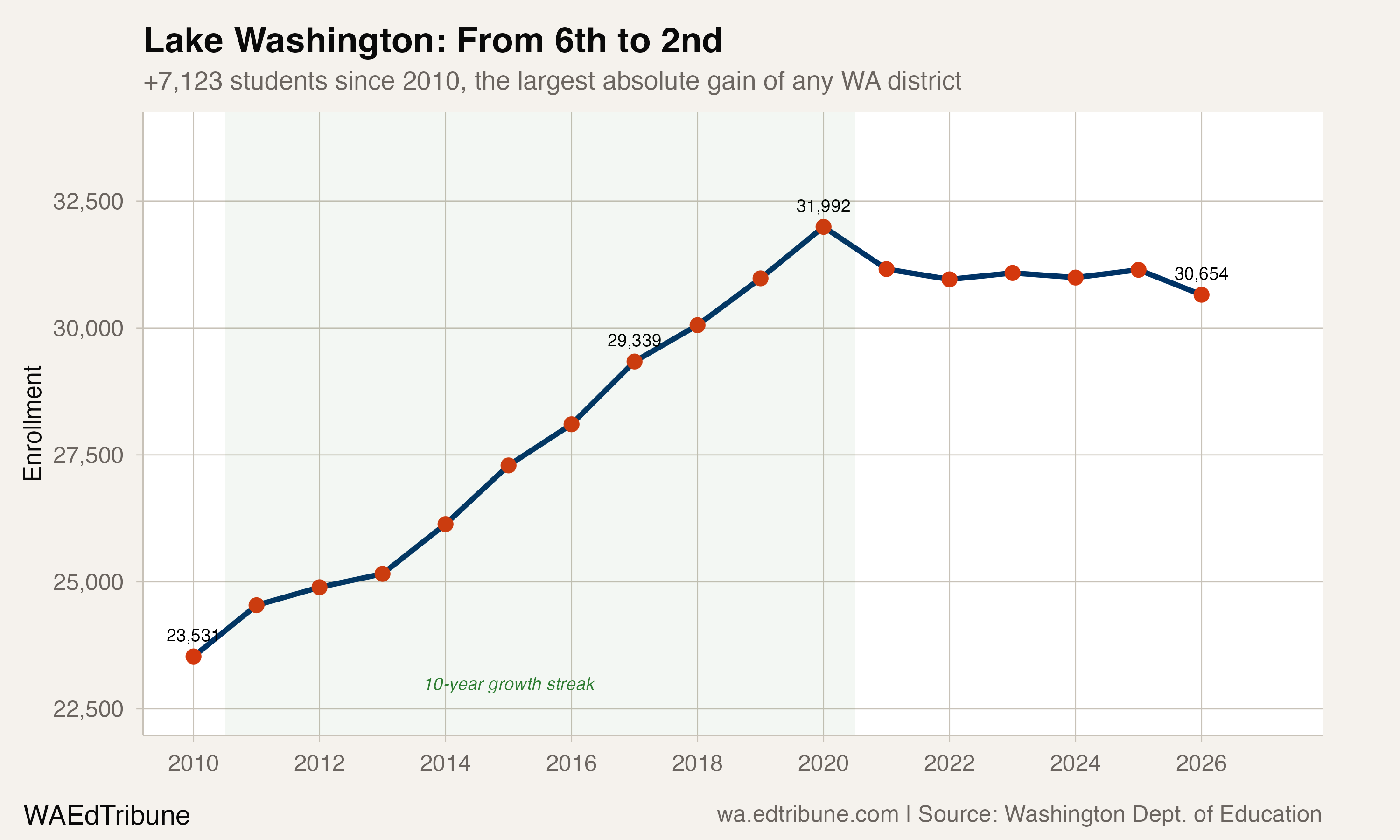
The sixth-largest school district in Washington in 2010, Lake Washington↗ enrolled 23,531 students that year. By 2026, it had 30,654, an increase of 7,123 students, or 30.3%. No other district in the state gained more in absolute terms. The next closest, Pasco, added 4,361.
That growth vaulted Lake Washington from 6th to 2nd in the state's enrollment rankings, behind only Seattle↗. It happened in two distinct phases: a 10-year unbroken growth streak from 2011 through 2020 that added 8,461 students, followed by a COVID disruption and a plateau that has left the district 1,338 below its 2020 peak.
The district has not simply grown. It has transformed.
A demographic crossover, 16 years in the making
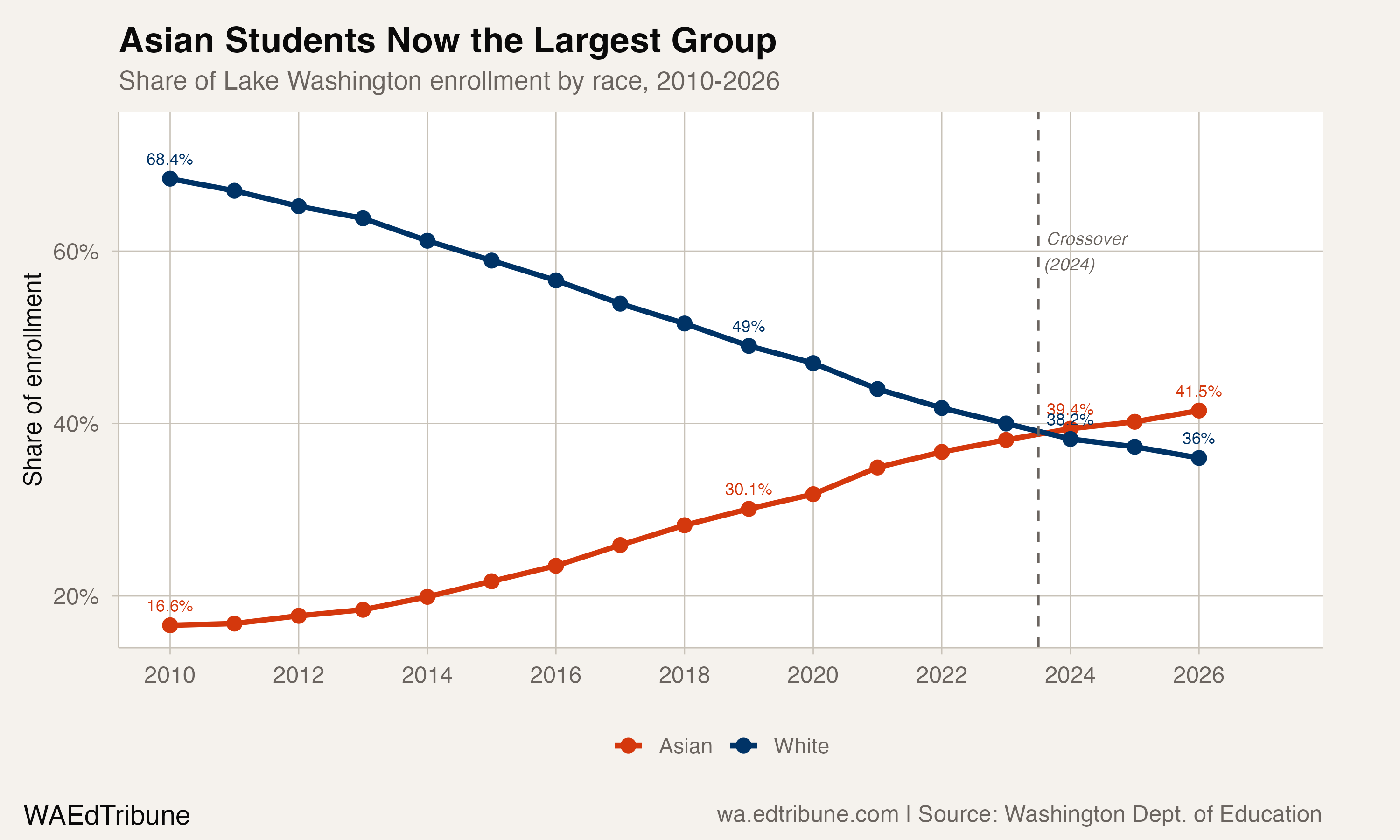
In 2010, Lake Washington was 68.4% white. Asian students made up 16.6% of enrollment. By 2024, those lines crossed: Asian students reached 39.4%, surpassing white students at 38.2% for the first time. In 2026, Asian students account for 41.5% of enrollment, white students 36.0%.
The shift is not just proportional. Asian enrollment tripled from 3,917 to 12,707, a gain of 8,790 students, or 224.4%. White enrollment fell from 16,101 to 11,041, a loss of 5,060 students. The entire net growth of Lake Washington over 16 years, and then some, came from Asian families.
Hispanic enrollment grew modestly from 1,754 to 3,375 (7.5% to 11.0% share), and multiracial students tripled from 858 to 2,561 (3.6% to 8.4%). But the defining demographic story is the Asian-white crossover, which happened faster than in any other large Washington district.
The Eastside's tech gravity
Lake Washington School District covers Kirkland, Redmond, and Sammamish, the heart of Washington's tech corridor. Microsoft's headquarters sits in Redmond. Google and Meta maintain major campuses in Kirkland. The connection between tech hiring and school enrollment runs through international migration.
According to The Seattle Times, census data shows more than 90,000 foreign-born residents employed in computer-related occupations in the Seattle metro area, making up roughly 45% of tech workers. Redmond leads King County cities with 45% of its population born outside the United States. India and China are the top two countries of origin for King County immigrants, with approximately 83,000 and 80,000 residents respectively.
"Since COVID, we have actually experienced one of the lowest enrollment declines in our surrounding districts in the Puget Sound area. So we've lost about 495 students total in all grade levels since the pandemic, which is about 1.6%." — Barbara Posthumus, Associate Superintendent, LWSD (Sammamish Independent, June 2024)
That 1.6% pandemic loss compares favorably to the district's Eastside peers. Bellevue lost 5.0% from its 2020 peak (21,761 to 20,670). Issaquah lost 12.5% (21,465 to 18,780). Northshore lost 5.1% (23,984 to 22,753). Lake Washington's tech-driven demographics appear to have provided a cushion against the enrollment losses that hit neighboring districts harder.
The Seattle contrast
The gap between Lake Washington and Seattle tells a story about where Washington families are choosing to live. Indexed to 2010, Lake Washington's enrollment stood at 130.3 in 2026. Seattle's stood at 108.2. Both grew through the 2010s, but Seattle peaked in 2020 at 56,051 and has since lost 5,153 students, facing a $104 million budget shortfall and a contentious debate over school closures.
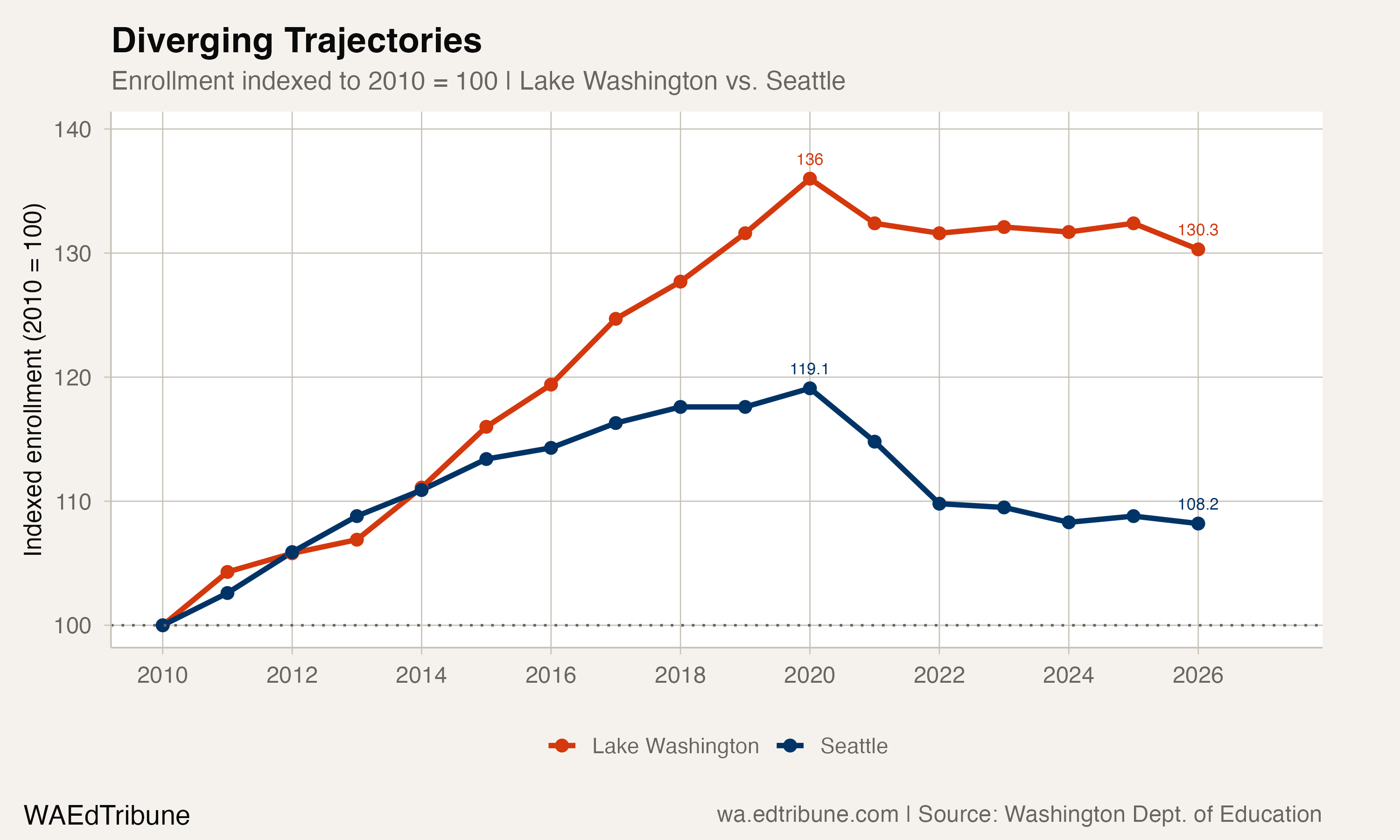
Lake Washington outpaced Seattle even during their shared growth era. Between 2015 and 2020, Lake Washington added 4,699 students (a 17.2% gain). Seattle added 2,690 (5.0%). The Eastside was simply pulling harder.
Overcrowded and shrinking at the same time
The paradox confronting Lake Washington is that a decade of growth built facilities for students who are aging out, while the pipeline feeding in is thinning. Kindergarten enrollment peaked at 2,353 in 2020 and has since fallen to 1,761, a 25.2% drop. Grade 12 enrollment rose from 1,737 in 2010 to 2,526 in 2026, a 45.4% increase.
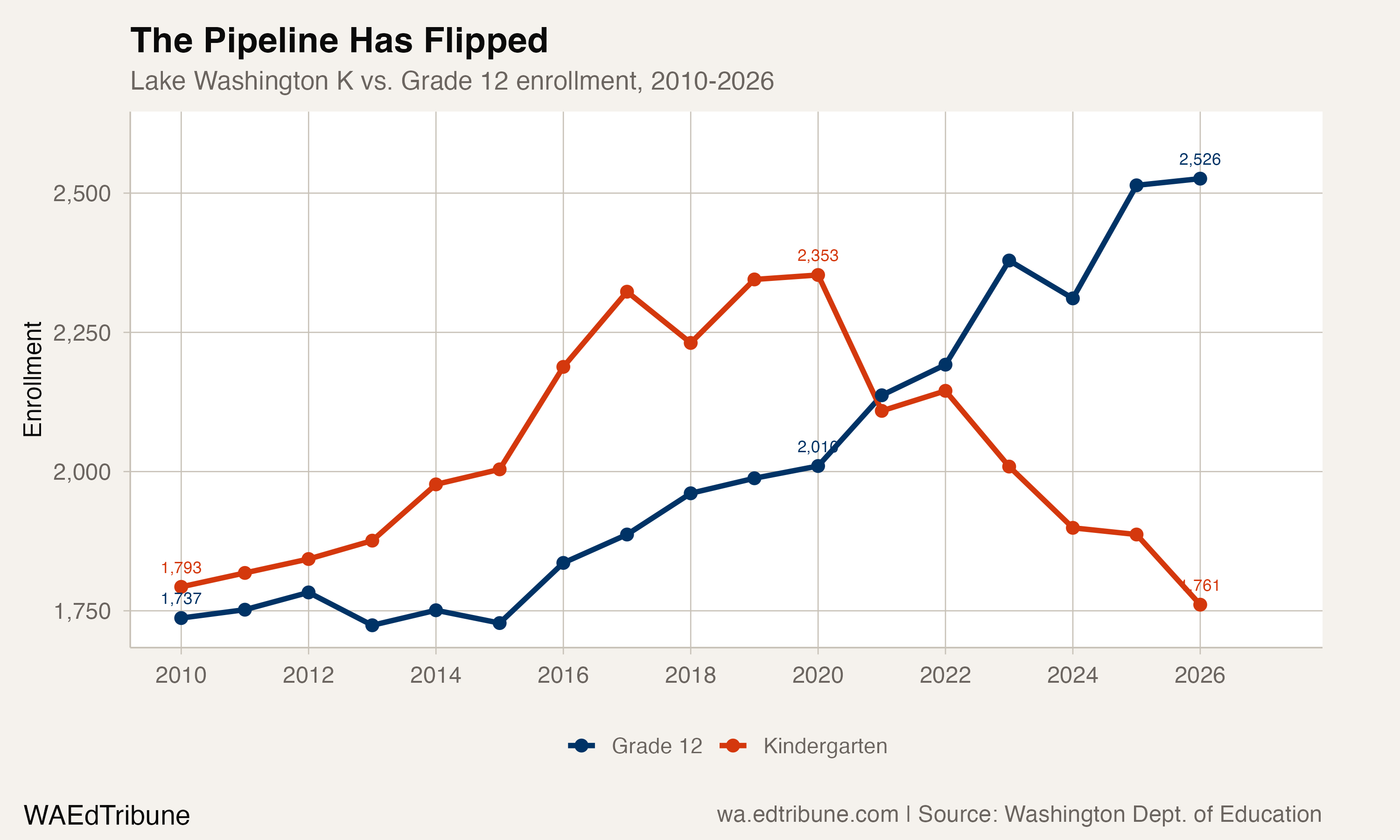
The result is high schools bursting at the seams while elementary schools consolidate classes. LWSD Board President Lisa Guthrie attributed the enrollment shift to "a decline in birth rate in the late 2010s and the lasting effects of the COVID-19 pandemic." The district is expanding Eastlake and Redmond high schools while cutting kindergarten sections: Christa McAuliffe Elementary reduced from three kindergarten classes to two for 2025-26.
Housing costs may compound the kindergarten squeeze. Median home prices in Sammamish, one of the three cities Lake Washington serves, reached $1.77 million in 2024. Principal Brady Howden put it simply: "House prices are obviously a factor. If you're a young family, being able to live in Sammamish is expensive."
English learners grew from 1,079 (4.6% of enrollment) in 2010 to 3,440 (11.2%) in 2026. Whether that growth reflects new arrivals, expanded identification of multilingual students already enrolled, or both, the data cannot distinguish. But it aligns with the broader pattern of a district whose student body increasingly reflects the international workforce on the Eastside.
A growth story with an expiration date
Lake Washington lost 492 students in 2026, its largest single-year decline since the pandemic. The 10-year growth streak that defined the district's rise has given way to something more uncertain: oscillation between small gains and small losses, with the overall trajectory tilting downward.
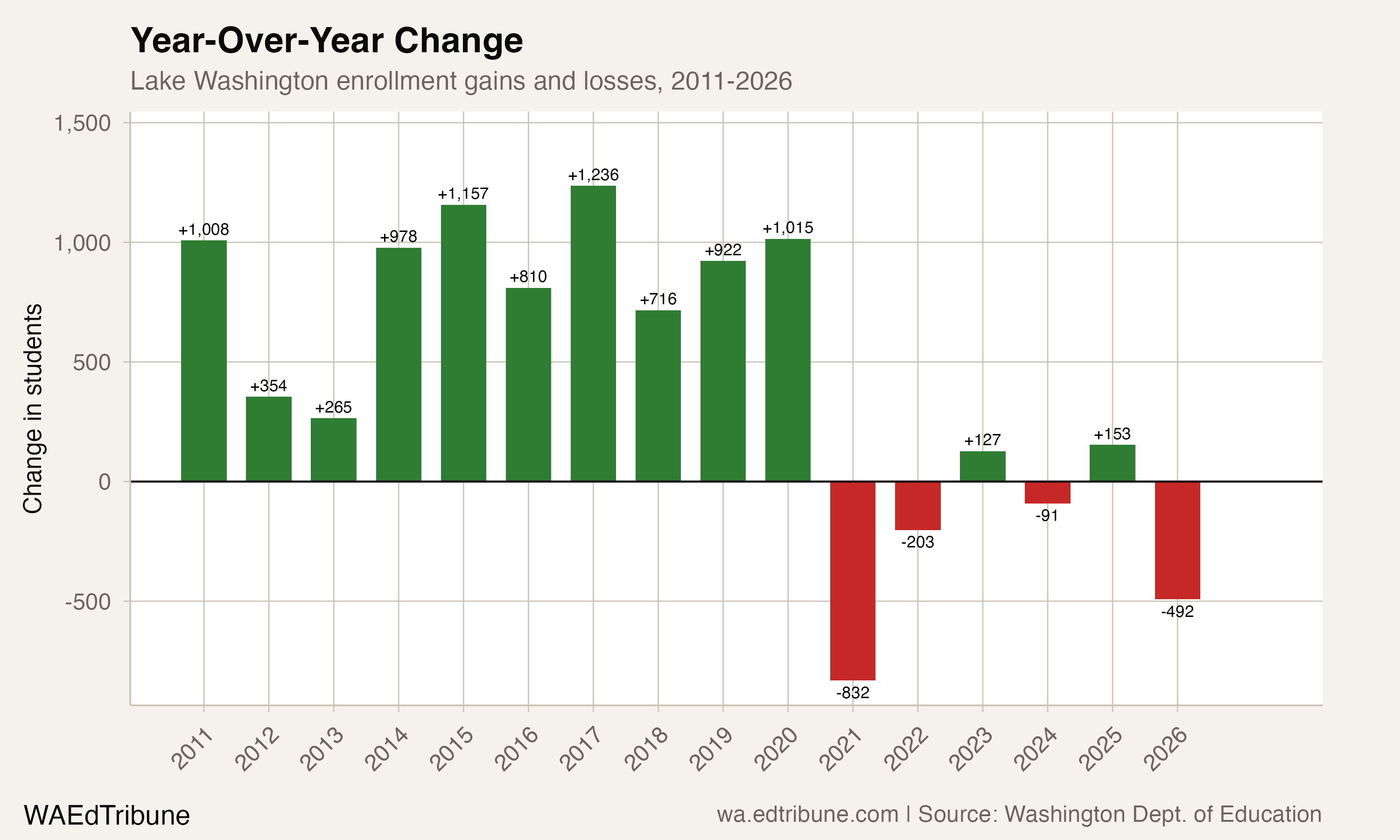
The district budgeted for a loss of 298 students in 2025-26, which translates to $2.5 million in lost revenue. Actual losses came in higher at 492. As the large cohorts that entered kindergarten during the boom years graduate out, smaller incoming classes will determine whether Lake Washington stabilizes at 30,000 or continues to slide.
The Eastside's tech economy brought Lake Washington this far. Whether it can keep attracting families fast enough to offset what birth rates and $1.77 million homes are taking away is a bet the district is making with every new high school wing it builds.
Detailed code that reproduces the analysis and figures in this article is available exclusively to EdTribune subscribers.
Discussion
Sign in to join the discussion.
Loading comments...