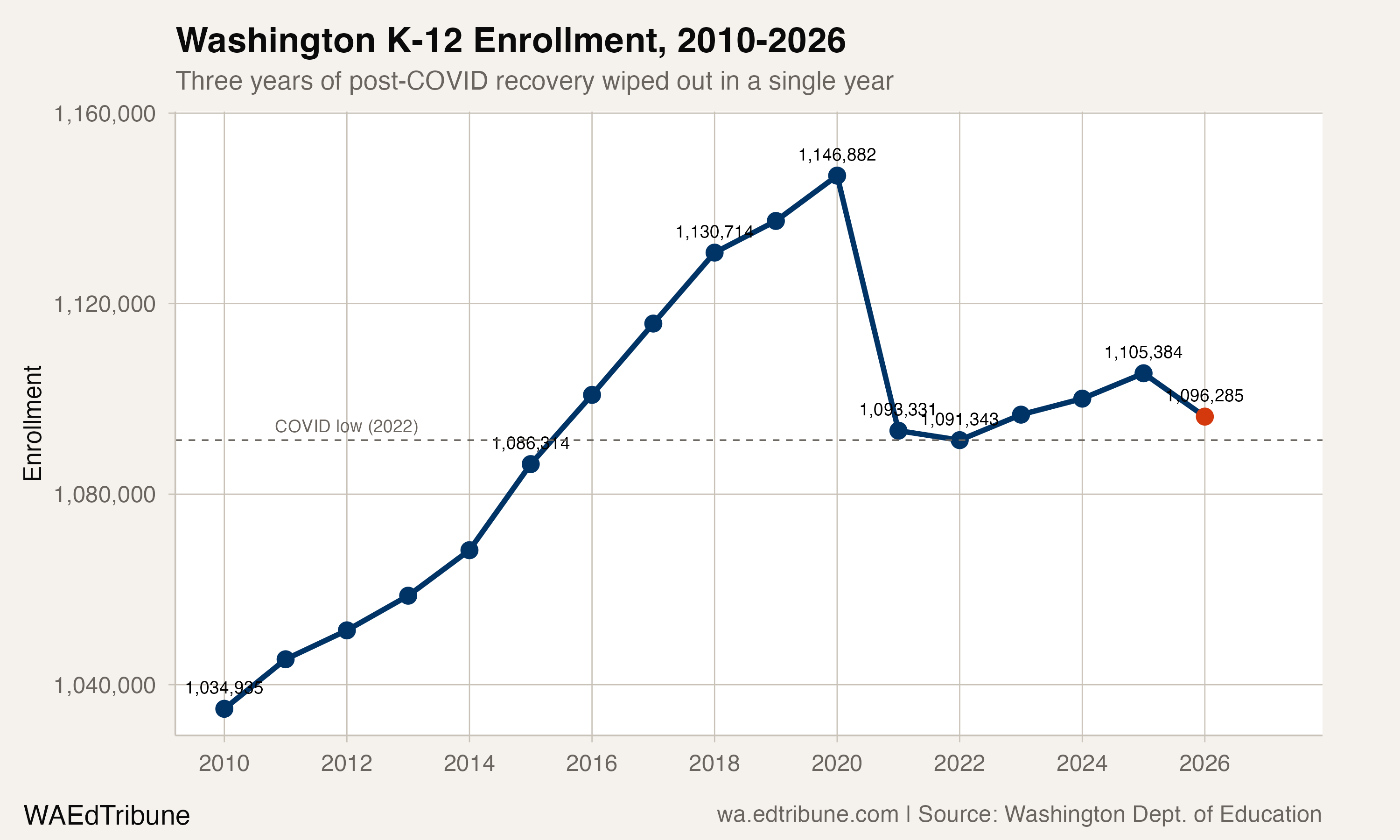
For three years, Washington's public schools looked like they were healing. Between 2022 and 2025, K-12 enrollment climbed back by 14,041 students, a modest but steady recovery from the 55,539-student crater the pandemic had carved. Then 2025-26 arrived: 9,099 students gone in a single year, erasing 64.8% of that recovery and dropping statewide enrollment to 1,096,285.
It is the largest single-year loss since 2020-21, when remote learning drove 53,551 students out of public schools. But unlike the COVID year, there is no obvious one-time shock to explain it. OSPI has attributed the sustained elementary decline to two forces: lower birth rates and persistent homeschooling gains that began during the pandemic and never reversed. The 2026 data suggests neither force has relented.
A decade of growth, undone in six years
Washington added 111,947 students between 2010 and 2020, a 10.8% expansion fueled by population growth along the I-5 corridor and in Puget Sound suburbs. The state peaked at 1,146,882 students in 2019-20, the last normal school year before COVID.
Six years later, the state sits 50,597 students below that peak, a 4.4% decline. The three-year recovery that followed the pandemic's bottom now looks less like a rebound and more like a brief plateau before a steeper drop. Net recovery from the COVID low stands at just 4,942 students, or 8.9% of what was lost.
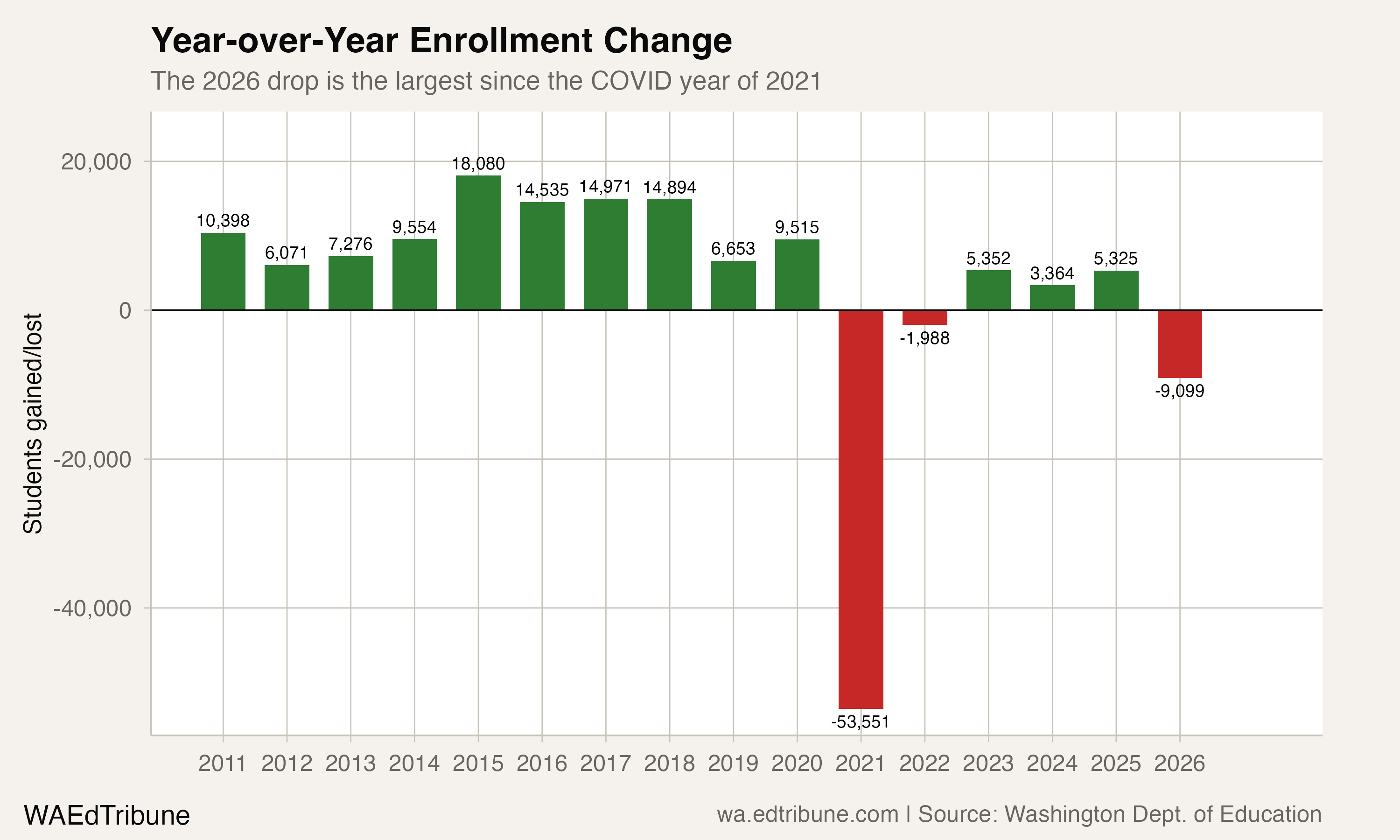
The acceleration is the worrying part. In 2022, the state lost 1,988 students. In 2026, it lost 9,099. Nothing in the intervening years suggested the trajectory would reverse this sharply. The three recovery years averaged gains of 4,680 students per year. The 2026 drop was nearly twice the size of any single year's recovery.
The kindergarten signal
The bottom of the enrollment pipeline tells the clearest story. Washington enrolled 69,338 kindergartners in 2025-26, down 16.4% from the 2020 peak of 82,947. That is the smallest kindergarten class in the 17 years of data available. Meanwhile, grade 12 enrolled 98,754 students, its largest class on record and 42.4% more students than entered kindergarten that same year.
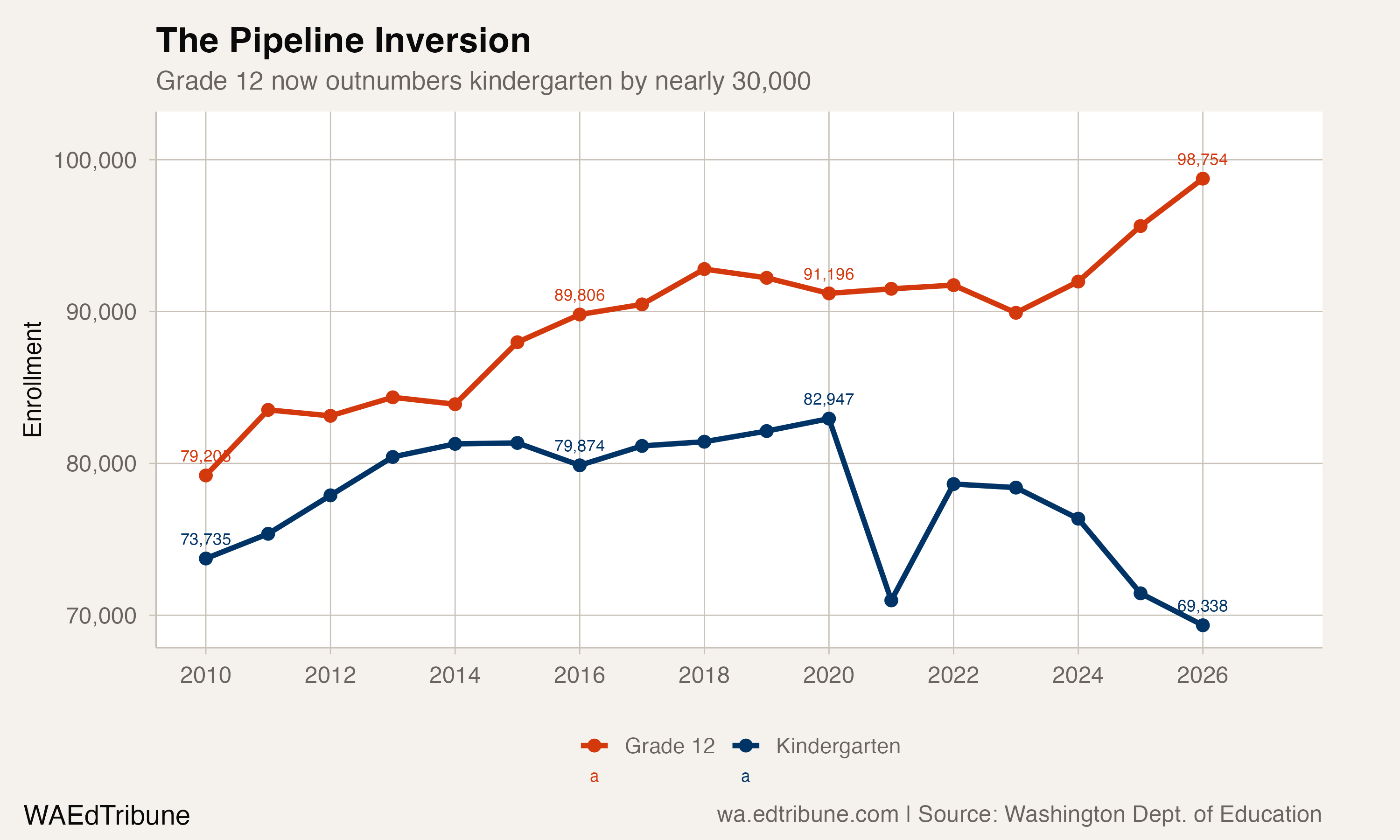
This is not a pandemic artifact. Kindergarten enrollment never recovered after the COVID crash: it bounced from a low of 70,977 in 2021 to 78,640 in 2022, then has declined every year since. The 2026 class is 2,105 students smaller than the 2025 class and 9,302 smaller than the 2022 partial rebound.
The pipeline inversion, 29,416 more seniors than kindergartners, means the state will lose more students to graduation over the next several years than it gains through new kindergarten entry. Without a surge in births or in-migration of young families, the math runs in one direction.
Washington's birth rate fell 22% over 15 years, from 13.77 per 1,000 residents in 2007 to 10.70 in 2022. The state's Office of Financial Management projects the school-age cohort will shrink from 2026 until 2038, reflecting the sustained decline in births since their peak in 2016. The kindergarten numbers are the first wave of that demographic shift reaching the schoolhouse door.
Where the students disappeared
The losses were not concentrated in a few large districts. Of 326 districts with comparable data, 207 lost students in 2025-26 while just 113 gained. The losing districts shed a combined 14,125 students; the winners added only 5,009.
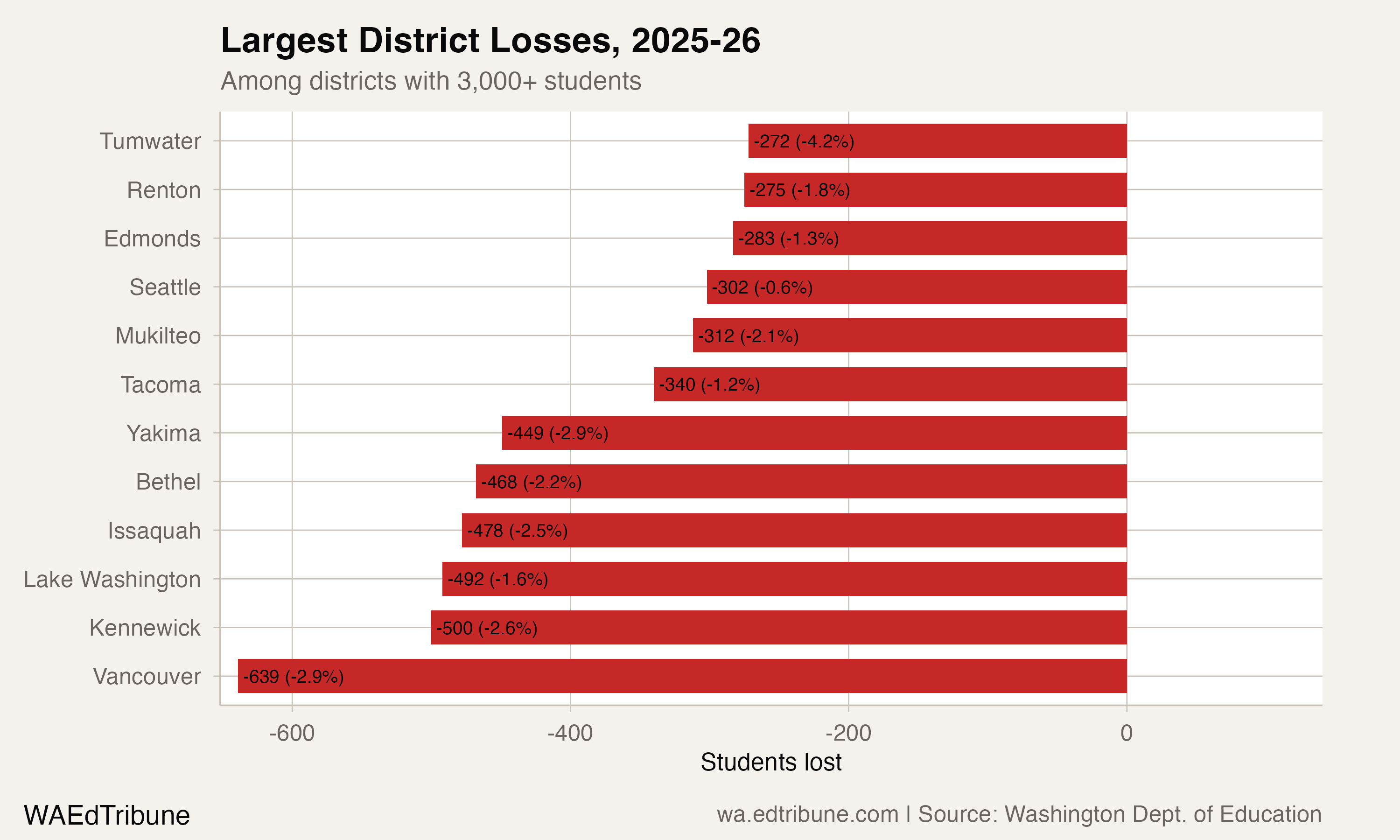
Vancouver↗ led all districts with a loss of 639 students (-2.9%), followed by Kennewick↗ (-500), Lake Washington↗ (-492), Issaquah↗ (-478), and Bethel↗ (-468). Seattle↗, the state's largest district at 50,898 students, lost 302, a 0.6% decline.
Fifty-five districts hit all-time enrollment lows in 2026 across the 17-year data window, including Evergreen (Clark County)↗, which has now declined for nine consecutive years and sits at 21,903 students, down from its peak of 26,581. Only 39 districts reached all-time highs.
Two of the largest apparent "gains" are virtual school artifacts. South Bend added 889 students because it hosts a digital academy. Similarly, Goldendale's 136-student gain reflects Connections Academy, not local enrollment growth. The underlying geographic trend is one of widespread, diffuse decline.
A white enrollment cliff, with a Hispanic dip
White students accounted for the bulk of the 2026 loss: 9,955 fewer white students, a 1.9% decline that exceeded the total statewide net loss of 9,099. White enrollment has fallen from 657,143 students in 2010 (63.5% of total) to 516,147 (47.1%), a loss of 141,000 students even as total enrollment grew and then fell.
Hispanic enrollment, which had grown steadily for over a decade, also declined in 2025-26 by 3,417 students (-1.2%). That reversal breaks a trend that had seen Hispanic enrollment rise from 167,426 in 2010 to 294,985 in 2025. Whether this reflects a demographic shift or a response to the current immigration enforcement climate is not distinguishable from enrollment data alone.
Asian (+2,906) and Black (+2,060) enrollment grew, partially offsetting the losses but not enough to change the aggregate direction.
The fiscal math
Washington funds schools on a per-pupil basis. Each 100 students represents roughly $1.3 million in state funding, according to a Bellevue School District estimate reported by Cascade PBS. By that measure, 9,099 students translates to approximately $118 million in reduced funding capacity statewide.
That pressure compounds what districts already face. Federal pandemic relief totaling $2.6 billion for Washington schools expired in September 2024. Adjusted for inflation, the state distributes roughly $1,000 less per student than it did in 2018, according to OSPI, an aggregate shortfall of about $1 billion annually.
"Any districts that escaped cuts this year are probably going to be in that boat next year unless something turns around." — Dan Steele, Washington Association of School Administrators, The Seattle Times
The consequences are already visible. Seattle Public Schools initially proposed closing as many as 21 schools before withdrawing the plan after public backlash. Marysville ran an $18 million deficit. In smaller districts, the cuts are quieter: Prescott eliminated preschool and its librarian position; Mount Baker reduced elective offerings and staff.
The state legislature has taken notice. SB 6125 would create an enrollment stabilization fund, holding districts harmless at their 2025-26 enrollment levels if revenue drops in 2026-27 or 2027-28. OSPI estimates 24 districts would qualify in the first year, for a total of $1.9 million. That is a rounding error against the scale of the problem.
The math from here
The 2026 drop is not a one-year anomaly that recovery will reverse. The kindergarten pipeline guarantees continued losses as large graduating classes cycle out and smaller entering classes replace them. The gap between grade 12 and kindergarten, nearly 30,000 students, will take years to work through the system.
State population projections indicate the school-age population will continue shrinking through at least 2038. The smallest kindergarten cohorts have likely not arrived yet.
For superintendents managing buildings designed for a larger student body, the planning horizon just shifted. The recovery was always fragile. Now it is over.
Detailed code that reproduces the analysis and figures in this article is available exclusively to EdTribune subscribers.
Discussion
Sign in to join the discussion.
Loading comments...