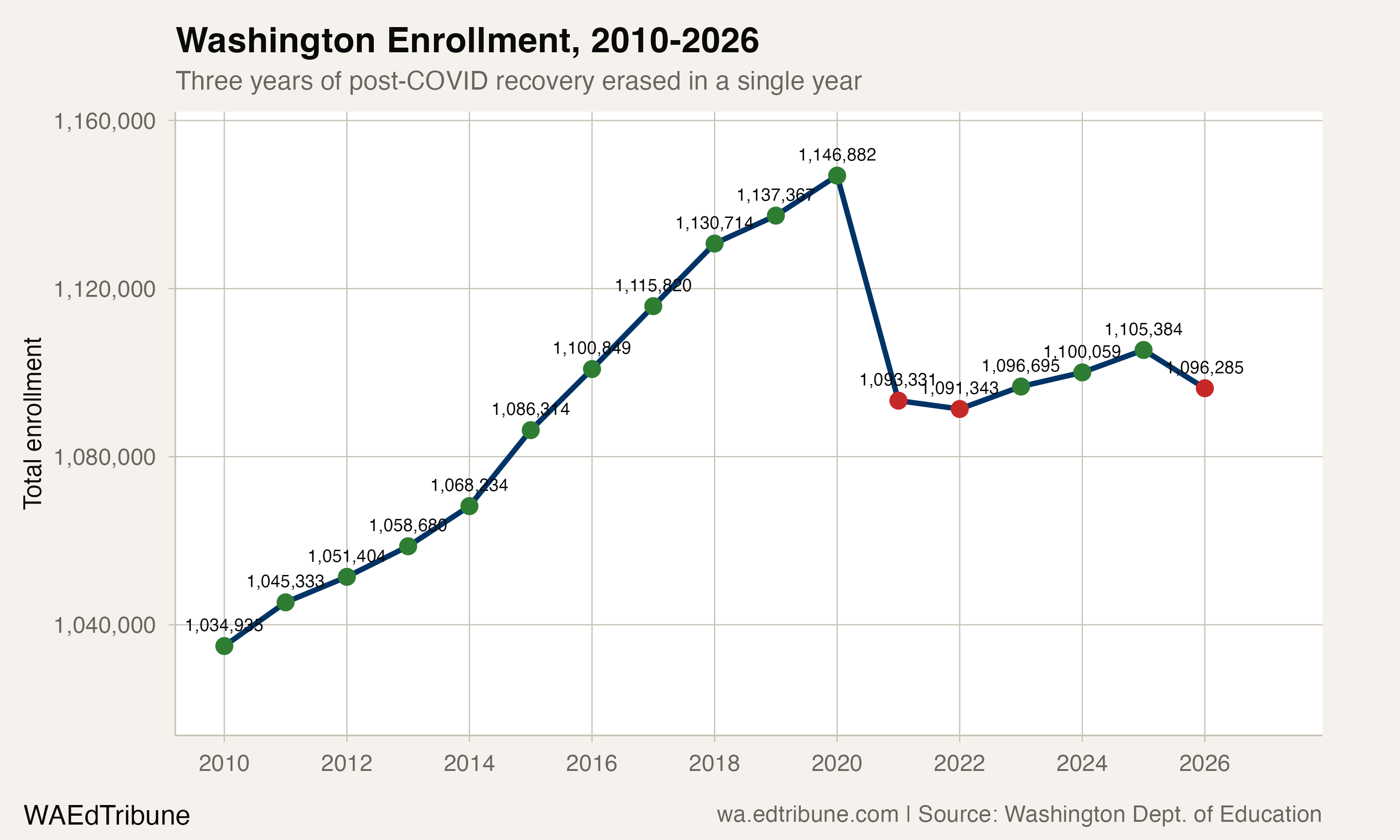
For three years, Washington's public schools were clawing their way back. From the COVID trough of 1,091,343 students in 2021-22, enrollment ticked upward: 5,352, then 3,364, then 5,325. The state had recovered about 14,000 of the 55,539 students it lost when the pandemic hit. Then 2025-26 arrived and took back most of it. Washington shed 9,099 students in a single year, dropping to 1,096,285, lower than any non-COVID year since 2015 and just 4,942 above the 2022 trough. Only 8.9% of the COVID-era loss has been recovered, and 61 districts now sit at the lowest enrollment in the 17-year data series.
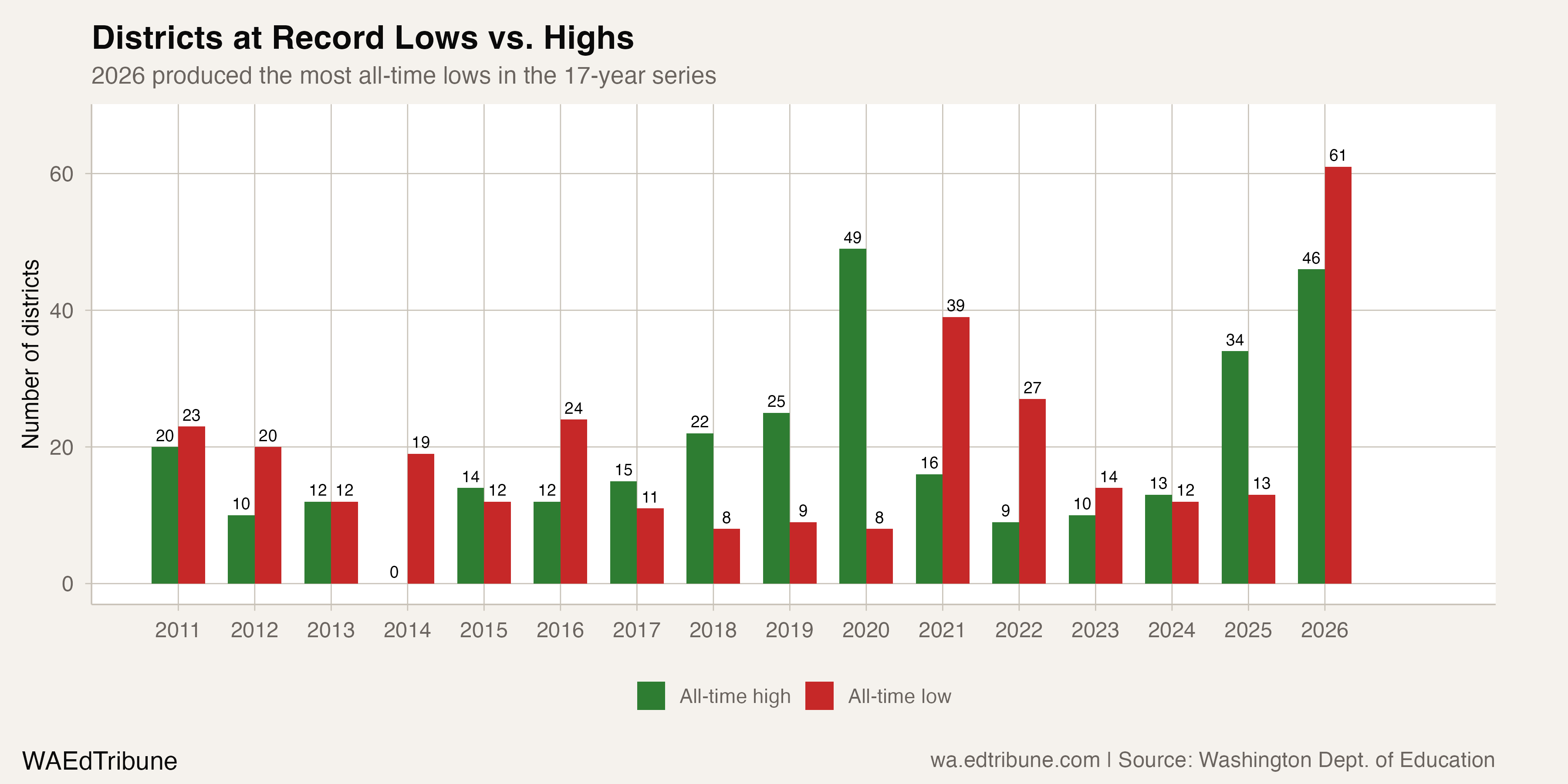
That is the most all-time lows recorded in any year since tracking began in 2009-10. By comparison, just 13 districts were at record lows the year before, and the previous worst year was 2021, when the pandemic pushed 39 districts to their floors. The 2026 figure is 56% higher than even that crisis year.
The asymmetry of decline
The 61 districts at all-time lows collectively enroll 136,140 students, 12.4% of the state total. On the other side of the ledger, 46 districts hit all-time highs in 2026, but they account for only 57,645 students, 5.3% of the state. The math is lopsided: shrinking districts are more than twice as large as growing ones.
The largest district at all-time high is Lake Stevens↗ at 10,276 students. After that, the list drops quickly: Cheney (5,750), Ridgefield (4,367), Lynden (3,679). Two of the "all-time high" districts, Goldendale (3,163) and South Bend (2,066), are inflated by virtual schools housed under their enrollment codes. Goldendale hosts Connections Academy, which accounts for roughly 2,300 of its students. South Bend jumped from around 650 students to 2,066 in two years, a pattern consistent with virtual program placement rather than families moving to town.
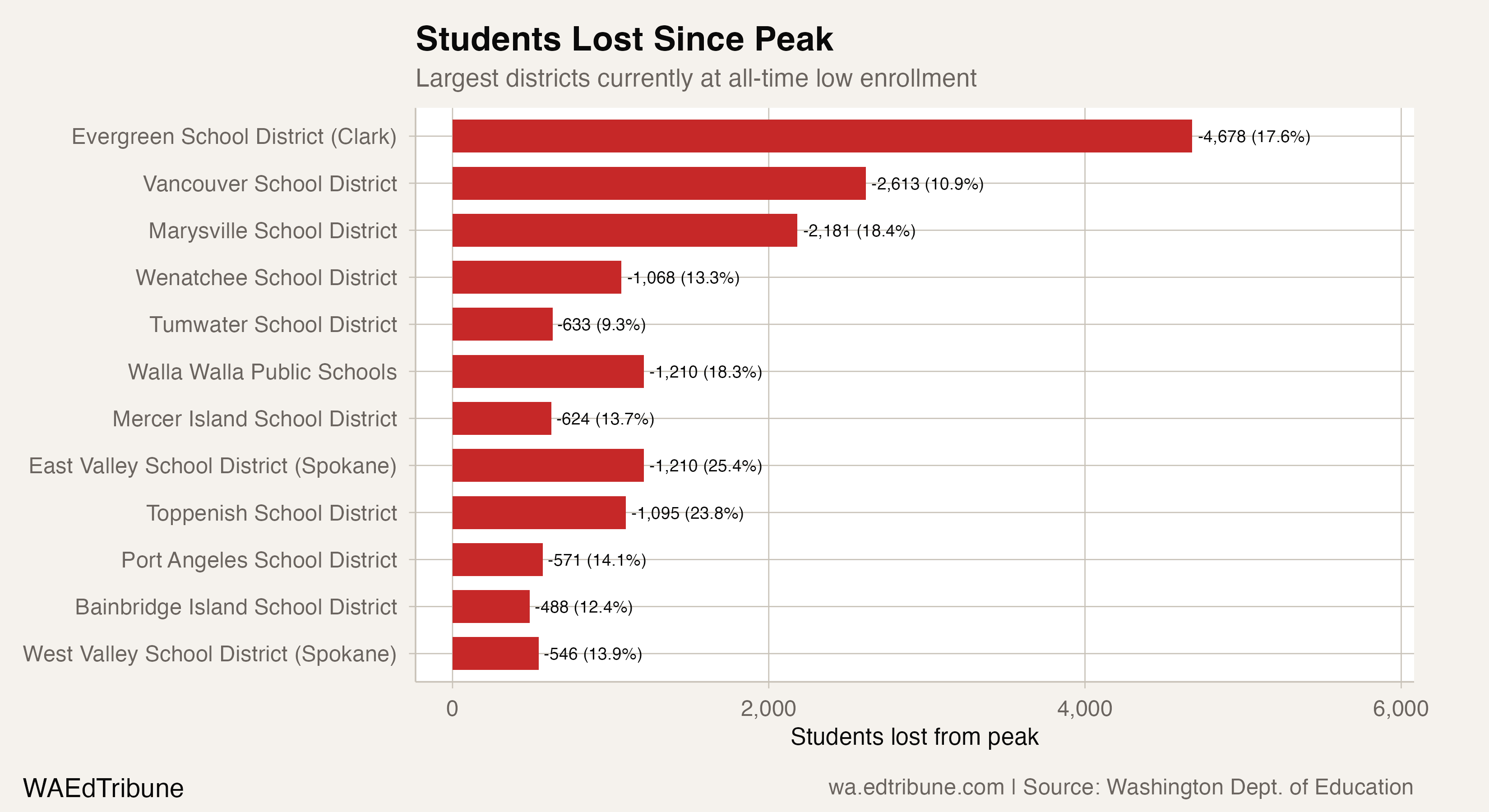
The record-low districts, by contrast, include Evergreen (Clark)↗ at 21,903 students, Vancouver↗ at 21,304, and Marysville↗ at 9,672. These are not small rural districts cycling through demographic noise. They are mid-to-large suburban systems losing hundreds of students per year.
Where the students went
Thirty-eight of the 61 all-time lows are new this year: districts that were not at their floor in 2025 but crossed it in 2026. The remaining 23 have been at or near their minimum for multiple years, unable to reverse the slide.
Evergreen (Clark)↗ has lost 4,678 students since its 2013 peak of 26,581, a 17.6% decline. Vancouver↗ peaked more recently, in 2017 at 23,917, and has shed 2,613 (10.9%). Marysville↗ peaked earliest, in 2010, and has lost 2,181 students (18.4%) since. Smaller districts show steeper percentage losses: East Valley (Spokane) is down 25.4% from its 2012 peak, and Toppenish has fallen 23.8% from 2017.
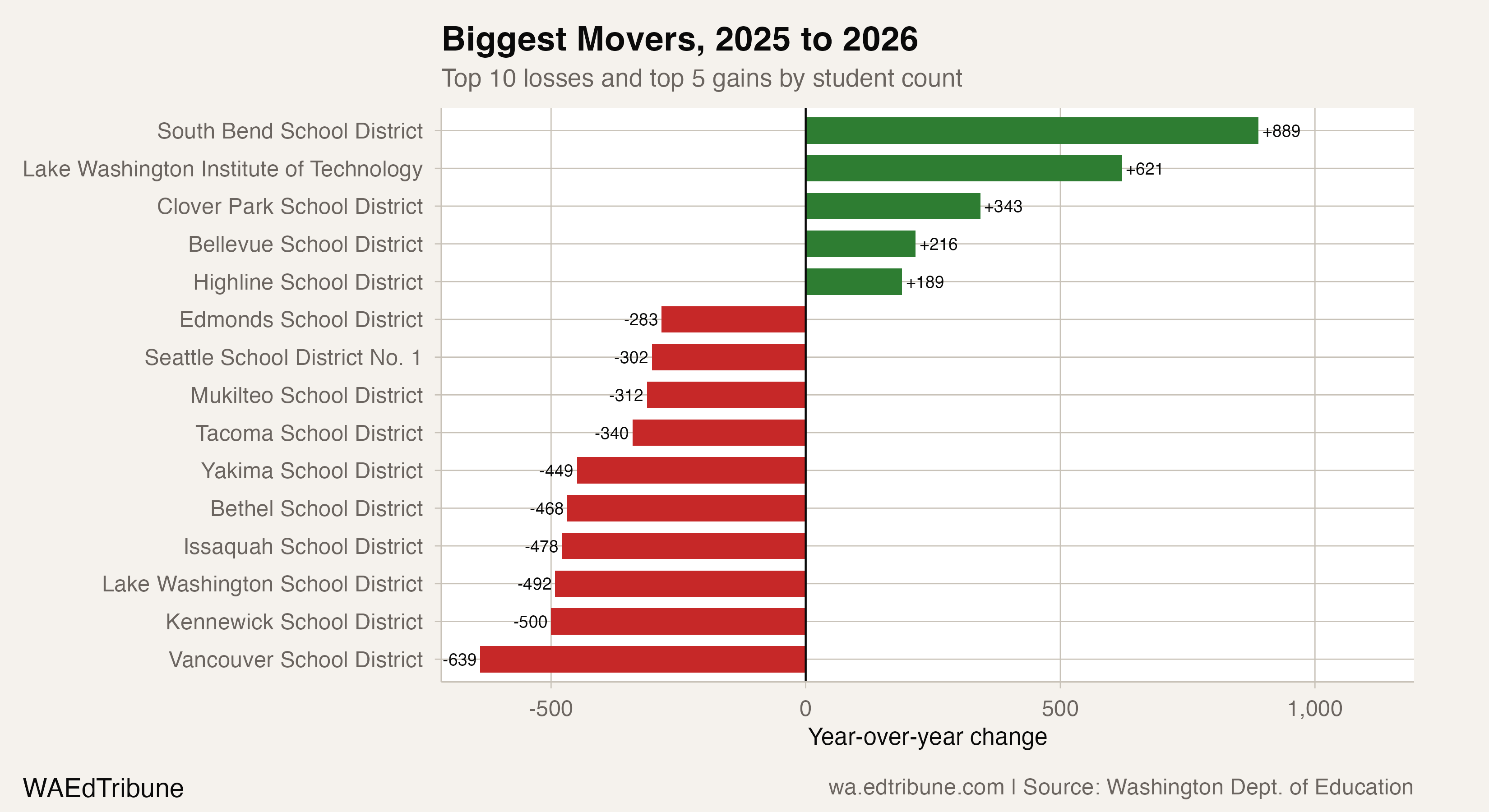
Statewide, 63.6% of districts lost enrollment between 2025 and 2026. Only 113 of 327 districts with data for both years gained students. The 10 largest single-year losses alone total 4,263 students, led by Vancouver (-639), Kennewick (-500), Lake Washington (-492), Issaquah (-478), and Bethel (-468).
Birth rates, housing costs, and the funding cliff
The most widely cited driver is demographic: Washington's birth rate has fallen roughly 8% since 2016, from 90,505 births to 83,838, a steeper drop than the 7% national average. Those smaller birth cohorts are now flowing through elementary grades. Lisa Guthrie, board president of Lake Washington School District, attributed the enrollment shifts directly, telling the Sammamish Independent that the decline reflects "a decline in birth rate in the late 2010s and the lasting effects of the COVID-19 pandemic."
The pandemic itself created a separate, compounding loss. Washington's public schools have recovered only 8.9% of the 55,539 students lost between 2020 and 2022. Many never came back: homeschool enrollment in Washington climbed by roughly 9,000 students, a 43% increase, while private school enrollment jumped by nearly 17,000, a 26% increase between the 2019-20 and 2022-23 school years. The pandemic accelerated a departure that has not reversed.
"If you are in a community and they are considering closing your elementary school, it is personal to you. It is very visceral, it is very powerful for you." — State Superintendent Chris Reykdal, The Seattle Times
Housing costs offer a third, less quantified explanation. Demographer Eric Hovee told The Columbian that "the enrollment drops are greatest in the school districts that aren't getting much new single-family residential development, coupled with declining birth rates." Clark County's median home sale price reached $380,000 by 2019 and has climbed since, pricing young families out of established suburbs. The districts that are growing, Ridgefield, La Center, and Deer Park, are precisely those outer-ring communities absorbing displaced families. But the students arriving in smaller districts do not replace the students leaving larger ones.
School closures are already underway
The fiscal consequences are tangible. Washington funds schools on a per-pupil basis, so every departing student takes state dollars with them. Evergreen Public Schools has faced a roughly $20 million budget deficit for three consecutive years, proposing to cut 140 positions in 2024-25 alone. Superintendent John Boyd was blunt: "Ninety cents of a dollar goes to staff. There's no way to reduce $20 million without affecting staff."
Marysville, which has fallen from 11,853 to 9,672 students since 2010, closed an elementary and a middle school for the 2025-26 year, targeting $2.4 million in annual savings. The state assigned a special administrator to oversee the district's finances. Seattle Public Schools proposed closing up to 21 schools to address a nearly $100 million budget shortfall before ultimately abandoning the plan, leaving the structural deficit unresolved.
The expiration of $2.6 billion in federal pandemic relief funds compounds the enrollment-driven squeeze. Districts that used one-time money to maintain staffing levels during the enrollment dip now face a double cliff: fewer students and less emergency aid simultaneously.
A bifurcated landscape
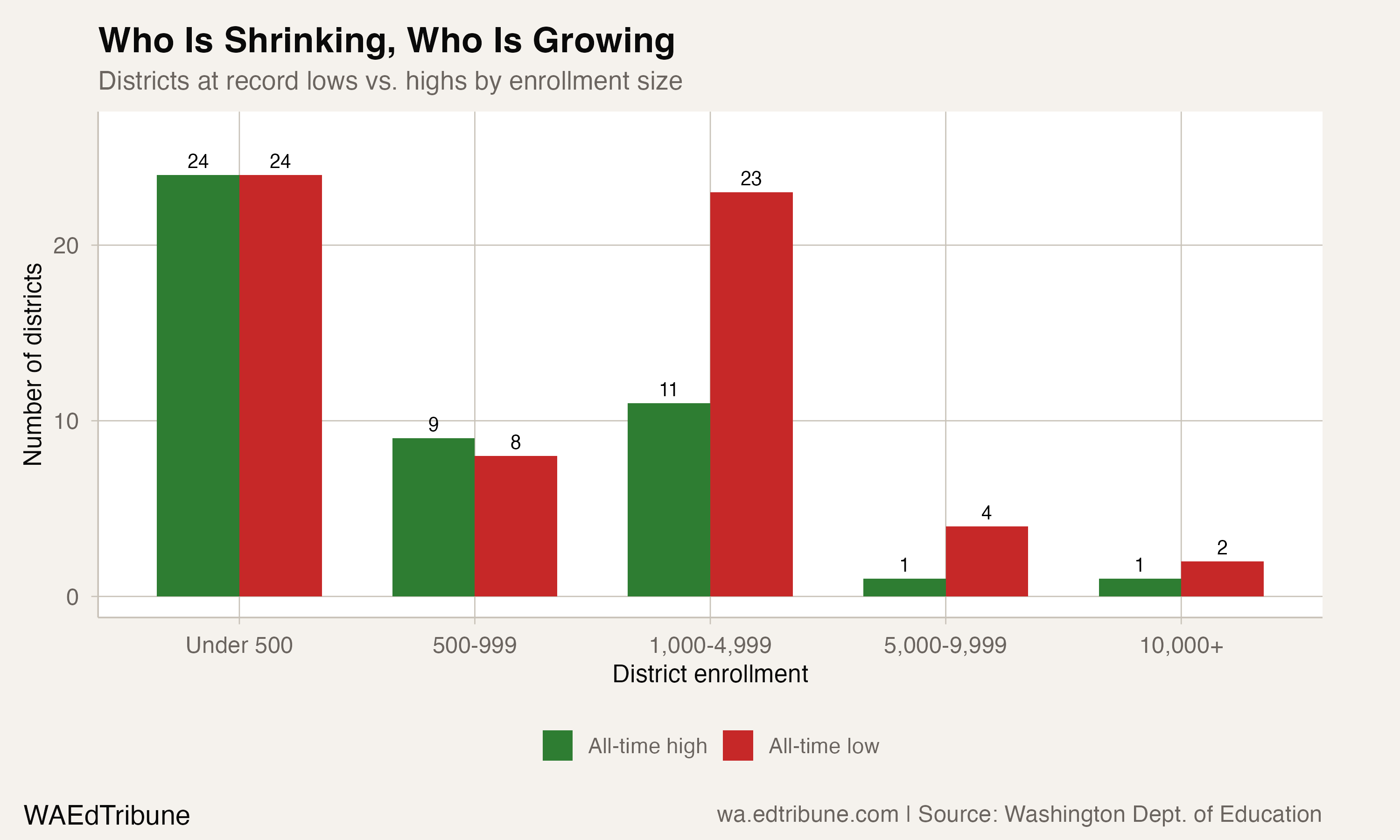
The size distribution of record-low districts reveals a pattern. Among districts with 1,000 to 5,000 students, 23 are at all-time lows and only 11 are at all-time highs. Among districts with 5,000 or more students, six are at lows and just two are at highs. The decline is concentrated where it costs the most: mid-sized districts with fixed overhead in buildings, administration, and specialized staff that cannot easily scale down.
Small districts under 500 students split evenly, 24 at lows and 24 at highs. Demographic fluctuations at that scale can swing a district from record to record on the arrival or departure of a few dozen families.
One data caveat: the 17-year window (2010-2026) means "all-time low" reflects the lowest point in the available series, not necessarily the lowest enrollment a district has ever seen. A district that was smaller in 2005 but grew before 2010 would not show 2010 as its minimum. The metric captures the direction of the current era, not a district's full history.
61 districts, one question
Washington's 2026 reversal raises a specific question: was it a one-year correction in an otherwise recovering trajectory, or the start of a new decline phase? The answer depends on whether the kindergarten cohorts entering in 2027 and 2028, born during Washington's lowest birth years on record, are large enough to offset the 12th-graders leaving. In Lake Washington School District, elementary enrollment has fallen 14.3% since 2019 while high school enrollment has risen 16.9%. That inversion will resolve itself within a few years, one way or the other.
For the 61 districts now at their floor, the operational question is whether to consolidate proactively or wait for the next year's count. Marysville and Evergreen have already made their cuts. The remaining 59 face the same arithmetic.
Detailed code that reproduces the analysis and figures in this article is available exclusively to EdTribune subscribers.
Discussion
Sign in to join the discussion.
Loading comments...