The number arrived at the Office of Superintendent of Public Instruction like a wall: 27.1%. After dropping three full percentage points the year before, Washington's chronic absenteeism rate in 2024-25 barely moved. The improvement was two-tenths of a point. Rounded generously, it still rounds to 27%.
That near-zero progress leaves 296,544 students — more than one in four across the state — missing 18 or more school days per year. It means the attendance crisis that exploded during COVID has, for all practical purposes, stopped getting better.
Three years of progress, then a wall
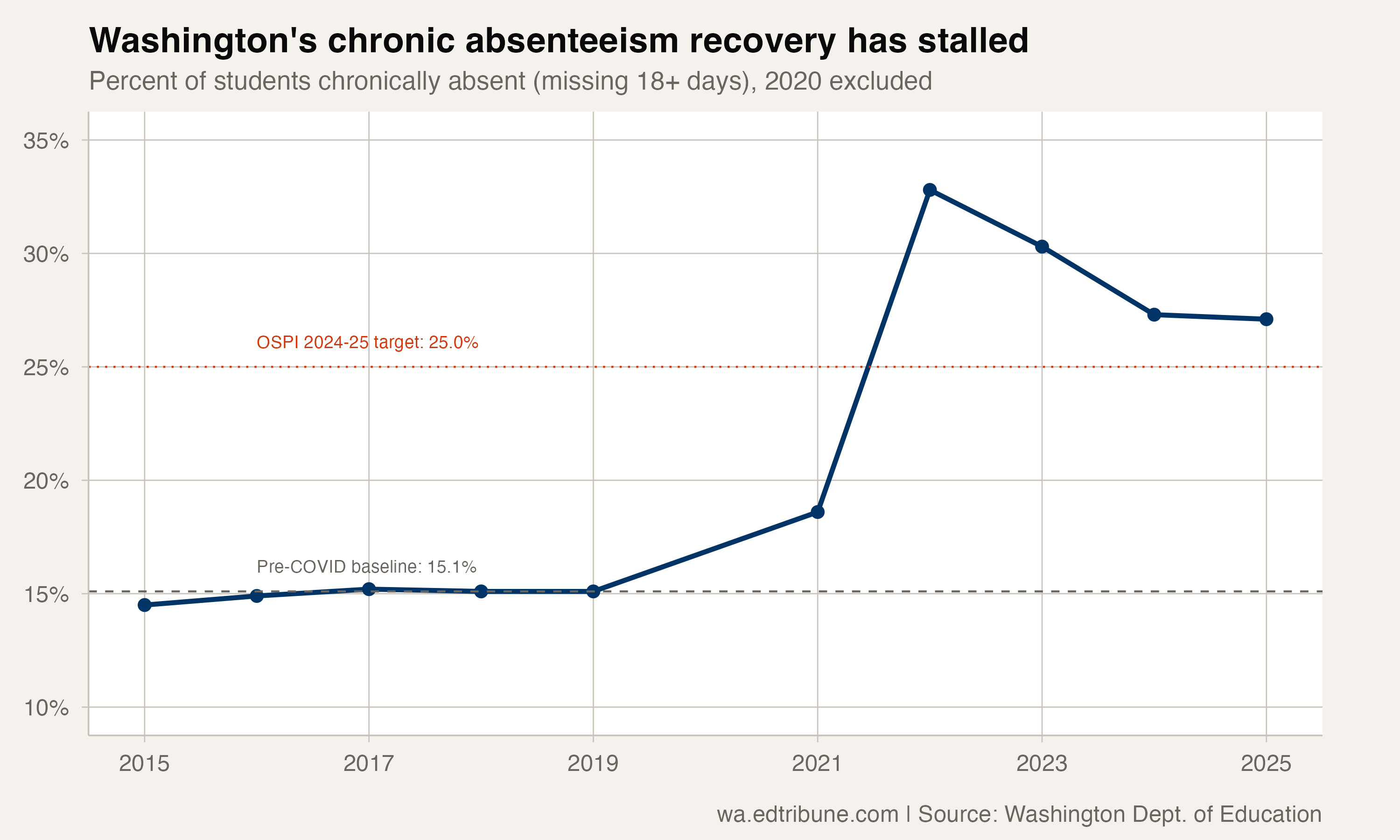
Before the pandemic, chronic absenteeism in Washington held remarkably steady. From 2015 through 2019, the rate hovered between 14.5% and 15.2%, never moving more than four-tenths of a point in any direction. Then came COVID. The rate spiked to 32.8% in 2021-22, more than doubling the pre-pandemic baseline, as remote learning habits, family disruptions, and disconnection from school took hold.
The recovery that followed was real but incomplete. The rate dropped 2.5 points in 2022-23, then 3.0 points in 2023-24. Those were meaningful gains, the kind that generated cautious optimism at OSPI and in district offices statewide. But the 0.2-point improvement in 2024-25 suggests Washington has hit a recovery ceiling.
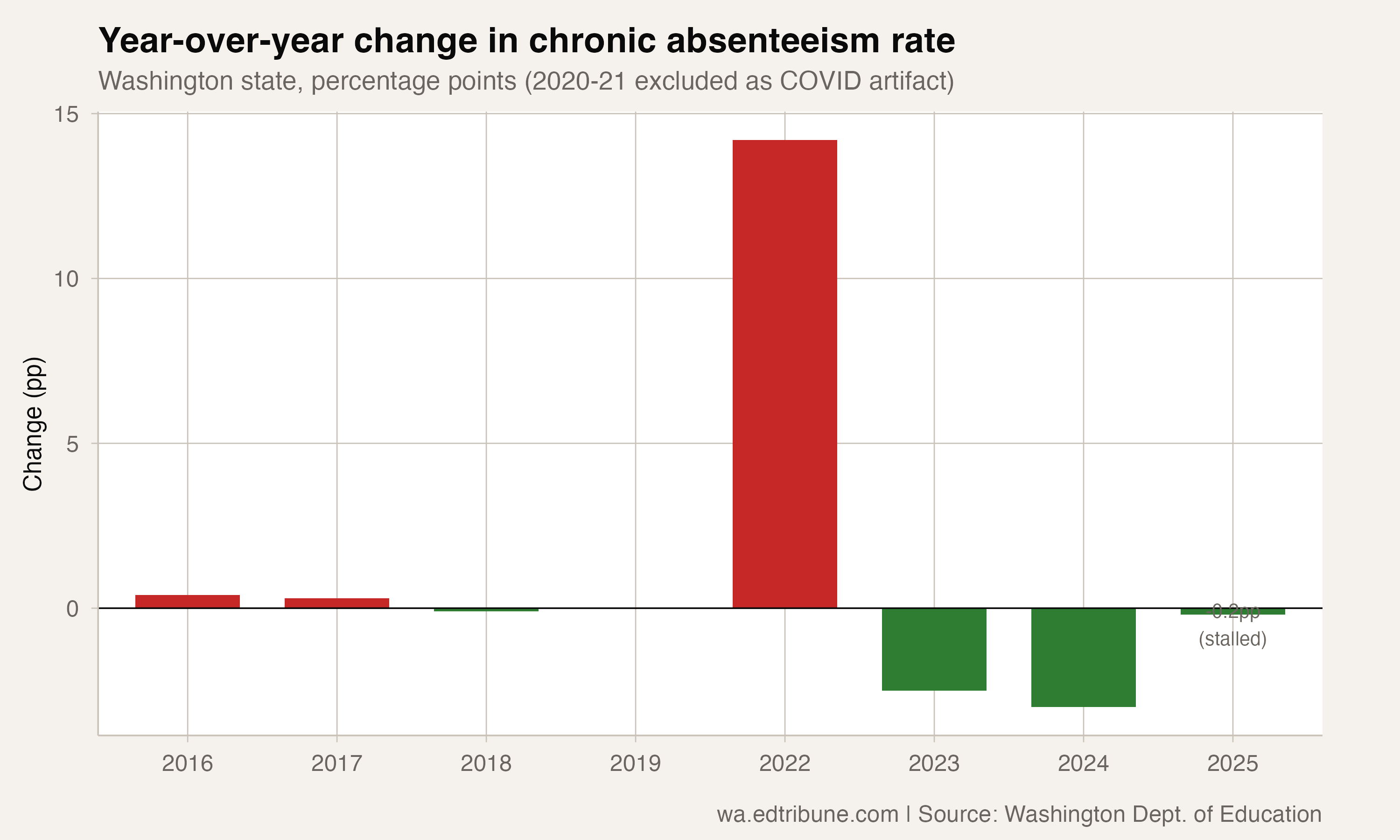
The state has recovered 5.7 of the 17.7 percentage points it lost during the pandemic — 32.2% of the way back to normal. At the average pace of improvement over the past three years (roughly 1.9 points per year), Washington would not return to pre-pandemic levels until 2031. At the 2025 pace, the math stops making sense entirely.
OSPI's target: missed by two points
Washington joined the nationwide 5-Year Attendance Challenge with an ambitious goal: cut chronic absenteeism from 27% to 14% by 2029. The intermediate target for 2024-25 was 25.0%. The actual rate of 27.1% missed that mark by 2.1 points, a gap that will compound if the stall continues.
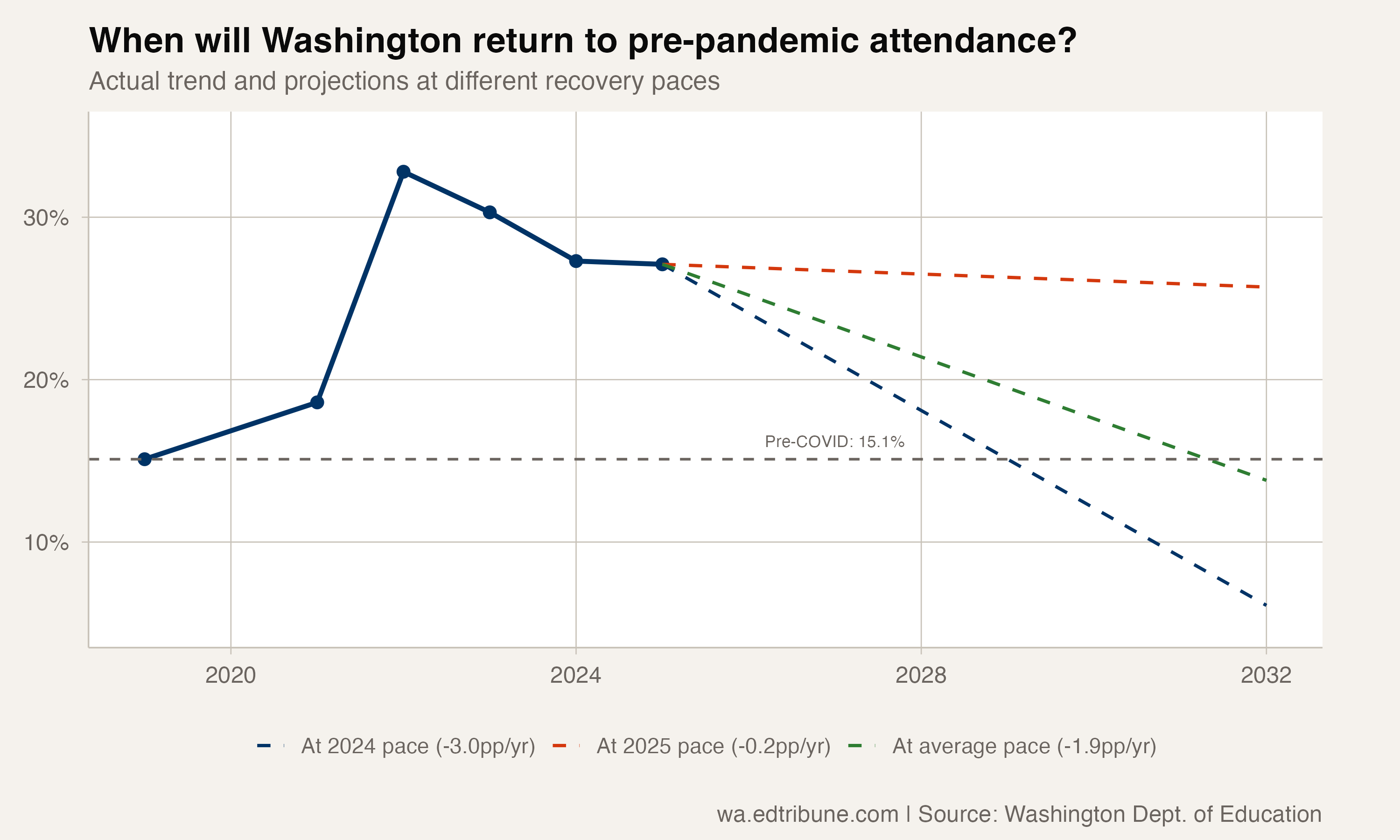
Hitting 14% by 2029 would require cutting the rate by roughly 3.3 points per year for the next four years — a pace Washington has never achieved, even in its best recovery year. The state is not on track, and the deceleration in 2025 makes the challenge substantially harder.
Who bears the burden
The statewide average masks dramatic variation by student group. Homeless students are chronically absent at 51.1%, a rate that has barely improved from the 59.7% peak. Native American students face a 45.6% chronic rate, nearly double the state average. Foster care youth are stuck at 41.3%, a number that has not meaningfully changed in three years.
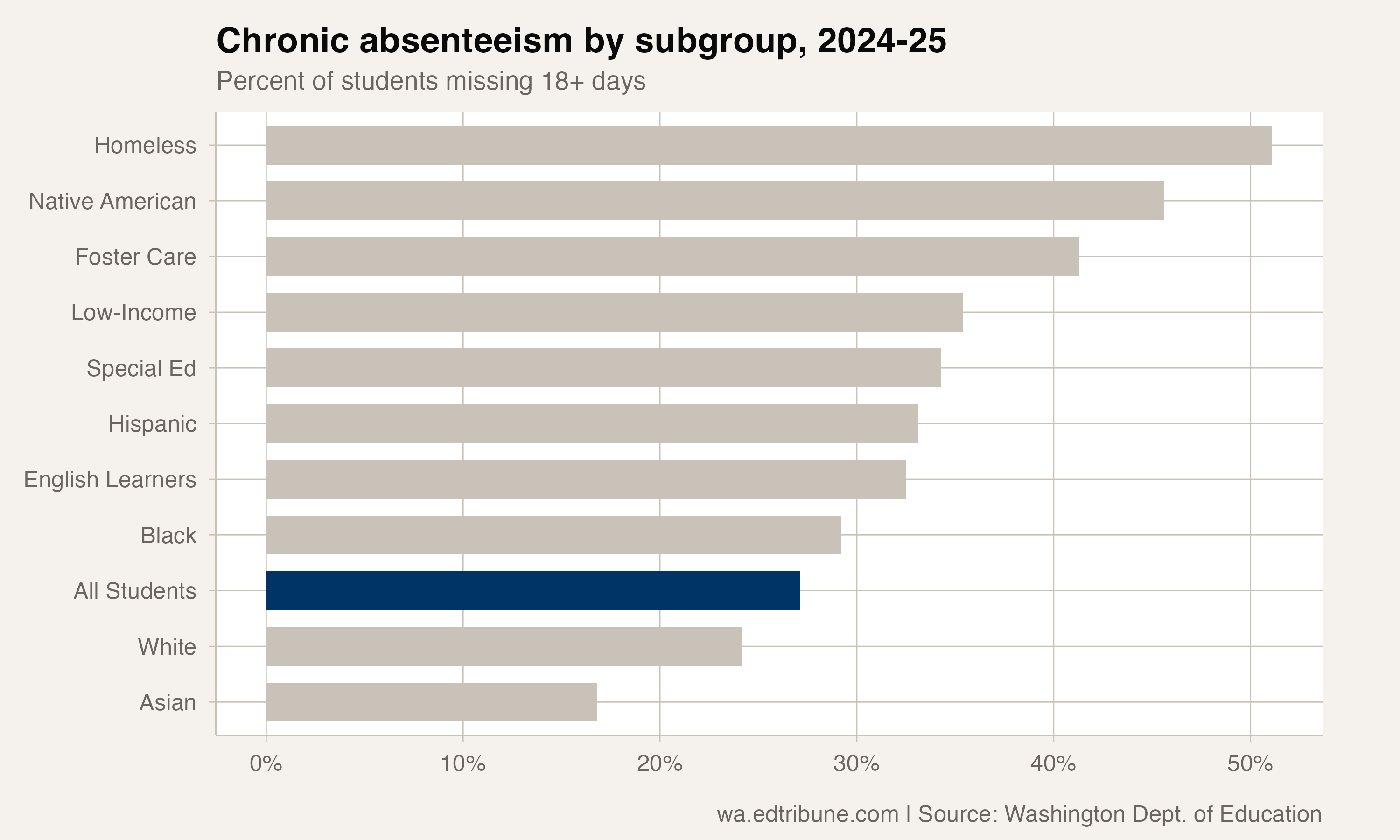
Low-income students miss school at 35.4%, compared to 19.0% for their non-low-income peers. Hispanic students are chronically absent at 33.1%, Black students at 29.2%, and students with disabilities at 34.3%. Only Asian students, at 16.8%, are anywhere near the pre-pandemic baseline.
The pattern is consistent: every equity gap that existed before COVID is wider now, and the groups with the highest rates are recovering the slowest. The pandemic did not create these disparities, but it stretched them to a degree that three years of recovery has not been able to compress.
What the legislature is doing about it
Senate Bill 5007, a bipartisan proposal currently moving through the state legislature, would allocate $20.4 million per biennium to address chronic absenteeism in high schools specifically. The bill would fund school-based absenteeism teams, data systems to identify at-risk students earlier, and community grants for organizations working on attendance barriers like housing instability and transportation.
The focus on high schools is deliberate. Elementary schools have recovered nearly half their COVID attendance losses, but high school chronic rates remain within two points of their pandemic peak. Grade 12 students are chronically absent at 37.5%, virtually unchanged from the 38.7% high-water mark.
The easy recoveries are done
The stall in 2025 raises an uncomfortable possibility: the students who were going to return to regular attendance already have. What remains is structural. The families dealing with housing instability, the teenagers who found jobs during remote learning and never came back full-time, the students with chronic health conditions exacerbated by the pandemic. These are not problems that an attendance letter or a phone call home will solve.
Senate Bill 5007 would put $20.4 million toward the high school piece of this puzzle. But at 296,544 students, the scope of the problem dwarfs any single intervention. Three years of recovery bought Washington a 5.7-point improvement. The next 12 points will be harder.
Detailed code that reproduces the analysis and figures in this article is available exclusively to EdTribune subscribers.
Discussion
Sign in to join the discussion.
Loading comments...