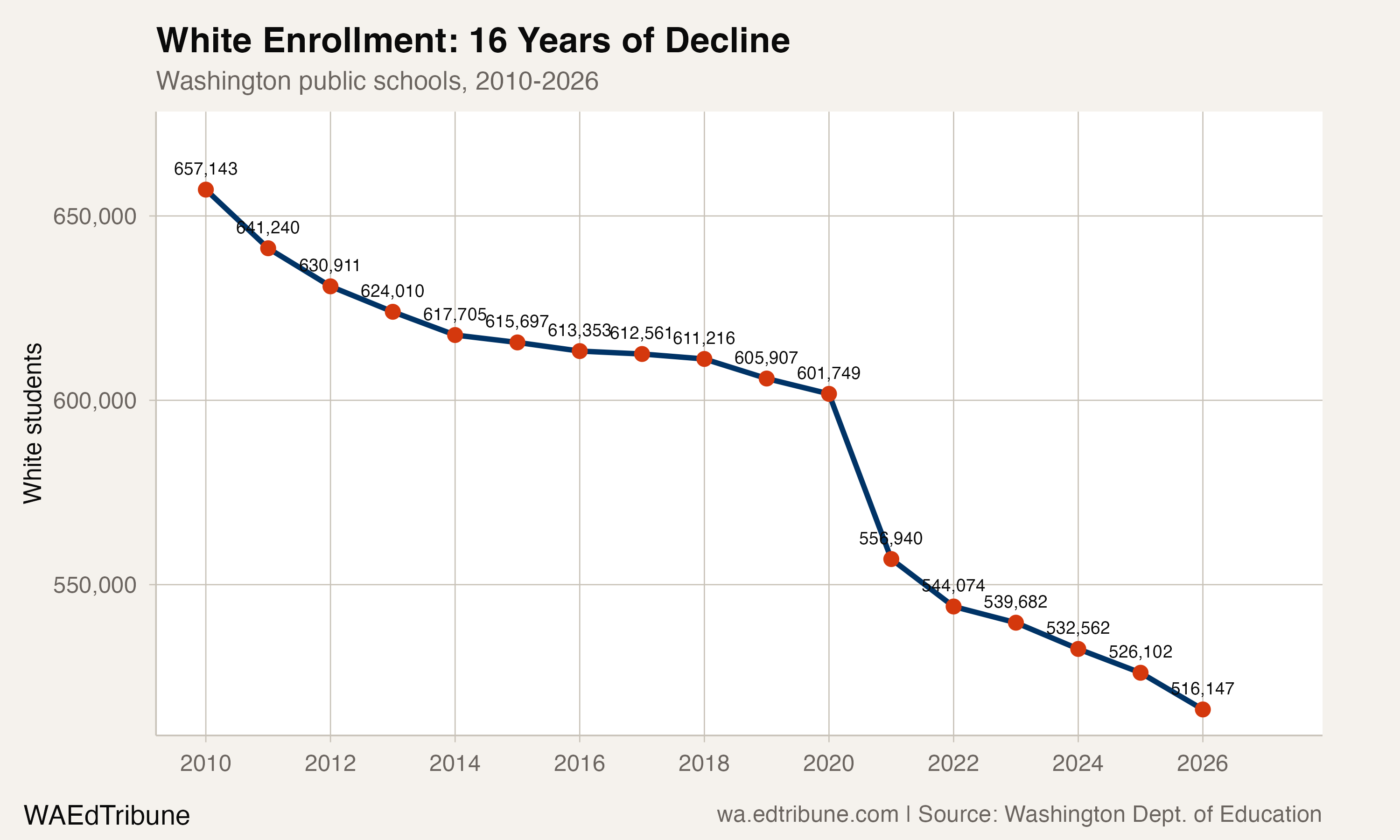
In 2010, nearly two out of three students in Washington's public schools were white. By 2026, fewer than half are. The state lost 140,996 white students over those 16 years, a 21.5% decline, and enrollment fell in every single year. No pause, no partial recovery, no plateau. Just a line that goes in one direction.
The scale of the loss is hard to grasp in the abstract. Seattle, Spokane, and Tacoma enrolled a combined 109,147 students in 2025-26. Washington lost more white students than those three districts hold in total.
Two eras of the same decline
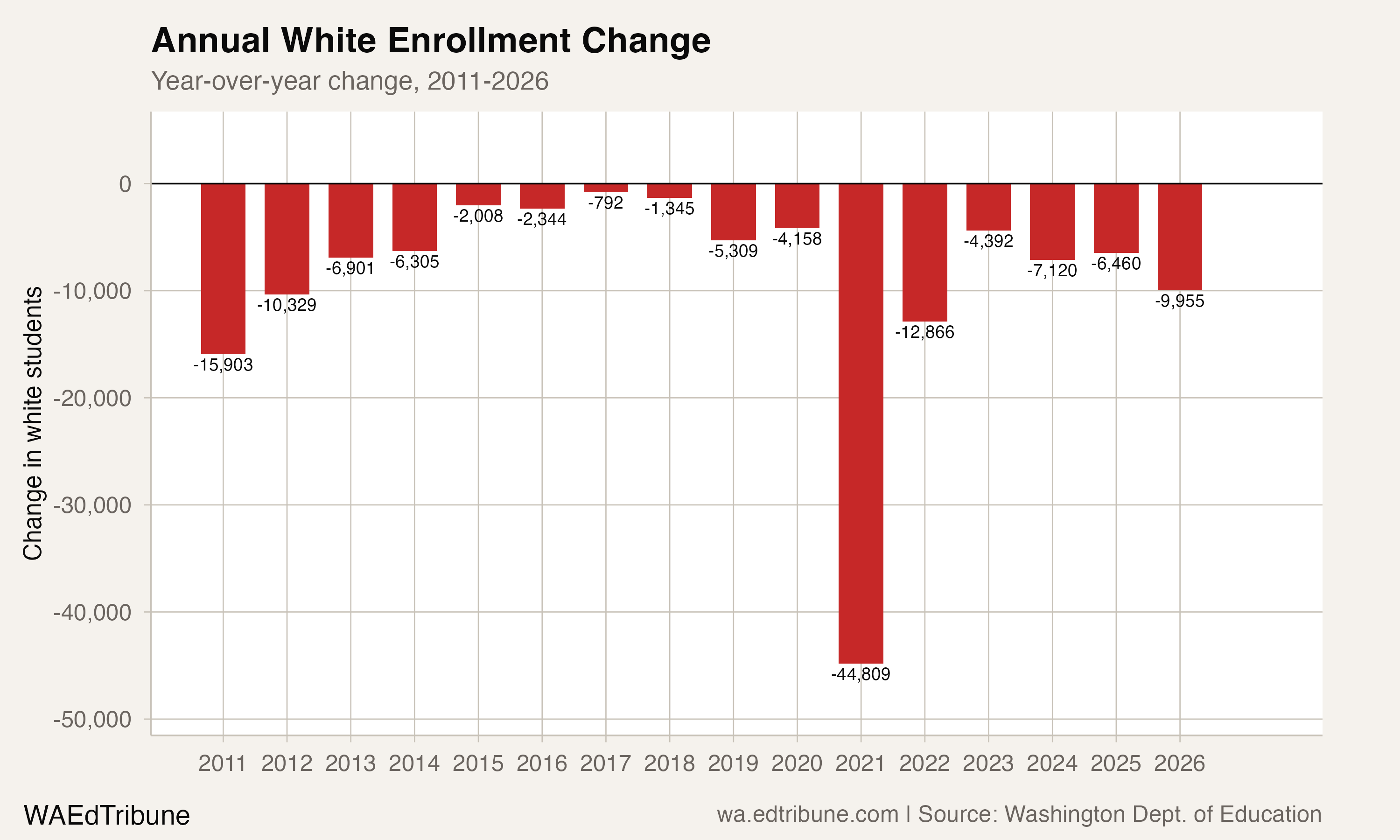
The 16-year streak breaks into distinct phases. From 2010 to 2014, white enrollment dropped by roughly 6,000 to 16,000 students per year, an initial adjustment from a peak. Then from 2015 to 2020, the losses moderated to between 800 and 5,300 per year. The smallest annual loss was just 792 students in 2017, a year when total enrollment was still growing.
COVID shattered that relative stability. In 2021 alone, 44,809 white students disappeared from the rolls. That single-year drop exceeded the combined white losses of the five previous years. White students made up 52.5% of enrollment before the pandemic but accounted for a far larger share of the exit: the loss was disproportionately white.
The post-pandemic period has not returned to the pre-COVID pace. Between 2022 and 2026, white enrollment fell by an average of 8,159 students per year, nearly double the pre-COVID average of 4,388. In 2026, Washington lost 9,955 white students, the largest annual decline since 2022.
Where the students went
Three forces are converging to drive white enrollment downward, and separating them from each other is not straightforward.
The most structural is demographic. Washington's natural increase (births minus deaths) fell from 40,736 in 2010 to 17,654 in 2025, a 57% decline over 15 years. The state's white population is older than every other racial group, which means fewer white children entering kindergarten each year. This alone would produce a steady, gradual decline even if no families left the system.
The second force is exit from public schools. Private school enrollment in Washington jumped 26% between the 2019-20 and 2022-23 school years, nearly 17,000 additional students, a rate triple the national average. Homeschooling grew 43%, adding roughly 9,000 students. National data suggests both pathways skew disproportionately white, though Washington does not publish demographic breakdowns of its private and homeschool populations.
"Private school enrollment increased by 26% between the 2019-20 and 2022-23 school years ... significantly higher than the national rate." -- KUOW, 2024
The third factor is harder to measure: reclassification. Multiracial enrollment in Washington grew from 35,867 to 100,034 between 2010 and 2026, a 178.9% increase. Some portion of that growth reflects students who might have identified as white in an earlier era now checking a different box. The multiracial category's explosive growth coincides almost perfectly with white enrollment's steepest declines, and the two trends are likely intertwined.
47 districts crossed the line
In 2010, 249 of Washington's districts were majority-white. By 2026, that number had fallen to 205. Forty-seven districts flipped from majority-white to minority-white in 16 years.
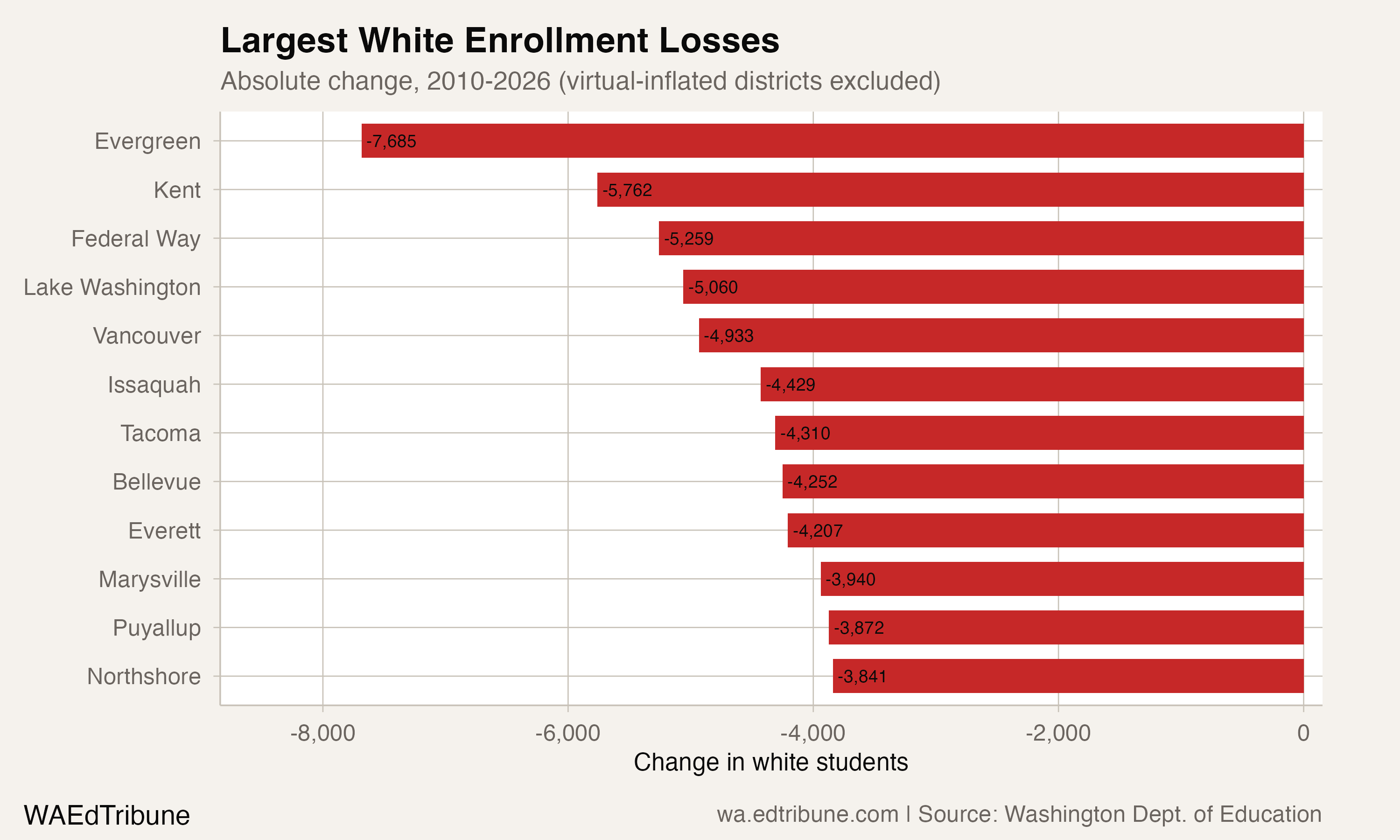
The losses were concentrated in the state's largest suburban districts. Evergreen (Clark County)↗ lost 7,685 white students, the most of any district, dropping from 72.0% to 49.1% white. Kent↗ lost 5,762, falling from 45.7% to 26.1%. Federal Way lost 5,259, and white students now make up just 17.9% of its enrollment, down from 41.2%.
The Eastside inversion
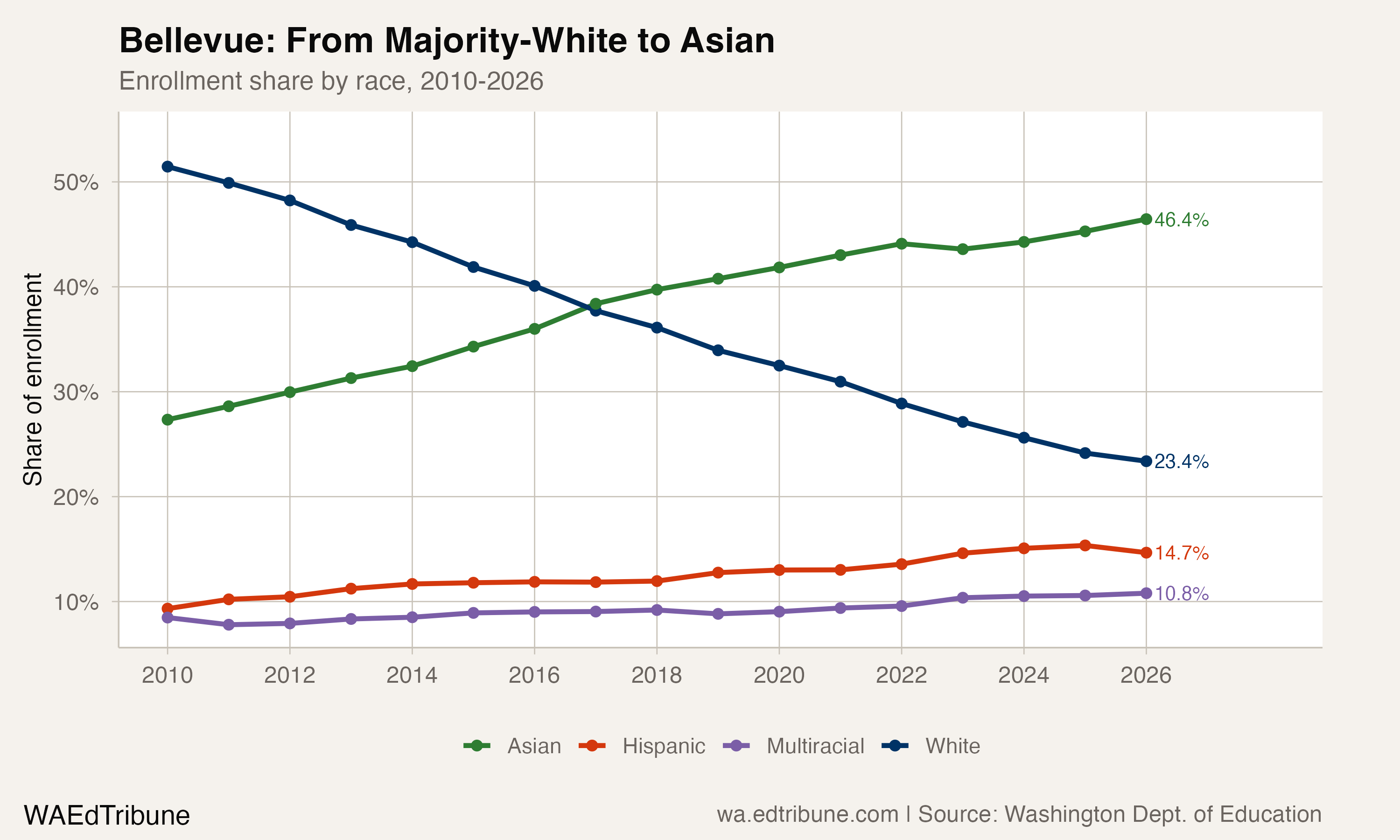
Nowhere is the transformation more visible than in the tech corridor east of Seattle. Bellevue↗, Lake Washington↗, Issaquah, and Northshore were all between 51% and 71% white in 2010. By 2026, all four had flipped. Bellevue's shift was the most extreme: white enrollment dropped from 51.5% to 23.4%, while Asian enrollment rose from 27.3% to 46.4%. The district is now plurality-Asian.
The driver is straightforward. The Seattle Times reported that the influx of tech-sector immigrant families to the Eastside, particularly from East and South Asia, has reshaped district demographics over the past decade. Mandarin, Cantonese, and Taiwanese speakers in Bellevue schools grew 91% in a single decade. Indian-language speakers quadrupled. The transformation is not a story of white families fleeing; it is a story of a new population arriving and an older one aging out.
Seattle↗ stands alone among large districts. It was the only one of the state's 10 largest to gain white students between 2010 and 2026, adding 1,865 over the period. White enrollment in Seattle rose steadily from 2012 to 2020, peaking at 26,060 (46.5% share), before reversing post-pandemic. By 2026, it had fallen back to 22,482 (44.2%). The decade-long gain may reflect the gentrification of historically non-white neighborhoods; its reversal aligns with the same pandemic-era exit that hit the rest of the state.
The composition underneath
The white decline did not happen in isolation. As 140,996 white students left, Washington's schools absorbed 124,142 additional Hispanic students (a 74.1% increase), 64,167 multiracial students (178.9%), and 23,207 Asian students (28.9%). Black enrollment was essentially flat, losing 1,279 students over 16 years. Native American enrollment fell by nearly half, from 24,768 to 12,622.
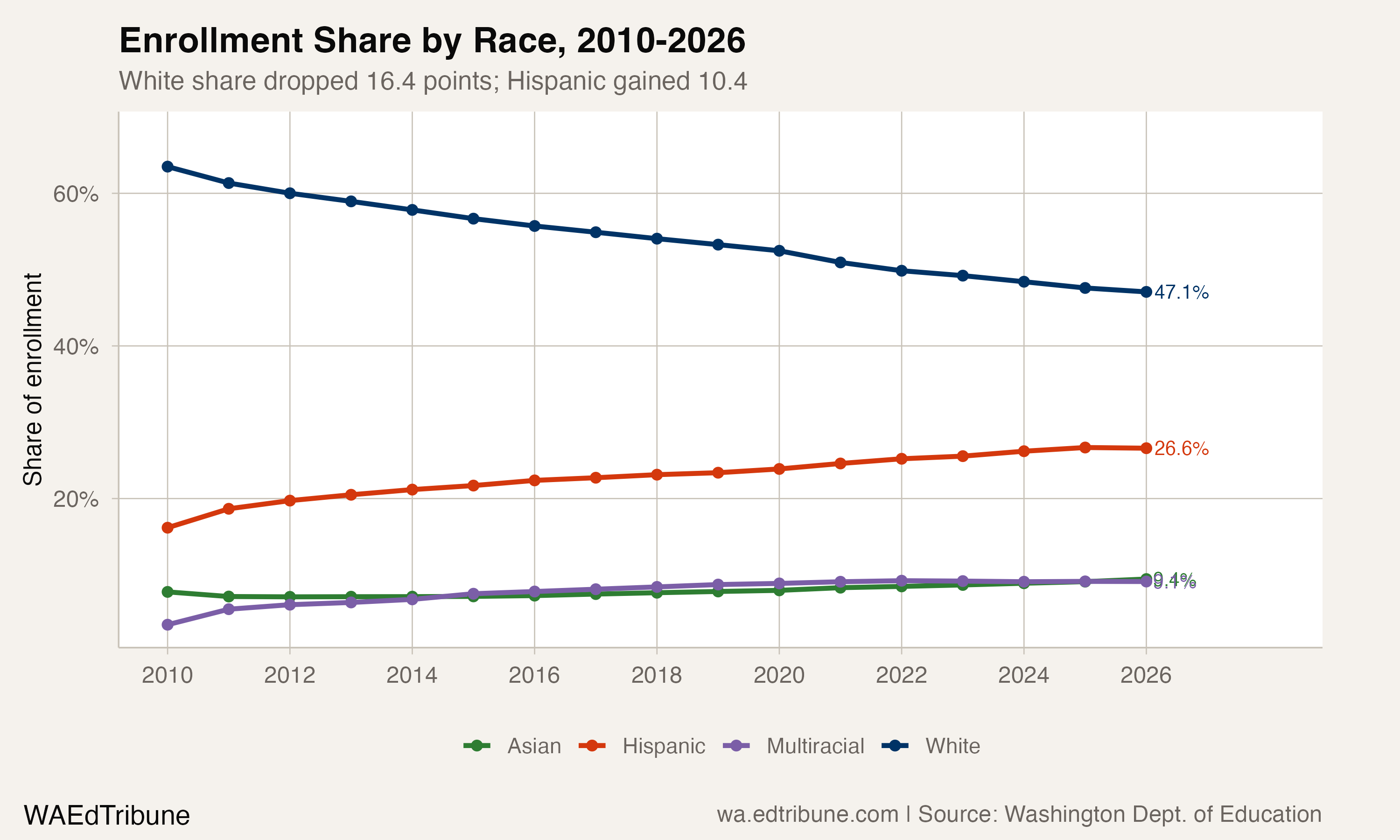
The net effect: a state that was 63.5% white is now 47.1% white, while Hispanic share more than doubled from 16.2% to 26.6%. White students dropped below 50% in 2022 and have continued falling since. The crossover happened, as The Seattle Times noted, "with remarkably little public awareness."
"We're just falling in line with the rest of the world." -- Sharonne Navas, Equity in Education Coalition, The Seattle Times
What 8,000 fewer students per year means
Washington's prototypical school funding model allocates resources based on enrollment counts. Each student who leaves takes per-pupil funding with them. At the state's average of roughly $18,000 per student, a sustained loss of 8,000 white students per year represents a significant funding redistribution, shifting away from the suburban and rural districts where white enrollment is falling fastest.
The operational consequences are already visible. Districts that were built for larger, more homogeneous student bodies are simultaneously managing enrollment decline and demographic diversification. A district that loses 3,000 white students while gaining 1,500 Hispanic and 500 multiracial students has a net enrollment loss of 1,000, but its needs have changed in ways the headcount does not capture: more bilingual programs, different professional development, updated curriculum.
The 2026 data suggests no inflection point is near. White enrollment fell by 9,955 students this year, accelerating from 6,460 the year before. With Washington's birth rate at its lowest level since 2004, the pipeline of white kindergartners entering the system will keep shrinking. Districts built for larger, more homogeneous student bodies now face a dual challenge: fewer students and different ones. More bilingual programs, different professional development, updated curriculum -- the headcount does not capture how much the work has changed.
Detailed code that reproduces the analysis and figures in this article is available exclusively to EdTribune subscribers.
Discussion
Sign in to join the discussion.
Loading comments...