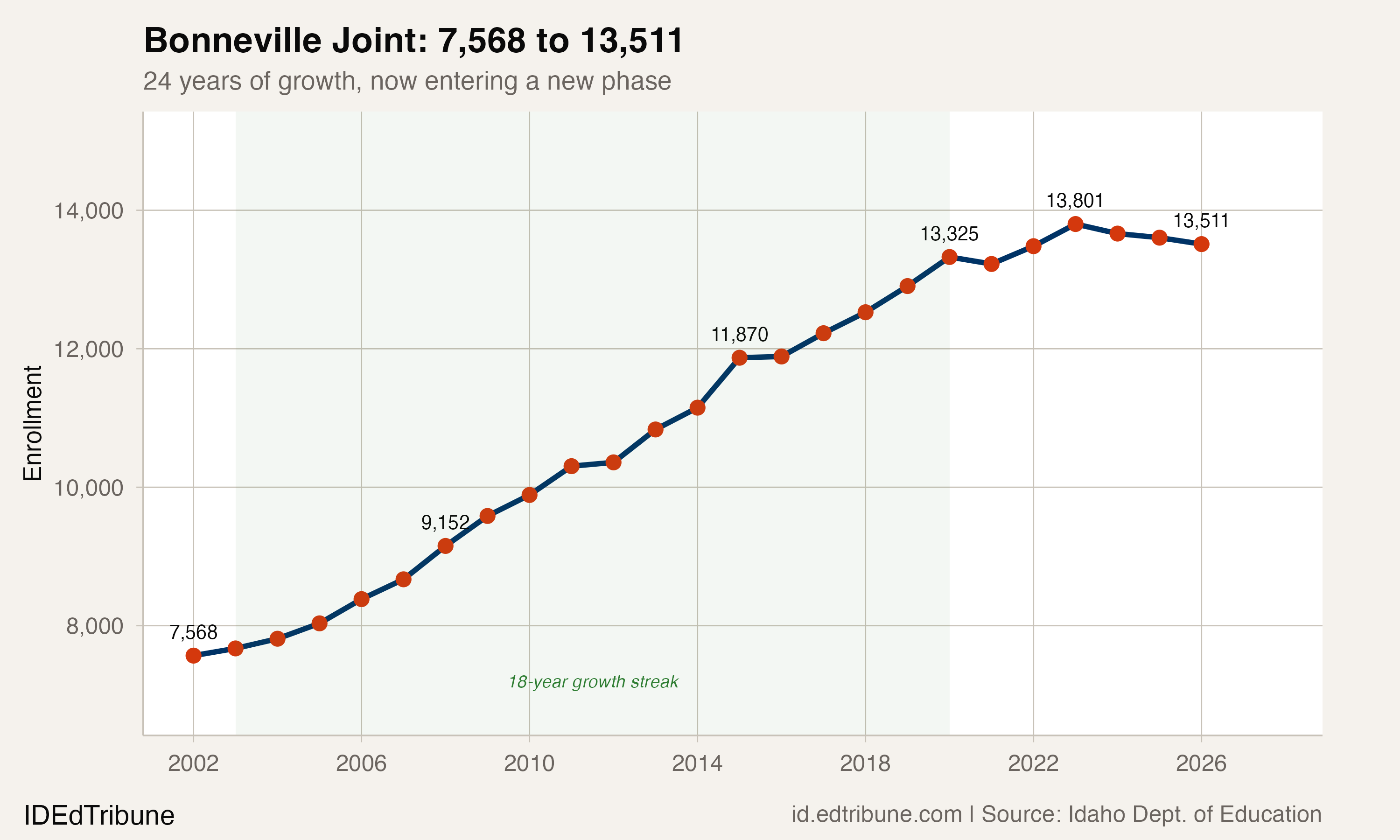
Bonneville Joint District↗ has 13,511 students. It is Idaho's third-largest district, behind only West Ada and Boise. Twenty-four years ago, it was seventh, with 7,568 students, sitting behind both Idaho Falls↗ and Pocatello↗ in eastern Idaho's enrollment hierarchy. It passed Idaho Falls in 2012 and Pocatello in 2018, by a margin of just 31 students.
The 78.5% growth rate over 24 years nearly triples the state's 27.6% gain over the same period. But the streak ended in 2024. Bonneville peaked at 13,801 in 2023 and has declined for three consecutive years, losing 290 students. The question is whether this is a pause or a turning point.
An 18-year run
From 2003 through 2020, Bonneville Joint grew every single year. The 18-year consecutive growth streak is the second-longest among Idaho districts over the period, tied with West Ada and Vallivue and trailing only Jefferson County (19 years).
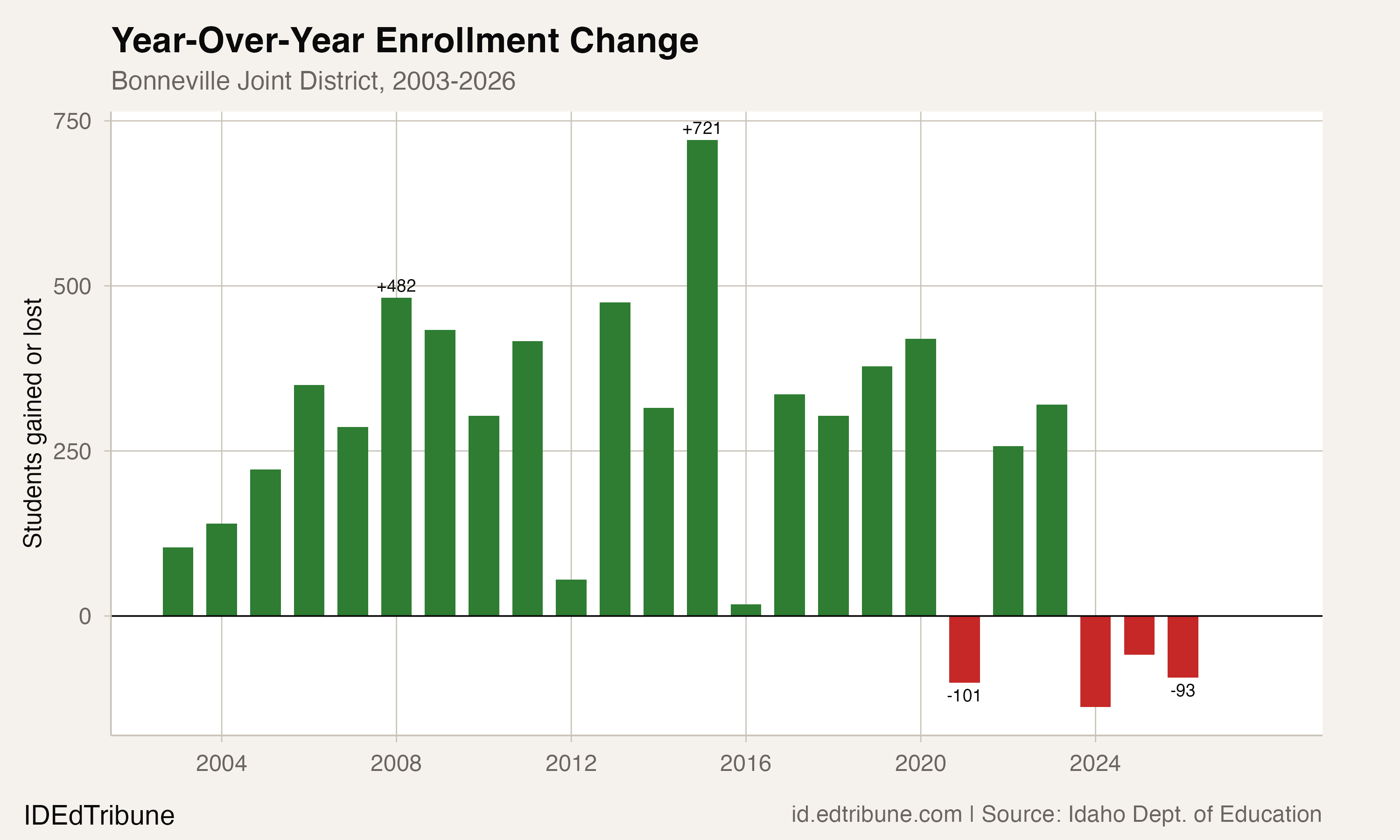
The growth came in waves. From 2002 to 2010, the district added 2,320 students (+30.7%), fueled by Idaho's pre-recession housing boom and Ammon's emergence as a bedroom community for Idaho Falls. From 2010 to 2020, another 3,437 students arrived (+34.8%), accelerating even through years when the state's growth moderated. The single largest annual gain was 721 students in 2015, a 6.5% jump over the prior year.
The district's share of Idaho's total enrollment climbed steadily: 3.1% in 2002 to 4.3% in 2026. Bonneville Joint grew faster than the state in almost every year of the streak.
The engine: Ammon and INL
Bonneville Joint District covers the communities south and east of Idaho Falls, including Ammon. Census estimates place Ammon's 2024 population at about 20,100, up from 6,187 in 2000. That 225% population increase over 24 years made it one of the fastest-growing small cities in the Mountain West.
The Idaho National Laboratory, located about 50 miles west of Idaho Falls, generates over $4 billion in annual economic impact and is one of the region's largest employers. Federal investment in nuclear research and clean energy has expanded INL's workforce over the past decade, drawing engineers and scientists with school-age children to the Idaho Falls metro area. The Idaho Falls MSA's population reached 171,233 in 2024, growing at 1.6% annually.
Proximity to BYU-Idaho in Rexburg also shapes the district's enrollment indirectly. BYU-Idaho enrolled 24,111 campus students in fall 2024, its largest incoming class ever. Many graduates settle in the Idaho Falls area, and the region's LDS population tends to have above-average family sizes, which sustained school enrollment even as birth rates fell elsewhere.
Eastern Idaho's hierarchy, rewritten
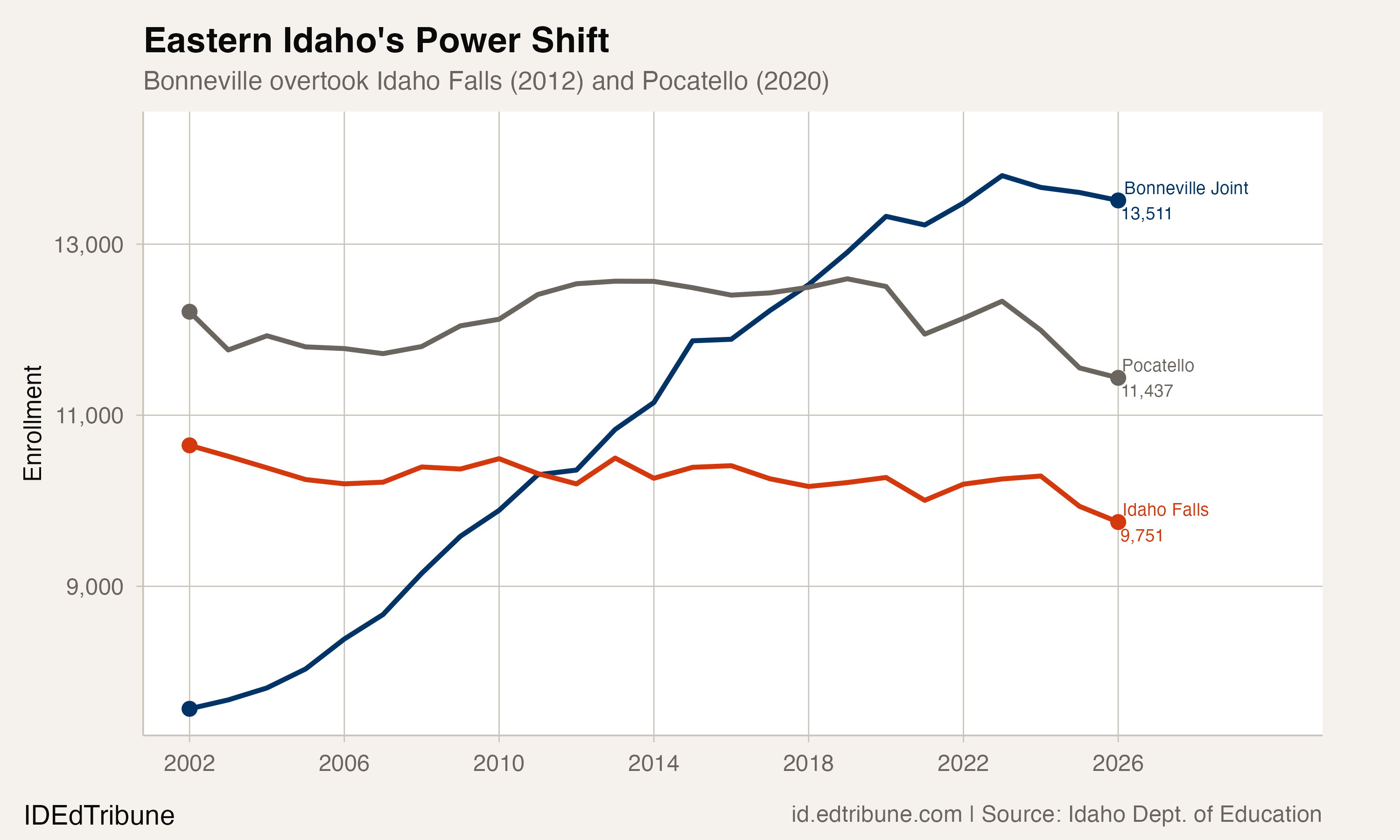
Bonneville Joint's rise reshuffled the region's enrollment rankings. In 2002, Pocatello (12,210) and Idaho Falls (10,648) were eastern Idaho's dominant districts, with Bonneville a clear third at 7,568. By 2026, the order has fully inverted: Bonneville leads at 13,511, Pocatello has dropped to 11,437 (-6.3% since 2002), and Idaho Falls has fallen to 9,751 (-8.4%).
The gap between Bonneville and Idaho Falls is now 3,760 students. In 2011, the year before the crossover, Bonneville trailed by just 14.
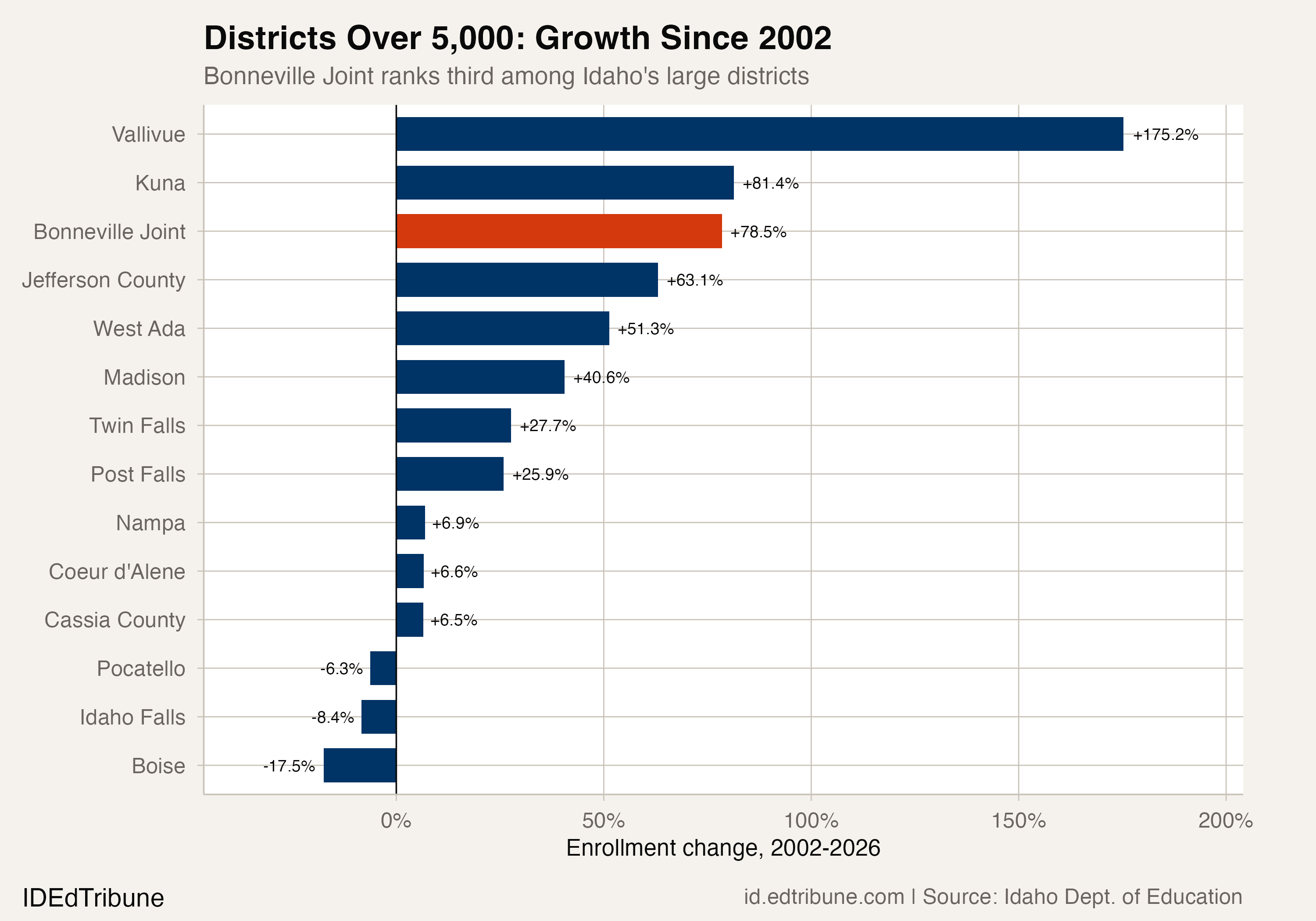
Among all Idaho districts currently enrolling more than 5,000 students, Bonneville's 78.5% growth ranks third behind Vallivue (+175.2%) and Kuna (+81.4%). Both of those are Boise-area suburbs that roughly doubled or tripled off smaller bases. Bonneville is the only district east of the Sawtooths in the top five.
Three red bars
The 2024-2026 period introduced something Bonneville had rarely experienced: consecutive decline. The district lost 138 students in 2024, 59 in 2025, and 93 in 2026. The total three-year decline of 290 students (-2.1% from peak) is mild compared to Boise's 4,604-student loss (-17.5% since 2002), but the pattern is new.
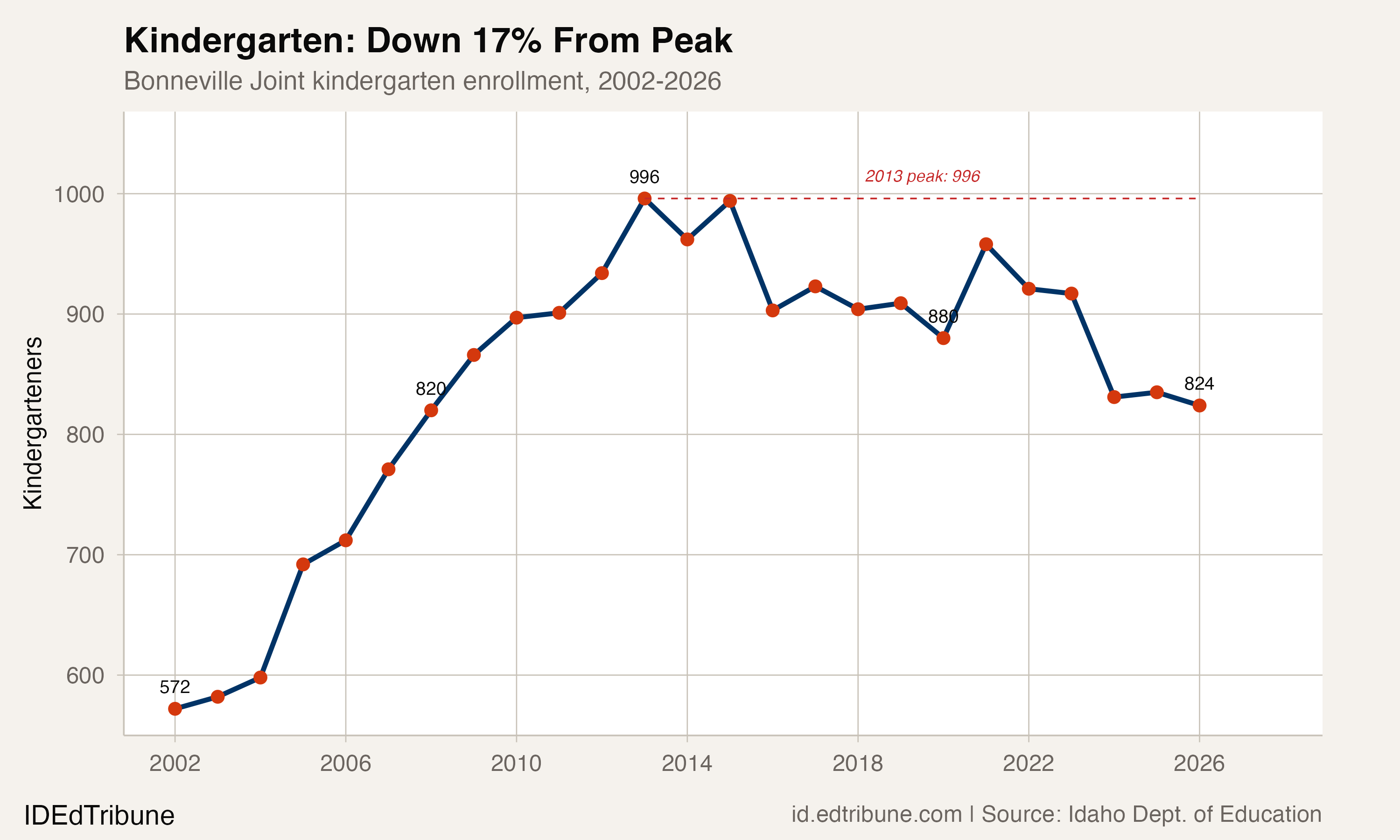
The most likely driver is the same force hitting districts statewide: fewer kindergarteners. Bonneville's kindergarten class peaked at 996 in 2013 and has not recovered. In 2026, the district enrolled 824 kindergarteners, a 17.3% decline from that peak.
Eastern Idaho's birth rate decline is steeper than the rest of the state. Idaho's overall birth rate fell 29% between 2007 and 2021, but eastern Idaho's dropped 31%, the largest regional decline. The children born during the 2007 peak are now in high school. The children born in the subsequent trough are the ones entering kindergarten.
A pipeline that tells two stories
Bonneville's grade-level data reveals a district that is simultaneously growing at the top and shrinking at the bottom. Grade 12 enrollment nearly doubled from 614 in 2002 to 1,161 in 2026, an 89.1% increase. Kindergarten grew only 44.1% over the same span, from 572 to 824.
The gap matters because today's kindergarten class becomes tomorrow's 12th-grade class. If incoming cohorts remain near 824 while graduating classes are 1,161, the district will lose roughly 300 students per cycle just from pipeline compression, even without any outmigration.
The district has been planning for continued growth. In August 2023, voters approved a $34.5 million bond to build a new 700-student elementary school near Iona. The rationale was that existing schools were at or over capacity, with several relying on portable classrooms. Whether a district that is now losing students will fill a new elementary school is an open question. It may simply relieve overcrowding at existing buildings rather than absorb new growth.
A new school for a shrinking pipeline
In August 2023, Bonneville voters approved a $34.5 million bond to build a 700-student elementary school near Iona. The rationale was that existing schools were at or over capacity, with several relying on portable classrooms. The bond passed during the district's peak year. Three consecutive declines later, the school is under construction for a district that is losing students.
It may simply relieve overcrowding at existing buildings rather than absorb new growth. The 824 kindergarteners entering in 2025-26 is the district's smallest class since 2008. INL's expansion and Ammon's housing pipeline provide structural support that Boise and Pocatello lack. But 78.5% growth over 24 years was built on a birth rate that has fallen 31% in eastern Idaho. The new elementary school will open into that arithmetic.
Detailed code that reproduces the analysis and figures in this article is available exclusively to EdTribune subscribers.
Discussion
Sign in to join the discussion.
Loading comments...