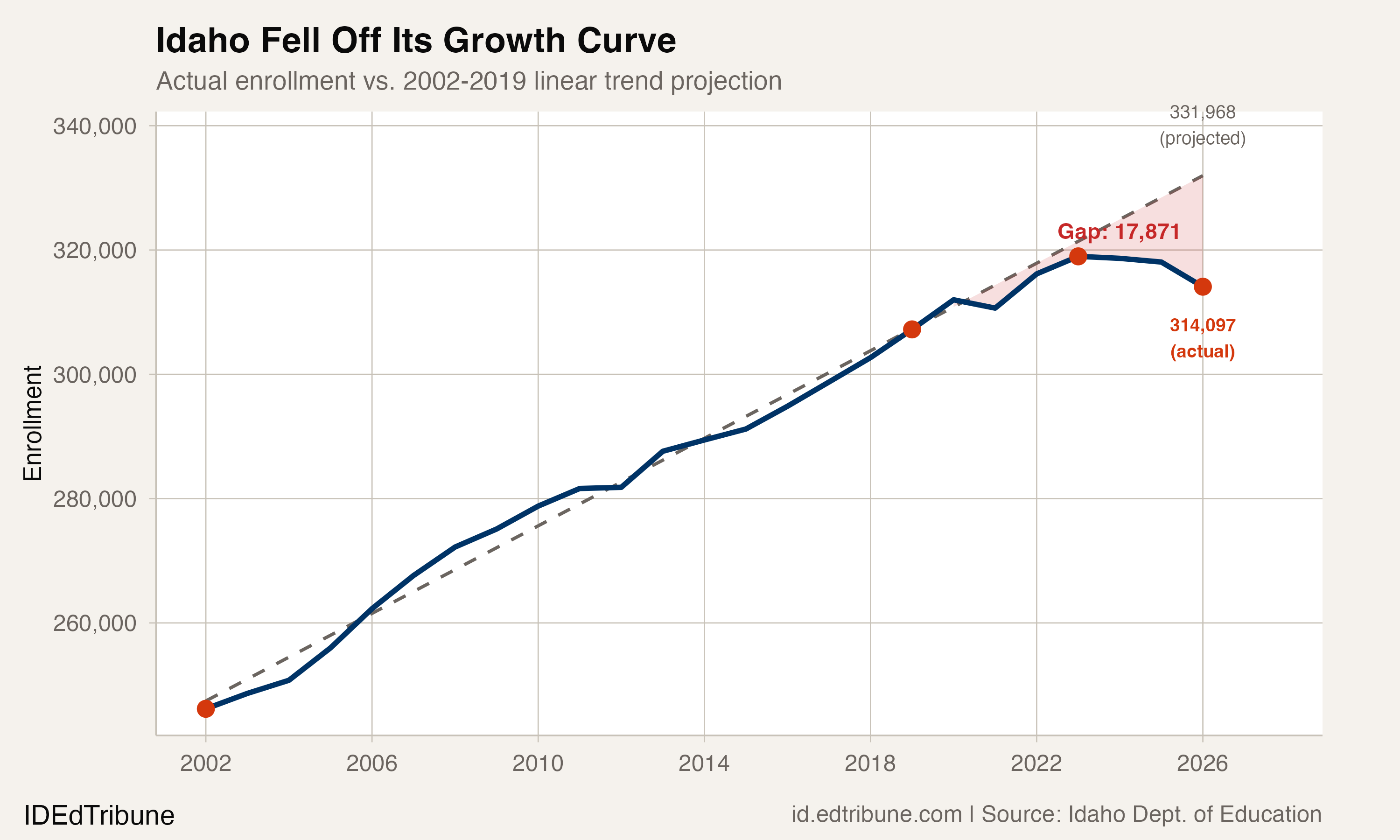
For 17 years, Idaho's public schools grew like clockwork. From 2002 to 2019, the state added an average of 3,522 students every year, a pace so steady that a simple line drawn through the data explained 98.6% of the variation. The state's enrollment rose from 246,184 to 307,228, a 24.8% gain that tracked Idaho's reputation as one of America's fastest-growing states.
If that line had continued, Idaho would have enrolled 331,968 students in 2025-26. Instead, 314,097 showed up. The gap between where Idaho was headed and where it landed is 17,871 students, and it has grown every single year since the pandemic.
Three years, twelve times the speed
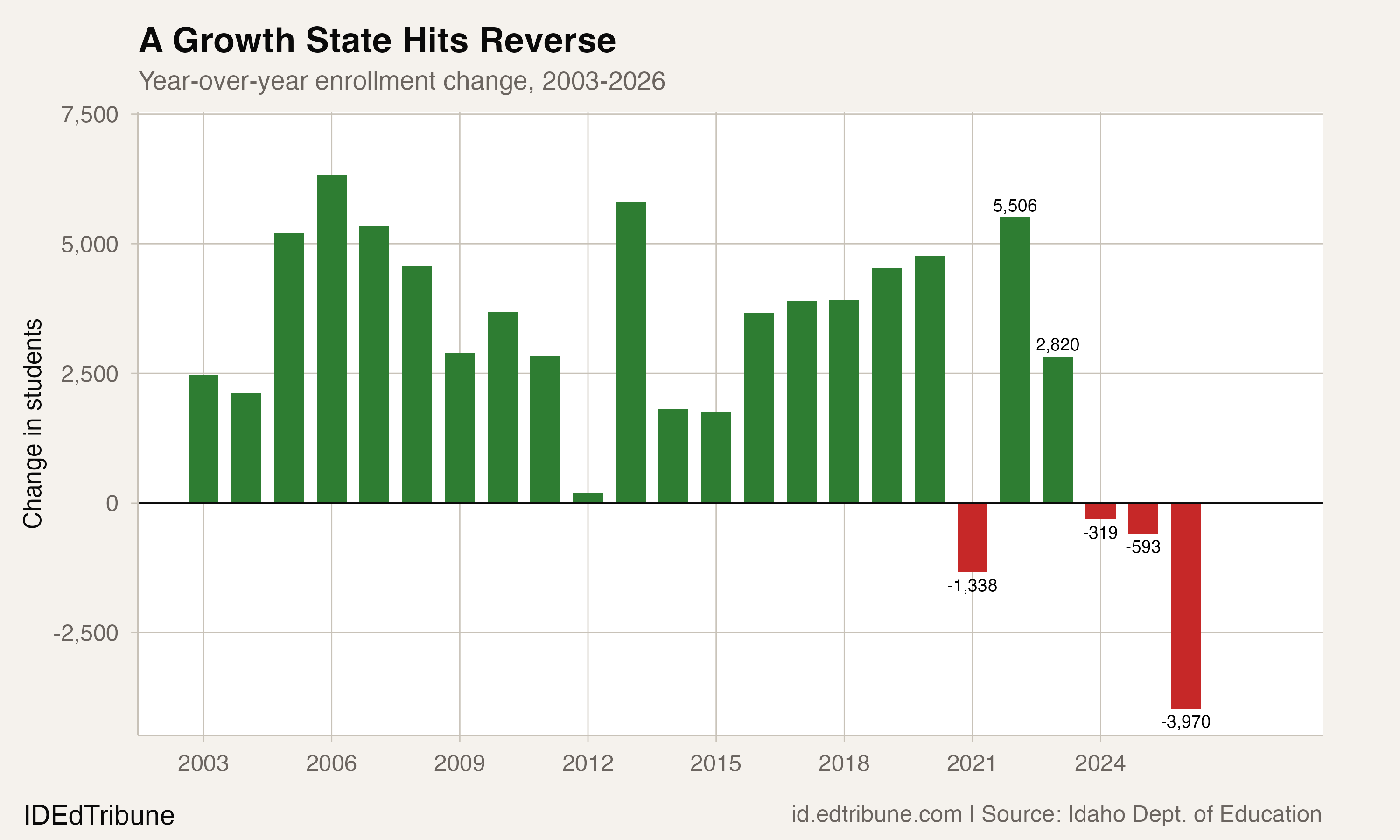
The raw totals obscure how quickly this shift happened. Idaho peaked at 318,979 students in 2022-23 and has declined every year since. But the pace of loss has accelerated sharply: 319 students in 2023-24, 593 in 2024-25, then 3,970 in 2025-26, a loss nearly seven times larger than the year before and triple the COVID-year dip of 1,338.
In 2025-26, 125 of 190 districts lost students. Only 60 gained.
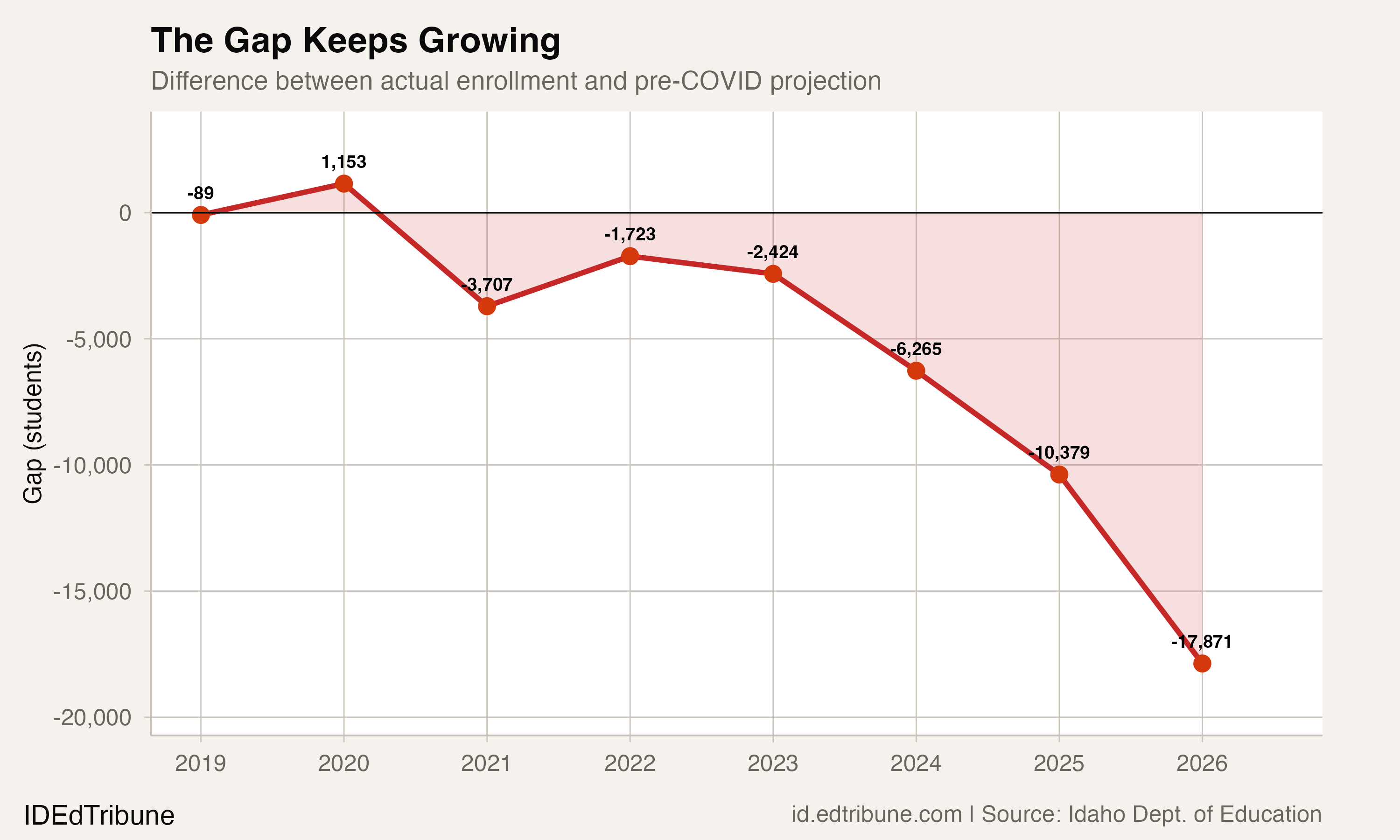
The gap from projection tells the structural story. In 2020-21, the first full pandemic school year, Idaho was 3,707 students below its trend line. That deficit partially closed in 2021-22 and 2022-23 as students returned. But starting in 2023-24, the gap began to widen again, from 2,424 to 6,265 to 10,379 to 17,871. The trajectory is not recovering. It is diverging.
The population paradox
Idaho's population surpassed two million in 2024 and continues to grow at 1.5% annually, seventh-fastest in the nation. Between 2020 and 2024, 74% of that growth came through domestic migration. The state is getting bigger. Its schools are getting smaller.
The explanation lies in who is moving to Idaho. According to Idaho Department of Labor data, youth (19 and under) contributed just 9.3% of the state's population growth between 2020 and 2024, the smallest share of any age group. Seniors grew 17.4% over the same period. Ada County, home to Boise, actually lost 891 youth during those four years even as the county's total population surged.
The Boise School District has pointed to rising housing prices, gentrification, and the fact that the district is "attracting older adults, i.e., retired individuals" rather than families. Boise Independent↗ enrolled 26,321 students in 2002, its highest mark in the dataset. By 2026, that number had fallen to 21,717, a loss of 4,604 students over 24 years. The district has declined every year since 2020-21, six consecutive years.
Rising housing costs are a direct mechanism. Since 2020, Ada and Canyon counties have gained new residents and lost public school students at a rate of nearly 14 to one.
Big districts bleed, small ones grow
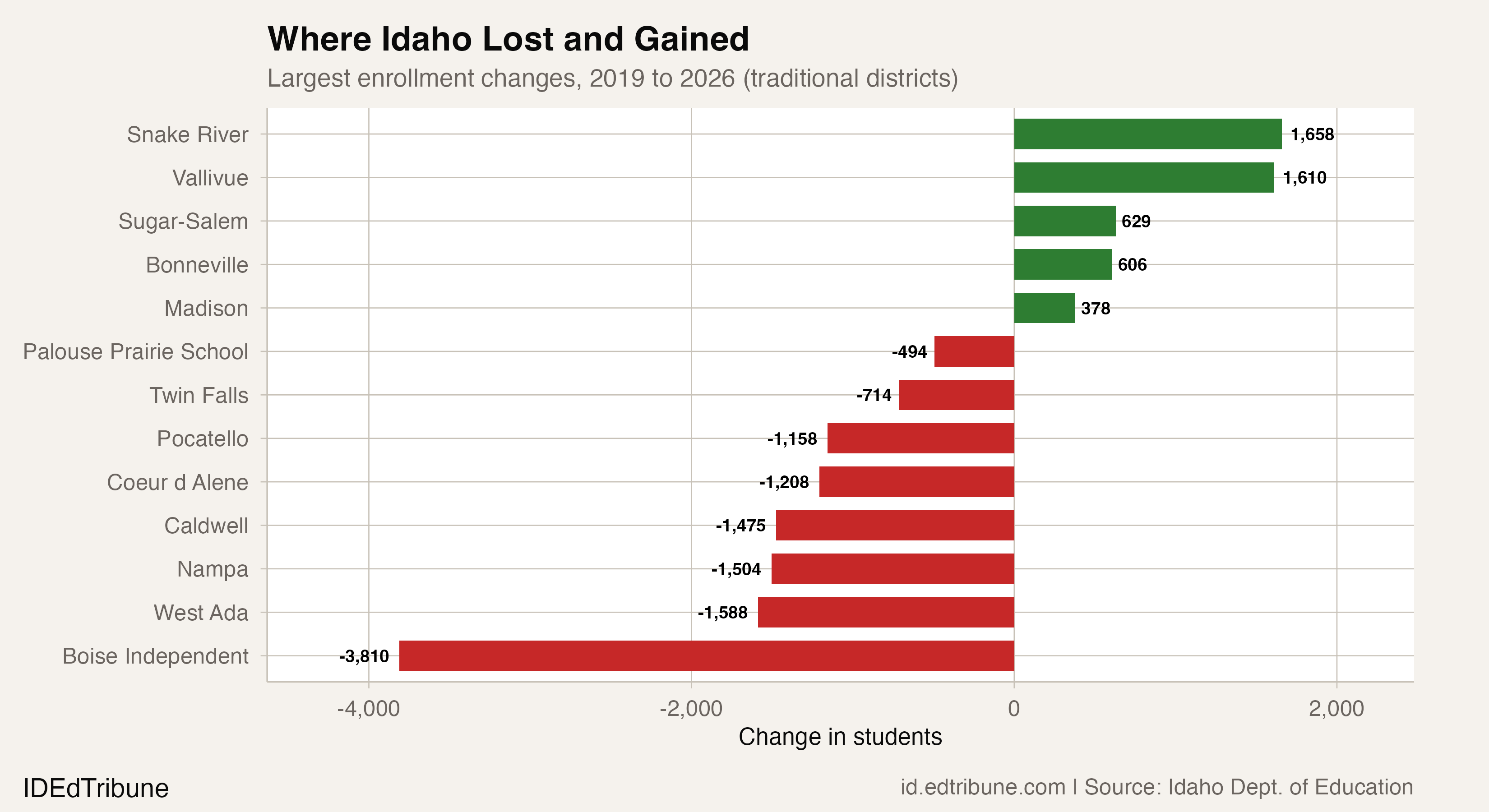
The losses are not evenly distributed. Idaho's seven largest districts (those enrolling 10,000 or more students in 2019) collectively lost 9,124 students between 2019 and 2026, a 7.3% decline. Only one of the seven, Bonneville Joint↗, grew. West Ada↗, the state's largest district, lost 1,588 students. Nampa↗ lost 1,504. Coeur d'Alene↗ lost 1,208.
Meanwhile, districts enrolling fewer than 500 students collectively grew 7.4%. Small districts (500 to 2,000) grew 5.3%. The pattern is a near-perfect inversion: the bigger the district, the worse the decline.
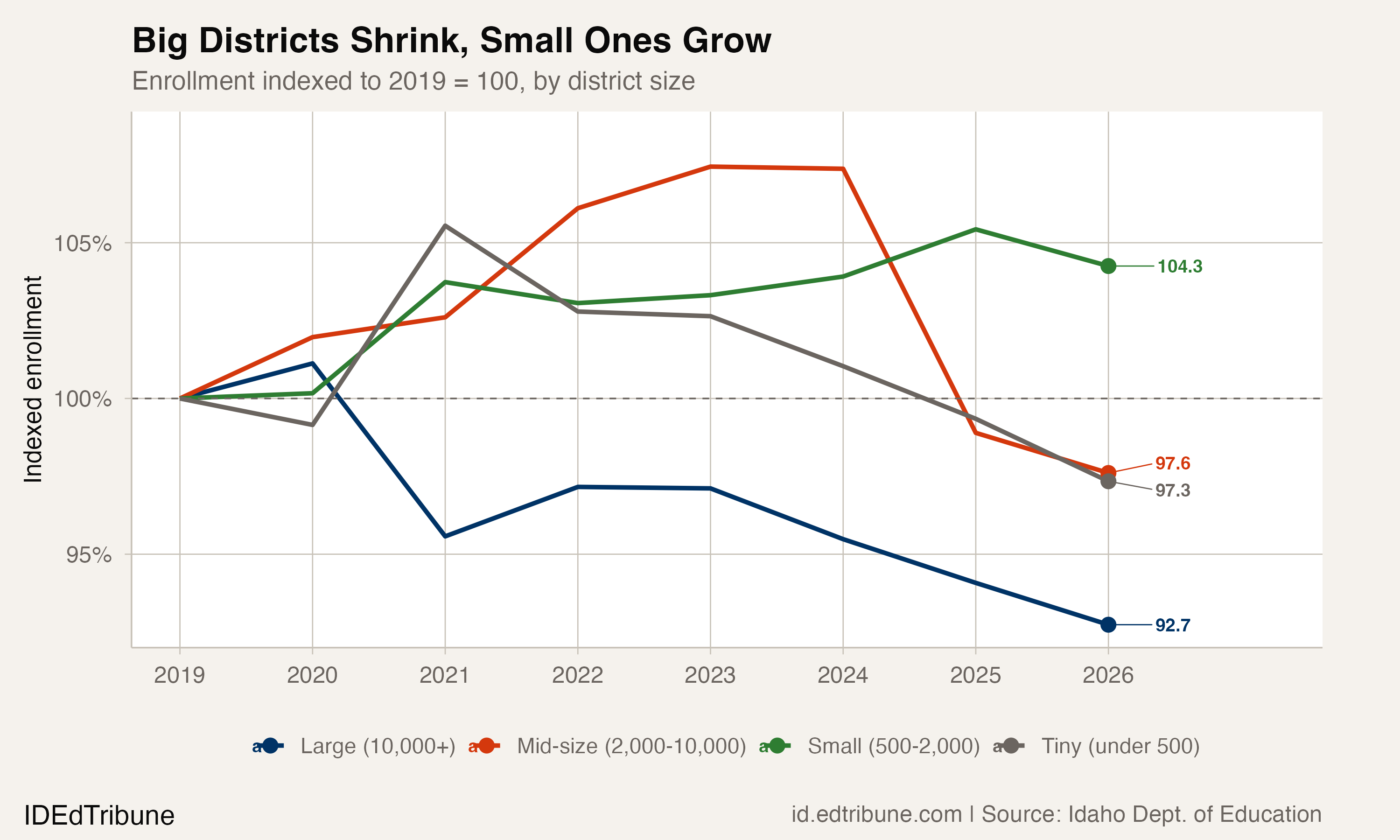
Only 46.3% of districts that existed in both 2019 and 2026 have recovered to their pre-pandemic enrollment levels. Among large districts, the recovery rate is 14.3%, meaning six of seven are smaller than they were before COVID.
Vallivue School District↗ is an outlier. Located in Caldwell, in Canyon County, Vallivue grew from 9,090 to 10,700 students since 2019, a 17.7% gain, making it one of the few mid-size districts still expanding.
The kindergarten signal
Kindergarten enrollment offers a forward-looking indicator, and in Idaho, it points down. The state enrolled 20,184 kindergartners in 2025-26, down 6.1% from 21,487 in 2018-19 and well below the 2012-13 peak of 22,537. At the other end of the pipeline, 12th grade enrollment reached 25,316, up 15.9% from 2019. Idaho's schools are graduating large cohorts built during the growth era while receiving smaller ones shaped by declining birth rates and housing affordability.
The K-to-12th-grade spread has implications for where the gap goes next. Each year's graduating class is roughly 5,000 students larger than the incoming kindergarten class. Unless kindergarten cohorts reverse course, the structural arithmetic favors continued decline.
The funding squeeze
Idaho funds schools through an attendance-based formula that distributes resources by "support units," a calculation tied to average daily attendance rather than enrollment. That formula amplifies the enrollment decline: when students leave, dollars follow, and districts that fall below attendance thresholds lose funding faster than they can cut costs.
The Idaho School Boards Association warned that the shift back to attendance-based funding after pandemic-era enrollment-based formulas could cost districts $162 million statewide:
"We knew and made our best attempts to warn state leaders that shifting back to attendance would bring a dramatic drop in how state funding is distributed." — Quinn Perry, Idaho School Boards Association, Idaho Education News
The 2025-26 enrollment decline alone reduced state funding by approximately $24 million. Bonneville Joint District Superintendent Scott Woolstenhulme told Idaho Education News in February 2026 that his district faces a $5 to $6 million shortfall: "We are cutting our budget. I think that's probably true of almost every district in the state."
Nampa closed four elementary schools in the summer of 2024. Administrators in Coeur d'Alene, Middleton, Kellogg, and Grangeville have all reported weighing budget cuts. Idaho ranks last in the nation for cost-adjusted per-pupil funding, leaving districts with little cushion when enrollment drops.
$170 million in ghost students
The 17,871-student gap is not abstract. At roughly $9,500 per student in state and local funding, it represents approximately $170 million that Idaho's funding formula was built to distribute but never will. That money was supposed to pay for teachers, bus routes, and building maintenance in a growing state. The growth stopped. The buildings remain.
Idaho does not officially track private school or homeschool enrollment. An estimated 18,000 students attend private schools, and a $50 million tax credit program now subsidizes their families' costs. Without data on how many new credits go to students leaving public schools versus those already outside, the competitive pressure remains unmeasured.
Bonneville Joint's superintendent told Idaho Education News in February that his district faces a $5 to $6 million shortfall. "We are cutting our budget," Scott Woolstenhulme said. "I think that's probably true of almost every district in the state." Sixty-one districts have now declined three consecutive years. Idaho ranks last in cost-adjusted per-pupil funding. The gap between the schools Idaho built and the schools Idaho needs widens by another 3,500 students each year.
Detailed code that reproduces the analysis and figures in this article is available exclusively to EdTribune subscribers.
Discussion
Sign in to join the discussion.
Loading comments...