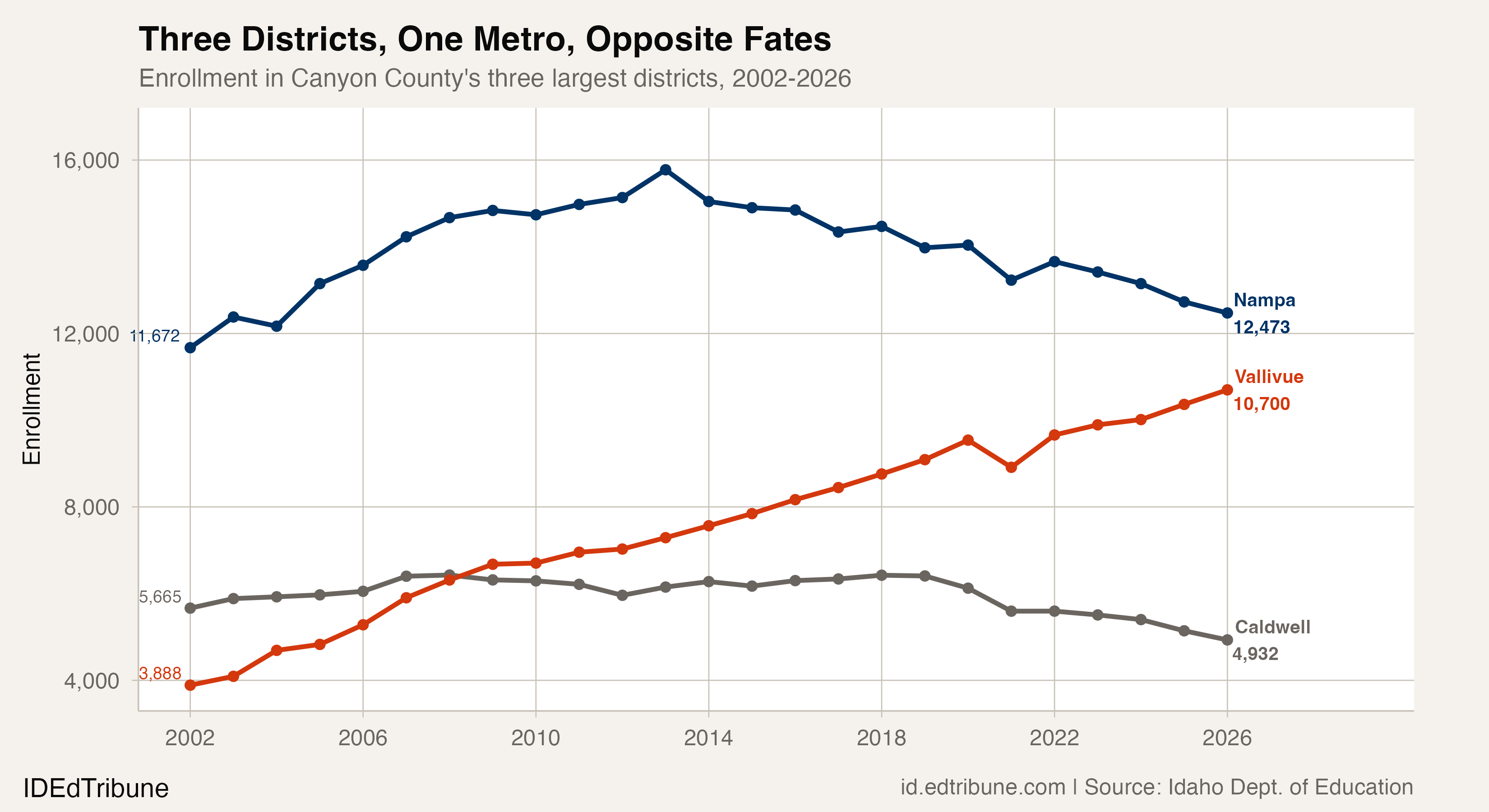
Vallivue↗ School District has nearly tripled. From 3,888 students and 20th place among Idaho districts, it has climbed to 10,700 and sixth. The gap with its neighbor Nampa↗ has closed from 7,784 students to 1,773. Vallivue was a small suburban system in the shadow of Canyon County's two established players. It is not in anyone's shadow now.
This is not a story about a state growing and all boats rising. Idaho's statewide enrollment grew 27.6% over the same period. Vallivue grew at more than six times that rate. And the two districts that share its metro area, Nampa and Caldwell↗, have been moving in the opposite direction for years.
23 growth years out of 24
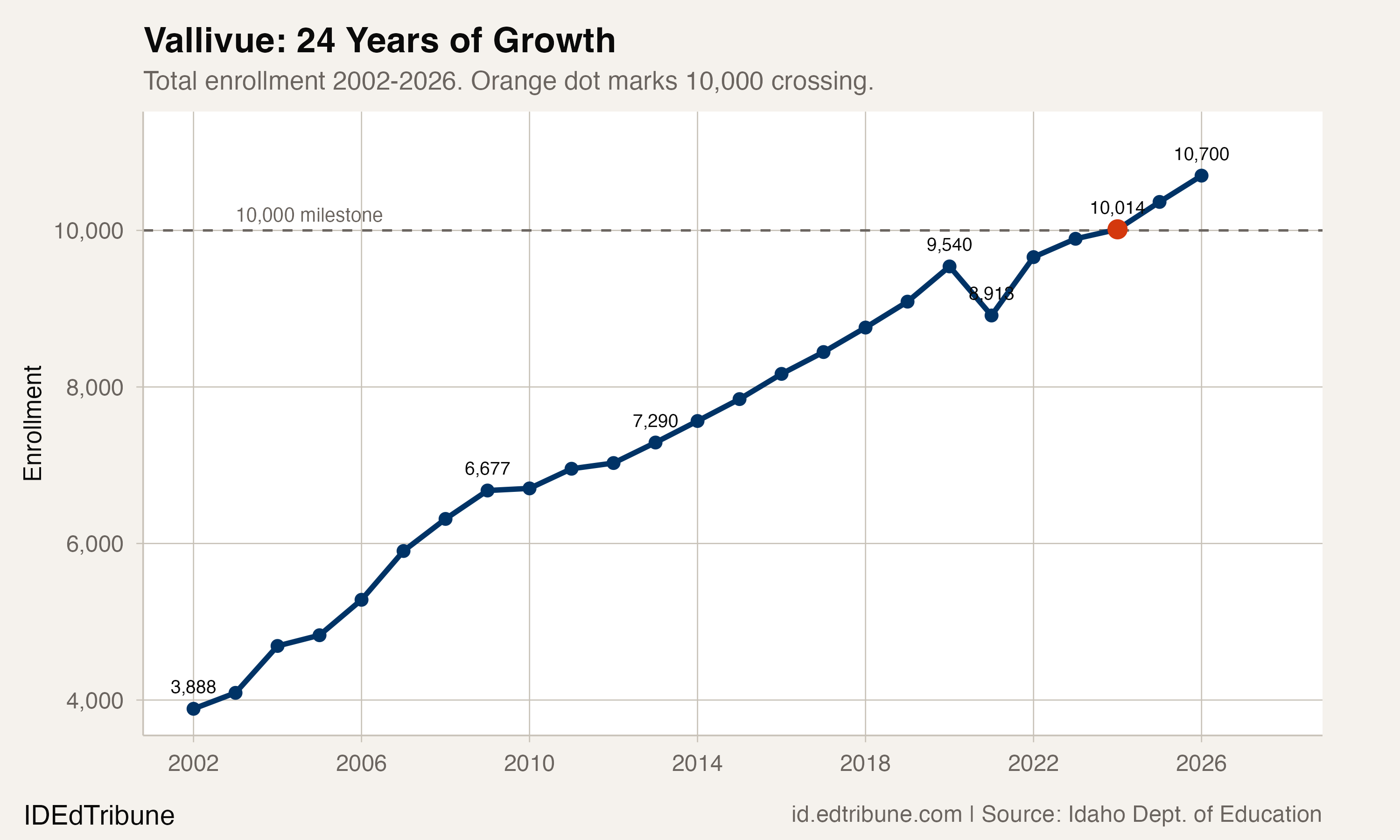
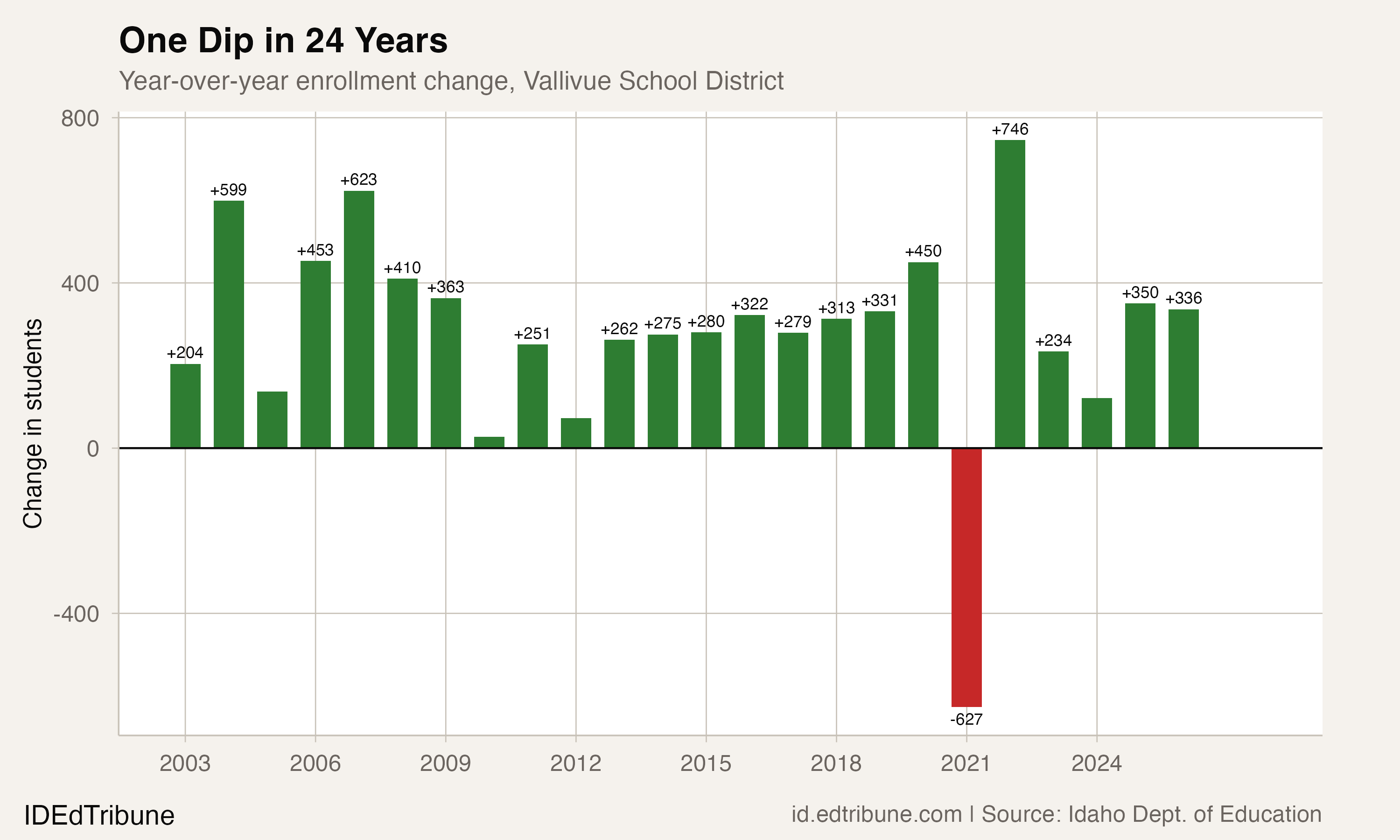
Vallivue has added students in every year since 2002 except one: the 2020-21 pandemic year, when it lost 627 students. It recovered all of them and then some by the following year, adding 746 in 2021-22 alone. By 2025-26, the district sits 1,160 students above its pre-pandemic level.
The growth has been remarkably steady. The district added an average of 284 students per year over 24 years, never posting a gain of zero, and only twice gaining fewer than 100 in a non-pandemic year. It crossed 5,000 students in 2006, 7,000 in 2012, 9,000 in 2019, and 10,000 in the 2023-24 school year.
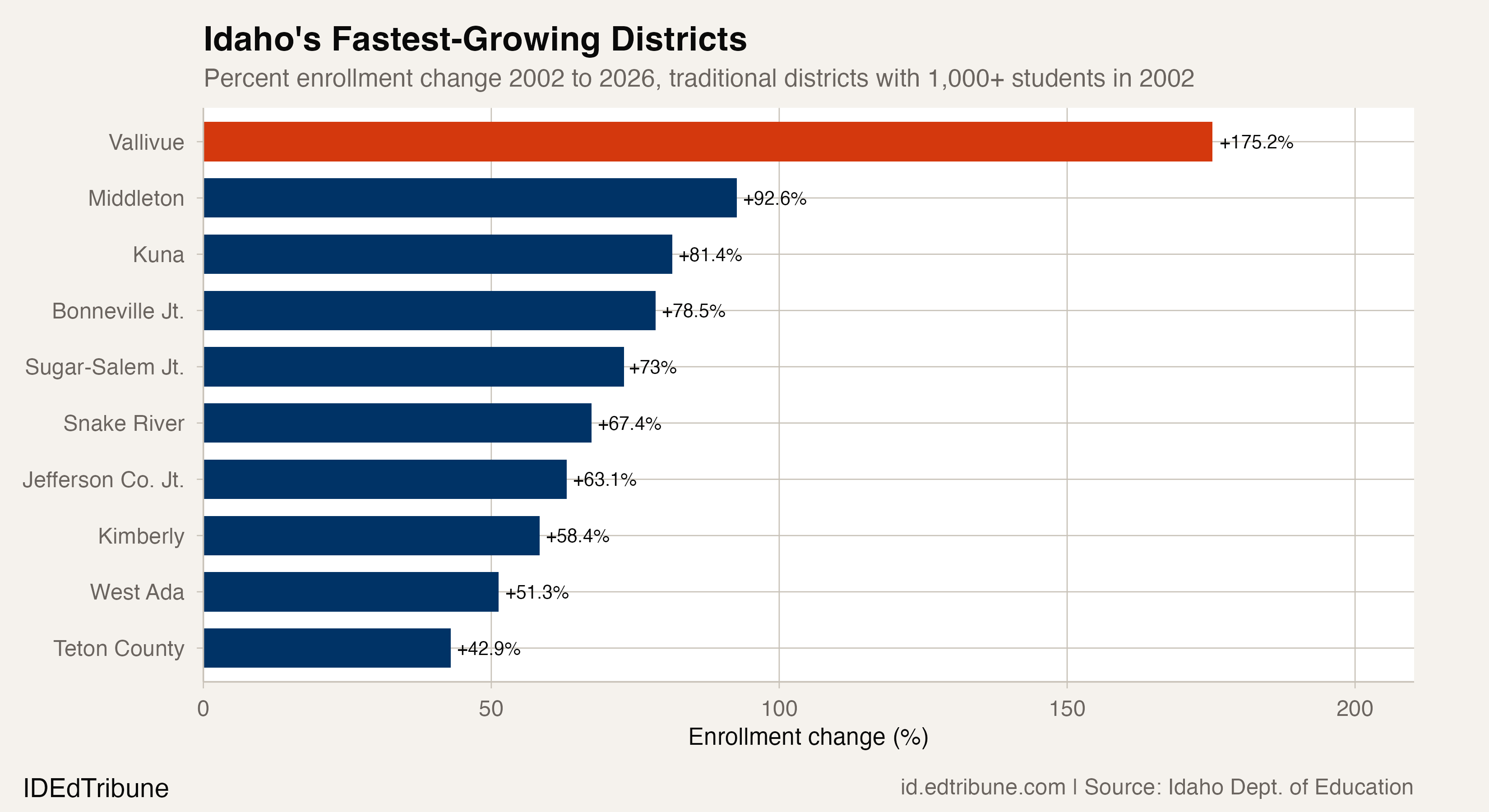
That 175.2% growth rate is not close to any peer. Among traditional Idaho districts that enrolled at least 1,000 students in 2002, the next-fastest grower is Middleton at 92.6%, followed by Kuna at 81.4%. Vallivue nearly doubled the growth rate of its nearest competitor.
Nampa closes schools, Vallivue builds them
The contrast with Nampa is the sharpest version of this story. Nampa peaked at 15,776 students in 2012-13 and has declined in 10 of the 13 years since, falling 20.9% to 12,473. Its kindergarten class dropped from 1,288 in 2013 to 850 in 2026, a 34.0% decline that signals the pipeline will not refill soon.
In December 2023, Nampa's school board voted to close four schools: Centennial Elementary, Snake River Elementary, Greenhurst Elementary, and West Middle School. The district faced $149 million in deferred maintenance across its aging building stock. Spokesperson Matt Sizemore told Idaho EdNews that with classrooms holding fewer students, "the cost ratio was not basically making sense."
Caldwell's trajectory is less dramatic but equally persistent. It peaked at 6,428 in 2007-08 and has lost students in 12 of the 18 years since, falling 12.9% to 4,932. Vallivue surpassed Caldwell in 2009 and now enrolls more than twice as many students.
Meanwhile, Vallivue voters in 2023 approved a $78 million bond to build two new elementary schools, Warhawk and Falcon Ridge, which opened for the 2025-26 school year. The district also purchased 87 acres on its western edge for future school sites.
"It's just a vicious cycle. But for the time being, having something is better than nothing." -- Joseph Palmer, Vallivue assistant superintendent, Idaho EdNews, July 2025
District projections show both new schools filling within five years, with most Vallivue campuses over capacity again by 2029.
Where the growth is going
The market share numbers quantify the shift. In 2002, Vallivue accounted for 18.3% of the combined enrollment of Canyon County's three largest districts. Nampa held 55.0% and Caldwell 26.7%. By 2026, Vallivue has climbed to 38.1%, Nampa has dropped to 44.4%, and Caldwell has fallen to 17.5%.
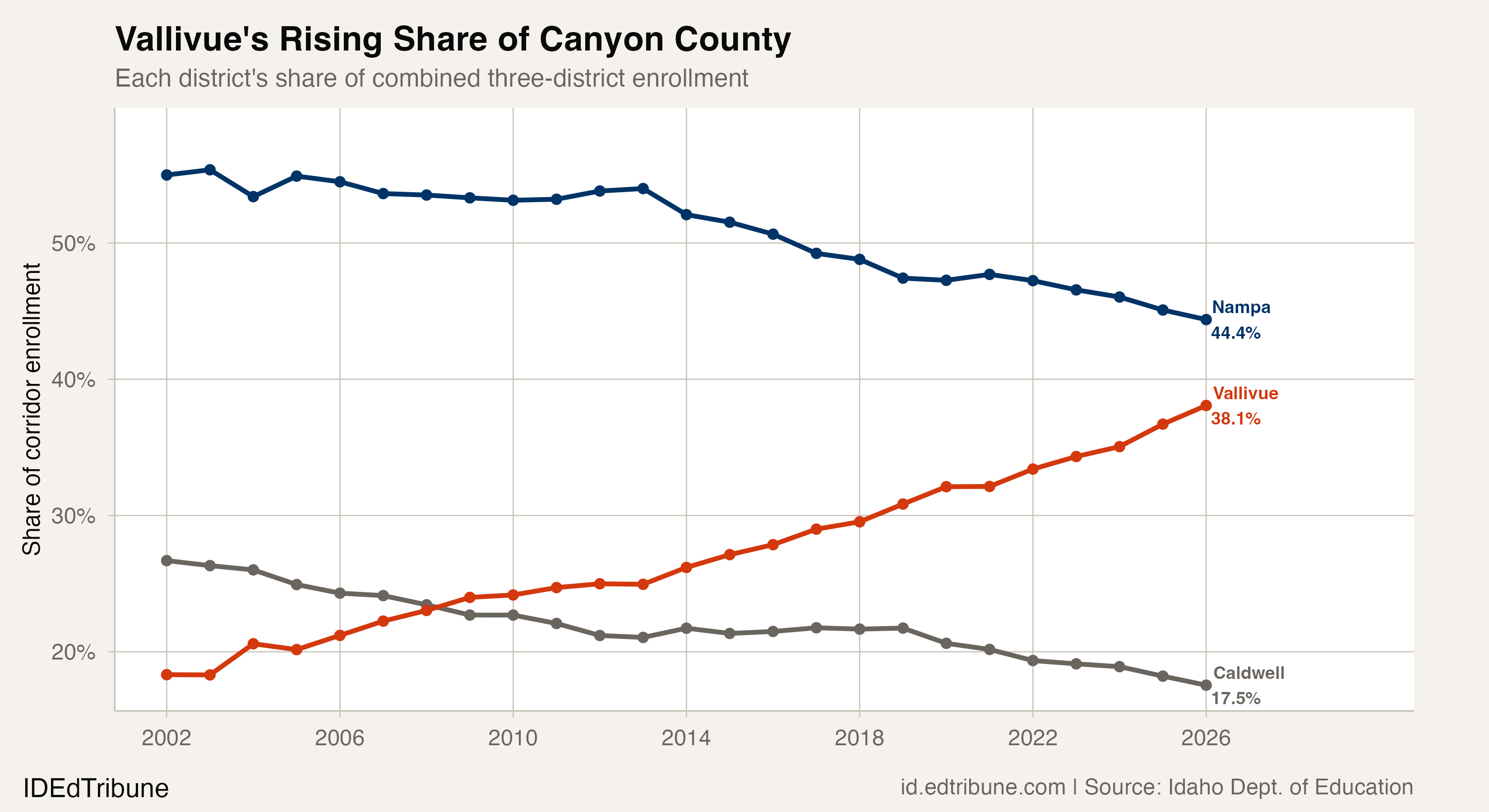
The total enrollment across all three districts has actually declined from its 2013 peak of 29,217 to 28,105 in 2026. Canyon County's student population is not growing. It is redistributing.
The most plausible driver is residential development patterns. Nampa and Caldwell are older cities with built-out cores. New housing construction in Canyon County has concentrated on the periphery, much of which falls within Vallivue's boundaries. The district sits between the two cities and captures growth from subdivisions spreading west from the Boise metro.
Idaho's in-migration compounds the pattern, but not in the way it might seem. Ninety percent of the state's population growth from 2019 to 2022 came from adults over 18, not families with school-age children. The state's share of residents under 18 fell from 25.1% to 23.9% over that span. New residents are landing in new construction, which benefits Vallivue. But they are not, on average, bringing students with them, which means the district's growth is coming disproportionately from young families choosing new subdivisions over established neighborhoods.
An alternative explanation is school choice: families within the overlapping commuting area may be selecting Vallivue over Nampa or Caldwell based on perceived quality or newer facilities. Idaho's enrollment data does not track inter-district transfers, so the relative contribution of boundary-driven growth versus family choice cannot be separated from these numbers alone.
The capacity question
Statewide, Idaho's enrollment has plateaued. After climbing from 246,184 in 2002 to a peak of 318,979 in 2022-23, the state total has slipped to 314,097. Idaho's birth rate fell from 16.6 per 1,000 in 2007 to 11.8 in 2021, a 29% decline. The largest enrolled class statewide in 2022-23 was ninth graders, born during the 2007 baby boom. First graders numbered roughly 3,000 fewer.
That statewide headwind makes Vallivue's sustained growth more unusual and more dependent on continued in-migration. If the flow of new construction into the district's attendance area slows, the underlying birth rate trend will catch up. The district's own projections assume it will not slow. Residential development continues to press into the district. One project alone, Verbena Ranch, will add more than 1,000 homes on Vallivue's western edge.
Warhawk Elementary and Falcon Ridge Elementary opened in August 2025, the product of a $78 million bond that passed on its third attempt. Both schools are projected to fill within five years. The district has already purchased 87 acres on its western edge for whatever comes after them. Verbena Ranch, a 1,000-home development, is rising on Vallivue's boundary. The bond is not yet paid off. The next one is already being planned.
Detailed code that reproduces the analysis and figures in this article is available exclusively to EdTribune subscribers.
Discussion
Sign in to join the discussion.
Loading comments...