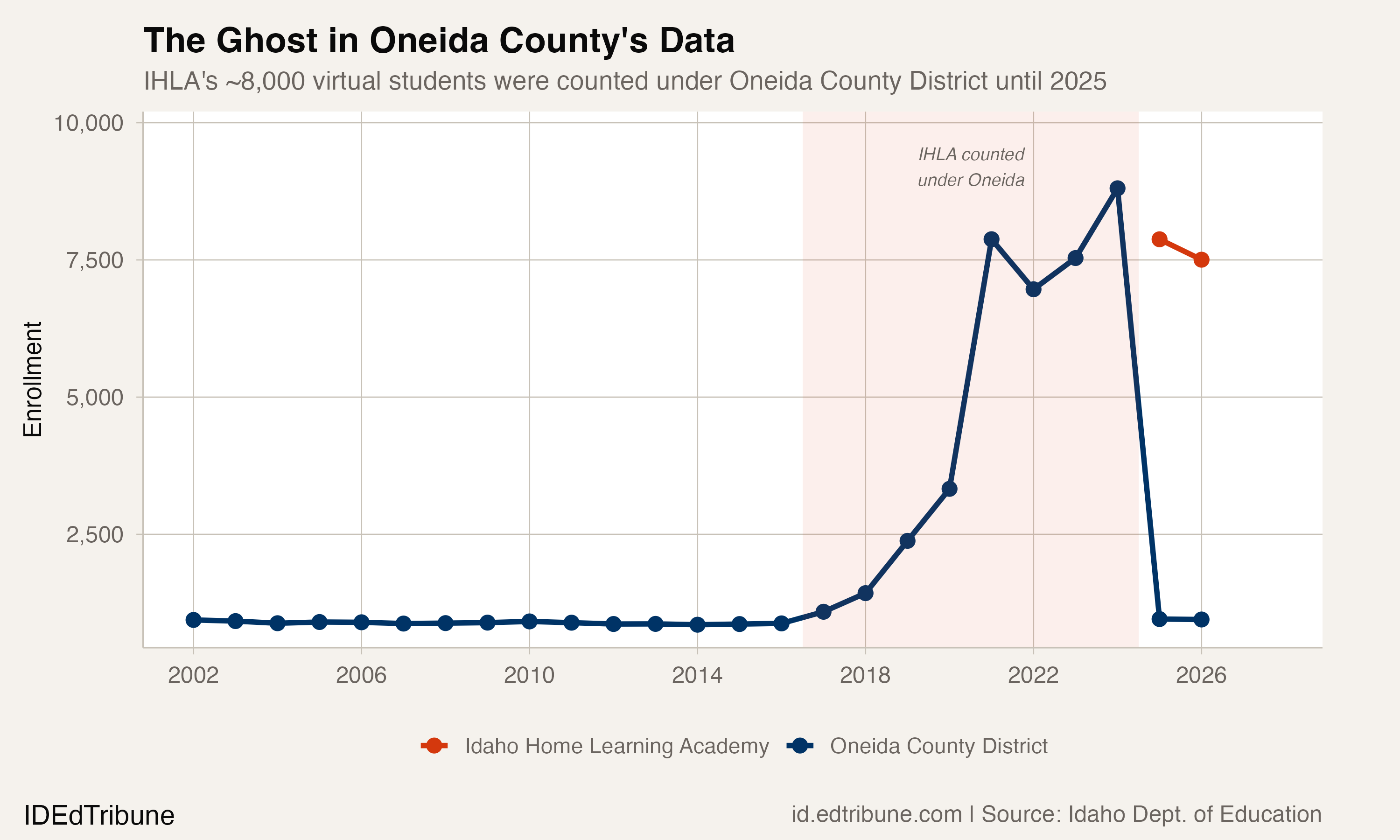
For years, Oneida County District↗ appeared to be one of Idaho's most remarkable growth stories. A rural district near the Utah border with roughly 880 students in 2016, it ballooned to 8,805 by 2024, a tenfold increase that would have been the envy of any boomtown suburb.
It was a mirage. Those students were never sitting in Oneida County classrooms. They were scattered across the state, logging into a virtual program called Idaho Home Learning Academy↗, which operated as an in-district online school under Oneida's umbrella. When IHLA formally separated and became a charter school in 2024-25, Oneida County dropped back to 956 students, and a new entity materialized in the enrollment data: 7,876 students in 2025, declining to 7,504 in 2026. No physical campus. No school bus. A $47.8 million annual budget.
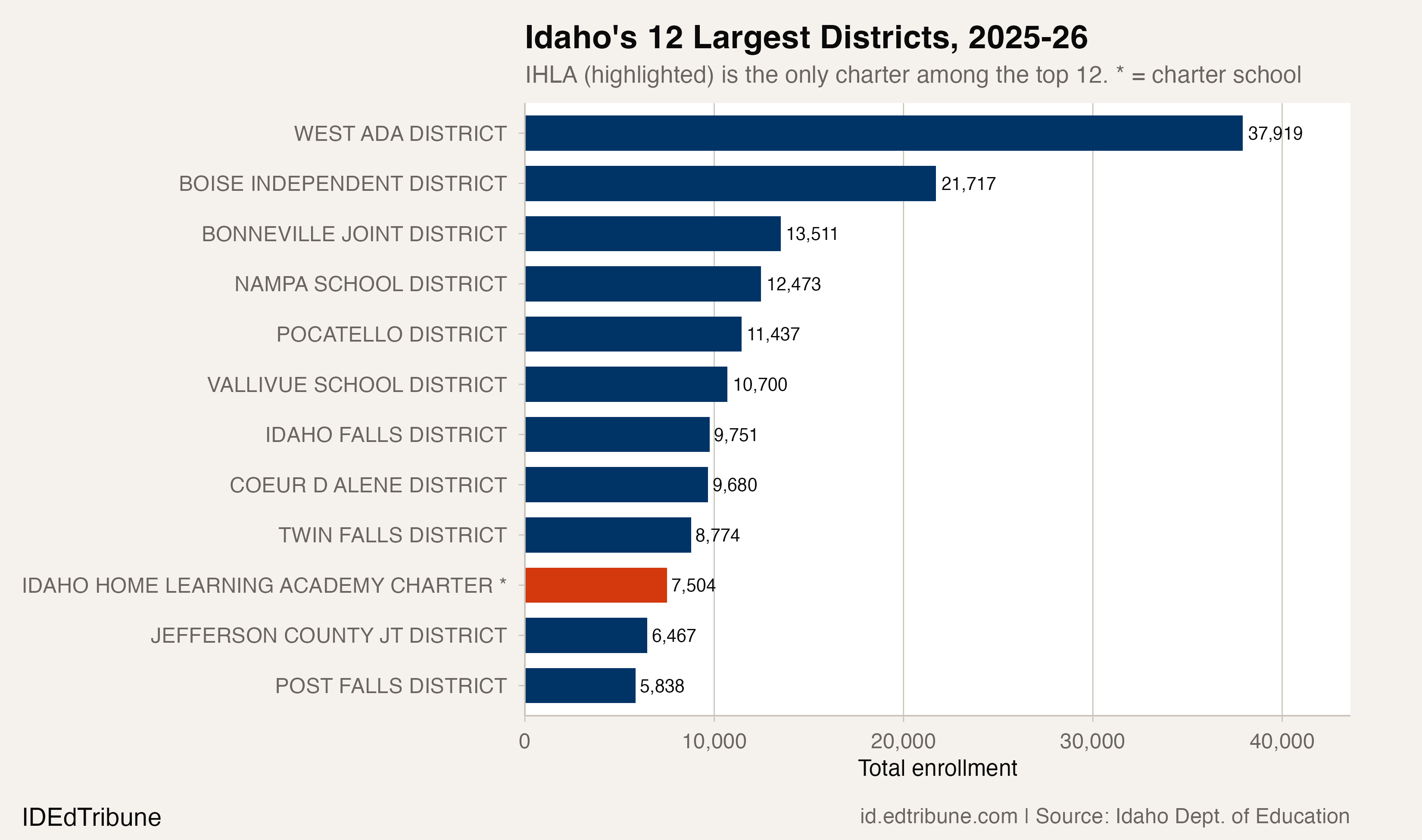
IHLA is now Idaho's 10th largest district. It is larger than 182 of the state's 192 districts, 94.8% of them. It enrolls nearly five times as many students as the next-largest charter school, Inspire Virtual Charter, which has 1,553.
The reclassification that rewrote the charter sector
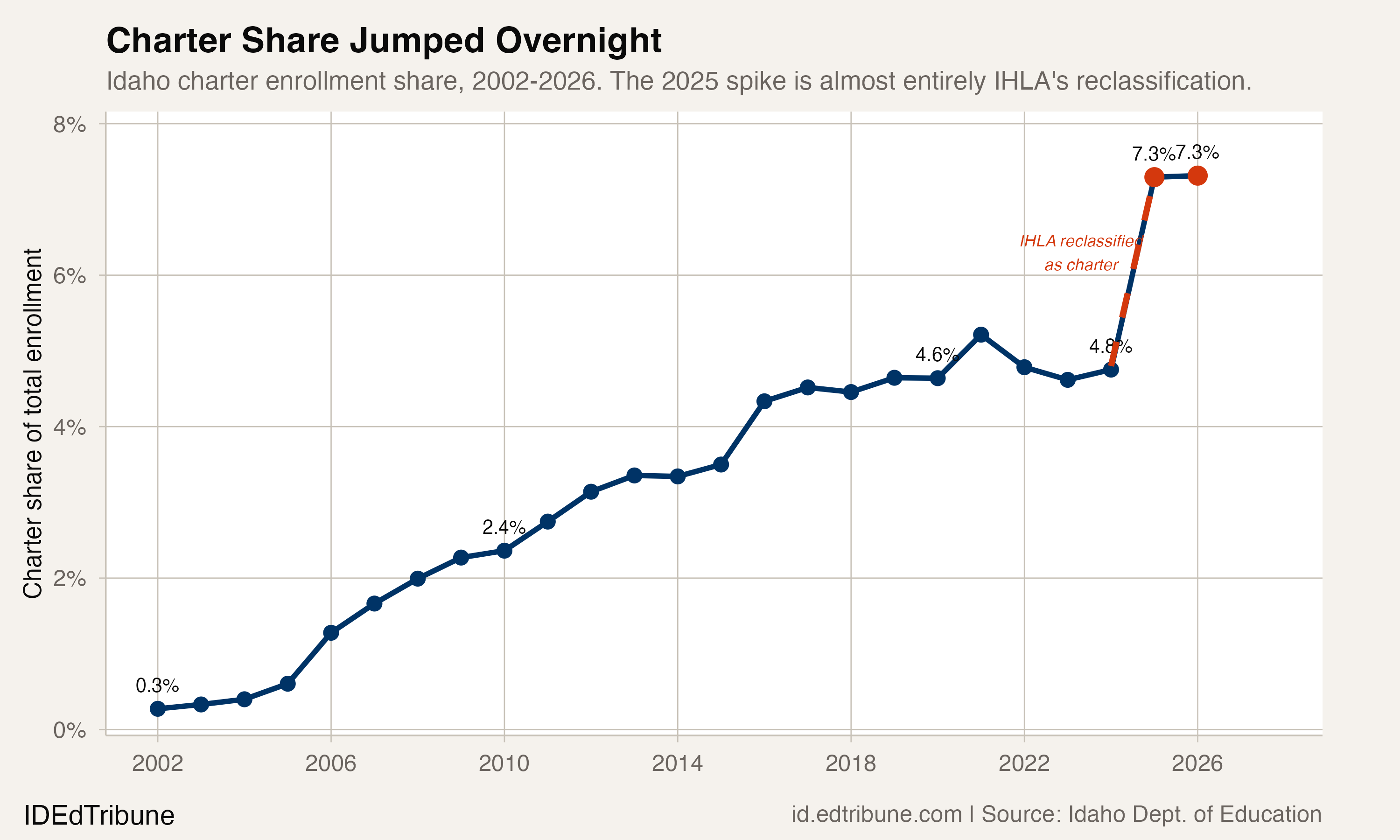
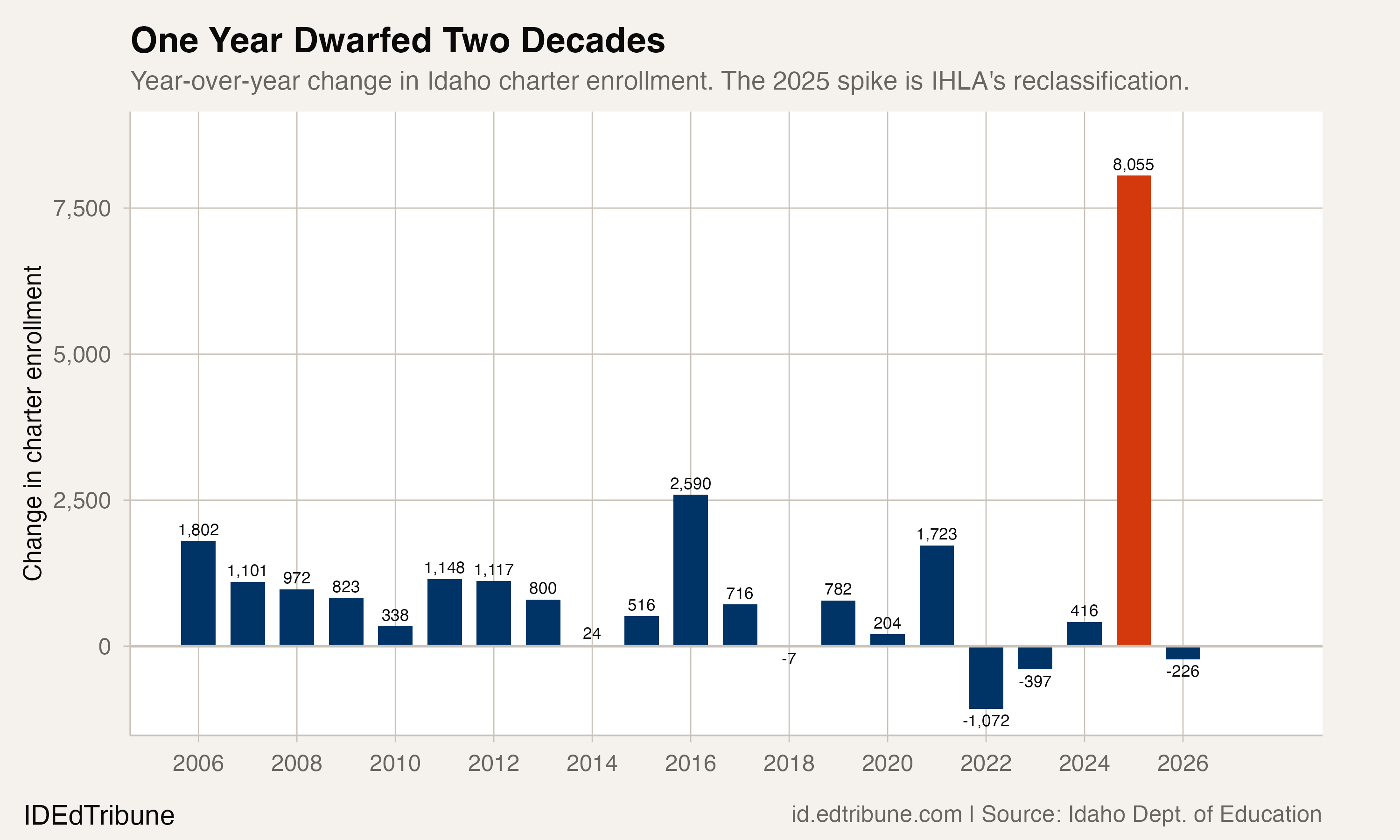
IHLA's formal separation did not create new students. It reclassified existing ones. But the statistical effect was seismic: Idaho's charter enrollment share jumped from 4.8% in 2024 to 7.3% in 2025, an overnight increase that took the broader charter sector 20 years to build organically. IHLA accounted for 97.8% of the charter enrollment gain between 2024 and 2025. Strip IHLA out, and charter enrollment grew by just 179 students that year.
The 32 charter schools counted in the state data enrolled 22,974 students in 2025-26. IHLA alone accounts for 32.7% of that total. Two virtual charters, IHLA and Inspire Virtual, together enroll 9,057 students, or 39.4% of all charter enrollment in Idaho.
A school without a building, a district without a rival
IHLA slots into the enrollment rankings between Twin Falls (8,774) and Jefferson County (6,467). The nine districts above it, from West Ada (37,919) to Twin Falls, all operate physical school buildings, employ full-time teachers, and run transportation systems. IHLA does none of these things at traditional scale.
The school's staffing model is built on part-time labor. The state funded 373 full-time teaching positions at IHLA, but the school filled just 232 jobs, most of them part-time. Its kindergarten through eighth grade instructional model relies heavily on parent-directed learning, with teachers typically offering feedback and oversight rather than direct instruction.
The high school cliff
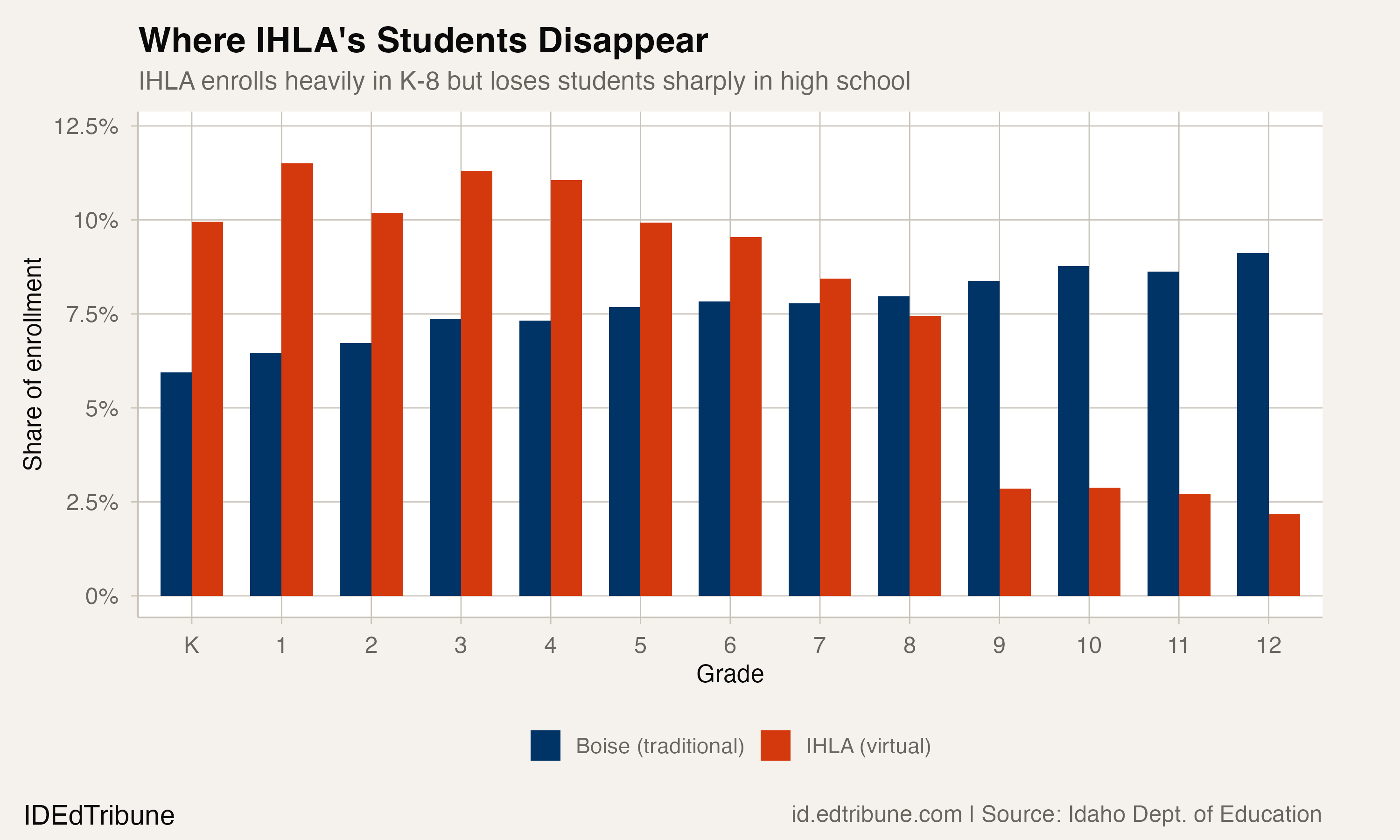
IHLA's grade distribution reveals a school that families choose for elementary education and abandon before high school. In 2025-26, 89.4% of IHLA's students are in grades K-8. Only 10.6% are in grades 9-12. At Boise Independent, that split is roughly 65% K-8 and 35% 9-12.
The drop-off is steep: IHLA enrolls 747 kindergartners but only 214 ninth graders, 28.6% as many. By 12th grade, enrollment falls to 164. The pattern suggests families turn to IHLA for the flexibility it offers younger students, especially in the homeschool-hybrid model, then transition to brick-and-mortar schools when coursework demands shift in high school. It also raises questions about whether the parent-directed model that structures K-8 instruction can sustain students through more complex secondary curricula.
What $47.8 million buys
The nonpartisan Idaho Office of Performance Evaluations released a 129-page evaluation of IHLA in December 2025. The findings were pointed. Of IHLA's total expenditures, 45%, or $20.6 million, went to three private education service providers. Another $12.6 million was distributed to families as supplemental learning funds, roughly $1,700 to $1,800 per household.
The report found no auditing system for vendor reimbursements. Families used the funds for water park admissions, streaming services, paddleboards, and plush toys. At least $92,000 went to private school tuition and programs. Parents could return taxpayer-funded items and keep the refunds. Vendors retained unspent supplemental funds.
"Statutory safeguards are insufficient, oversight is inconsistent, and accountability measures have not kept pace." — Gov. Brad Little, December 2025
IHLA's test scores compound the scrutiny. On the 2024-25 Idaho Standards Achievement Test, 42% of IHLA students scored proficient in English language arts, compared to 52% statewide, a 10-point gap. In math, 25% scored proficient versus 43% statewide, an 18-point gap. IHLA's executive director has acknowledged that math is a "struggle," noting that parents often have difficulty helping their children with math assignments.
Legislative reckoning
The OPE report triggered bipartisan legislative action. A bill co-sponsored by Rep. Douglas Pickett (R-Oakley) and Rep. Sonia Galaviz (D-Boise) would require board-approved contracts with education service providers, mandate that curricular materials meet state content standards, and restrict how families spend supplemental learning funds to a defined list: computer hardware, internet access, textbooks, testing fees, therapies, and State Board-approved services.
"This bill will provide clarity, transparency and accountability to the processes that virtuals follow." — Rep. Douglas Pickett, February 2026
Governor Little went further, proposing a $23 million cut to virtual school funding: $20 million from supplemental learning funds and $3 million from transportation. According to the OPE report, 71% of IHLA parents said they would pull their children from the school if the supplemental payments disappeared, a figure that raises questions about how central the financial incentive is to families' enrollment decisions.
71% would leave
IHLA lost 372 students between 2025 and 2026, a 4.7% decline. The OPE report found that 71% of IHLA parents said they would pull their children if the supplemental payments disappeared. Governor Little has proposed cutting $20 million from those payments. Rep. Pickett's bill would restrict eligible purchases to computers, textbooks, and therapies.
If both measures pass, IHLA's enrollment could contract by thousands in a single year. The 7,504 students counted at IHLA today generate $47.8 million in state funding. Much of that would follow them, wherever they land. Idaho's broader virtual sector, 32 schools serving more than 18,500 students, is not defined by IHLA's spending problems. But IHLA is the reason the legislature is paying attention, and the oversight framework it builds will shape every virtual school that comes after it.
Detailed code that reproduces the analysis and figures in this article is available exclusively to EdTribune subscribers.
Discussion
Sign in to join the discussion.
Loading comments...