In the shadow of Nampa's four closed elementary schools, the Vallivue School District↗ broke ground on two new ones. The districts share a border. They do not share a trajectory.
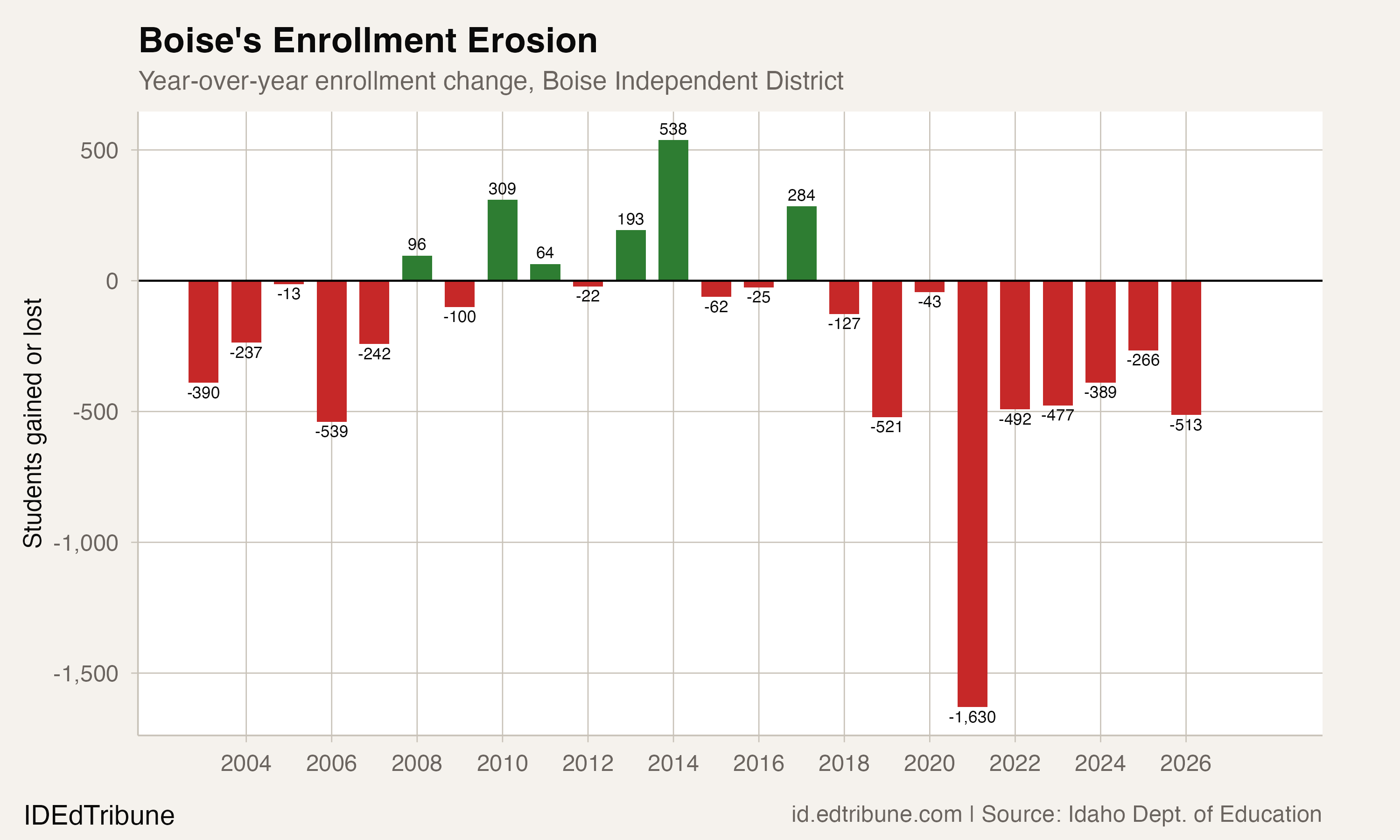
Vallivue has grown from 3,888 students to 10,700 since 2002, a 175.2% increase that has made it one of the fastest-expanding districts in Idaho. Across the Treasure Valley, Boise Independent District↗ has moved in the opposite direction, losing 4,604 students over the same period, a 17.5% decline from its 2002 enrollment of 26,321. The state's capital city school district now enrolls fewer students than at any point in the 25-year dataset.
The pattern is a suburban donut: families and enrollment flowing outward from the urban core to the suburban fringe, hollowing out the center while inflating the edges.
The Donut Takes Shape
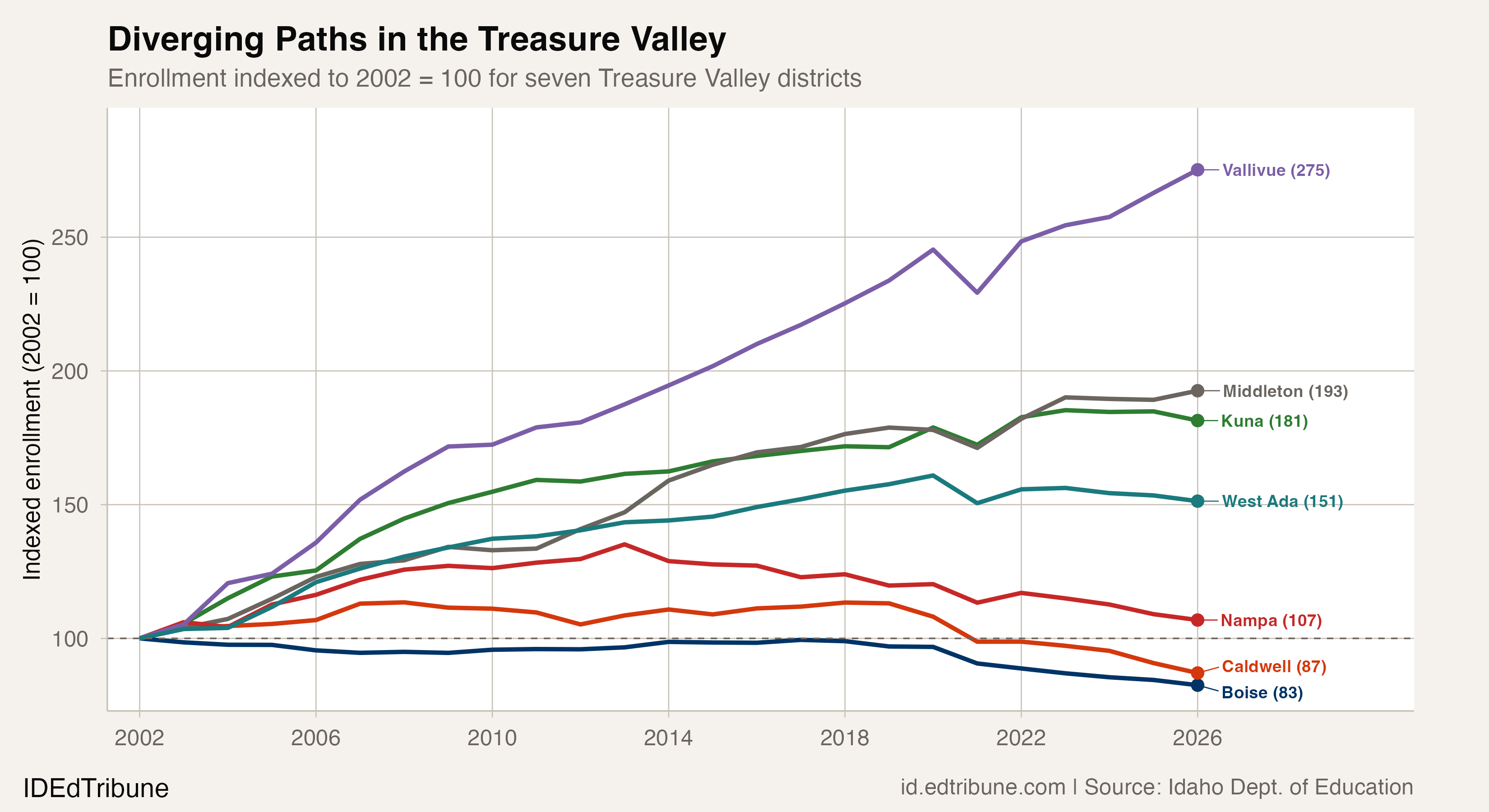
The seven largest Treasure Valley districts have split into three distinct rings since 2002, each on its own trajectory.
The outer ring, Kuna↗ (+81.4%), Middleton↗ (+92.6%), and Vallivue (+175.2%), has collectively more than doubled its enrollment, rising from 9,314 students in 2002 to 20,800 in 2025-26. These districts sit at the suburban fringe where new housing subdivisions are reshaping formerly agricultural land into bedroom communities.
The inner ring, West Ada↗, Nampa↗, and Caldwell↗, grew substantially through 2020 but has since reversed. West Ada, Idaho's largest district, peaked at 40,326 students in 2019-20 and has since shed 2,407 students, a 6.0% decline. Nampa peaked even earlier, at 15,776 in 2012-13, and has dropped 20.9% from that high. Caldwell is down 19.5% since 2019-20 alone.
And then there is the core. Boise has lost students in 18 of the past 24 years, including every year since 2019-20. The current six-year decline streak has erased 3,767 students, a 14.8% contraction.
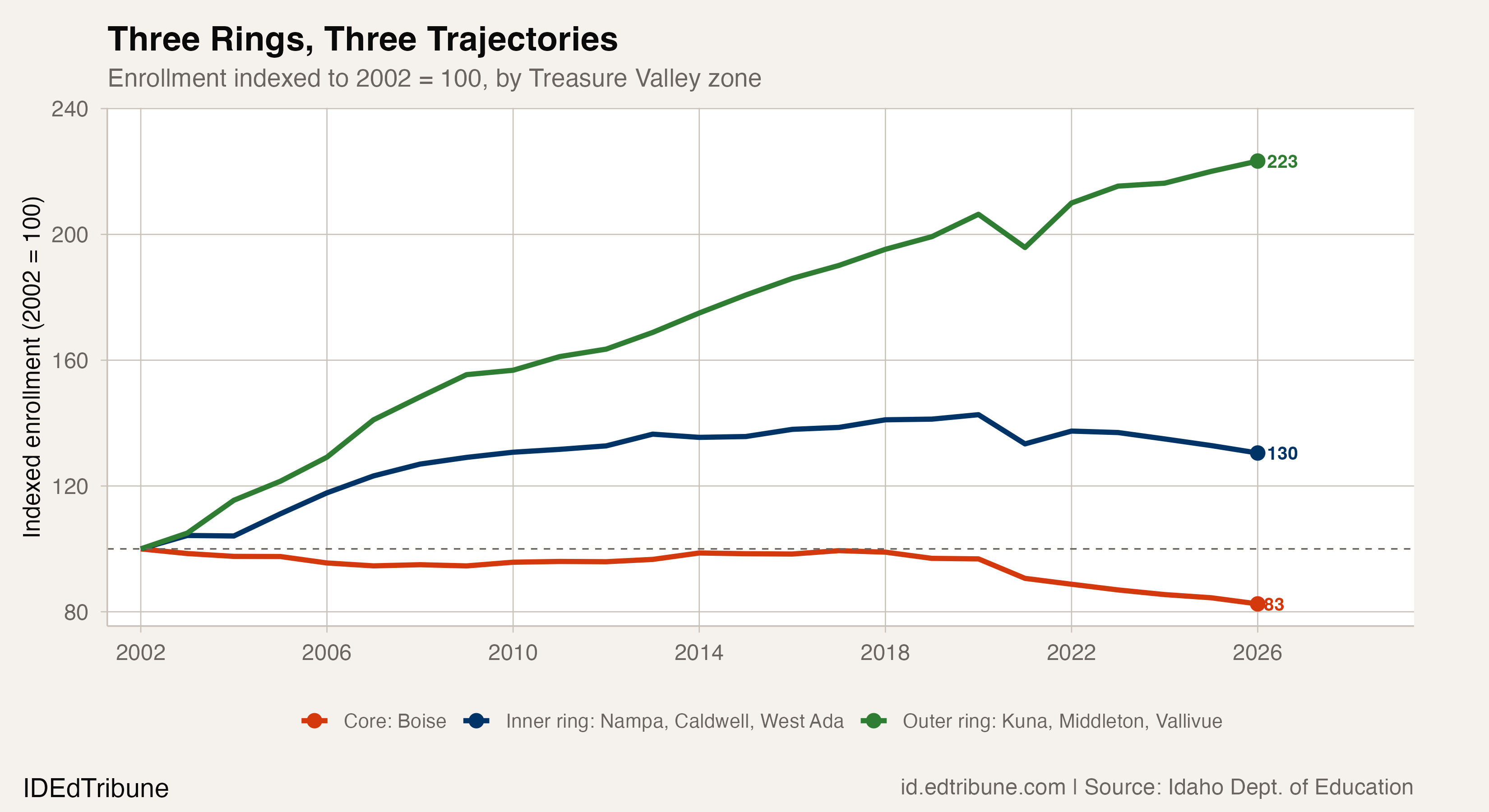
Indexed to 2002, the outer ring now sits at 223, meaning it enrolls more than twice what it did 24 years ago. The inner ring stands at 130. Boise is at 83. That spread, 140 index points between the core and the fringe, captures how thoroughly the geography of enrollment has shifted.
Where the Growth Went
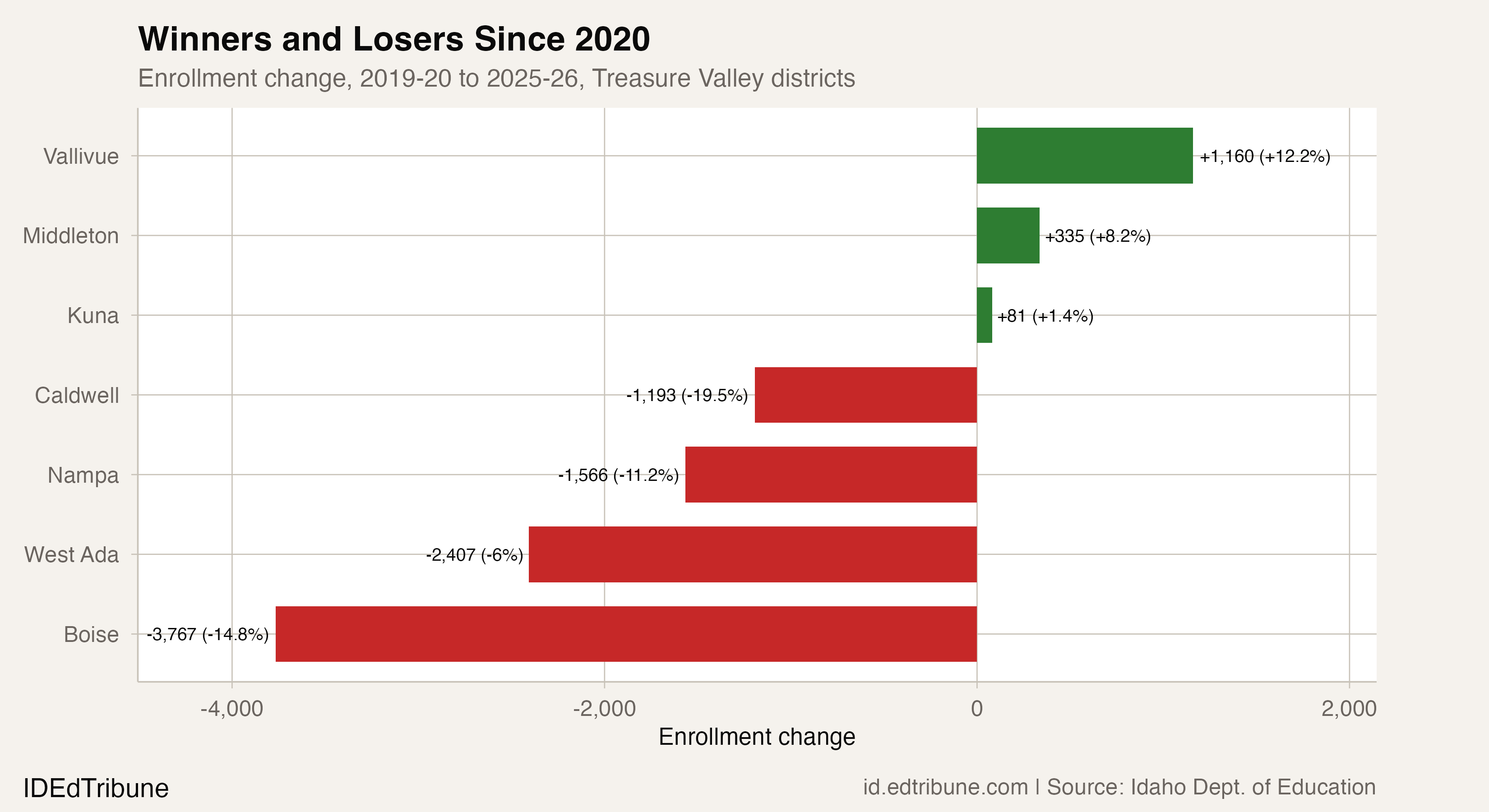
Since 2019-20, the Treasure Valley's four largest traditional districts, Boise, West Ada, Nampa, and Caldwell, have collectively lost 8,933 students. Only Vallivue (+1,160), Middleton (+335), and Kuna (+81) gained.
Vallivue crossed 10,000 students for the first time in 2023-24 and reached 10,700 this year. The district opened two new elementary schools for 2025-26 after a $78 million bond passed on its third attempt. Without them, average class sizes would have reached 35 students, according to the district.
The contrast with next-door Nampa is stark. Nampa has lost 3,303 students from its 2013 peak, a decline of 20.9%, and closed four elementary schools in the summer of 2024. Two districts separated by a boundary line: one building schools, the other shuttering them.
Housing Costs Are Sorting Families by Income
The Treasure Valley's population has boomed during this period. Ada and Canyon counties have gained new residents while losing public school students at a rate of nearly 14 to one since 2020. That ratio captures the core mechanism: the new arrivals skew older, without school-age children, while rising housing costs push younger families to the periphery.
The Boise School District itself has identified the dynamic plainly. In a 2024 statement to CBS2, the district listed its enrollment drivers:
"Declining birth rate in Idaho and Ada County ... Rising housing prices and lack of affordable housing ... Boise area is attracting older adults, i.e., retired individuals, as noted in national news."
The district concluded that "our ability to impact enrollment in any significant way is severely limited when compared to external socio-economic forces such as housing costs, personal family dynamics and employment factors."
Eagle, which sits within the West Ada district, saw its median age increase by 11.5 years between 2000 and 2021, reaching nearly 47. The national average increased about four years over the same period. When a community's median age rises three times faster than the country's, its schools feel it.
The Kindergarten Signal
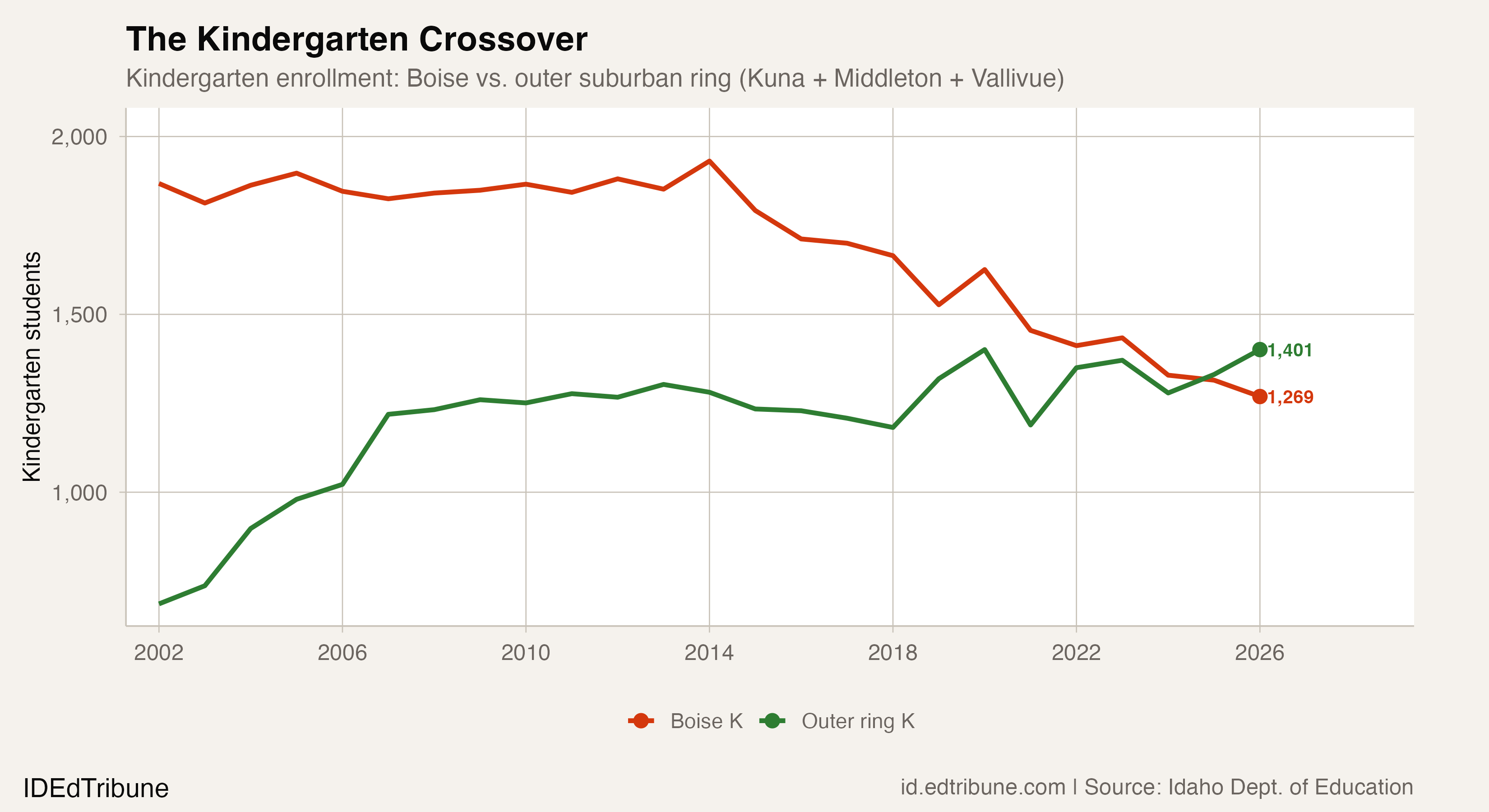
The pipeline data makes the trajectory visible a decade before it arrives at 12th grade. Boise enrolled 1,868 kindergartners in 2002 and 1,269 in 2025-26, a 32.1% decline. The outer suburban ring (Kuna, Middleton, and Vallivue combined) enrolled 686 kindergartners in 2002 and 1,401 this year, a 104.2% increase.
The two lines crossed around 2023. For the first time, the three outer-ring districts collectively enrolled more kindergartners than Boise. This is the leading edge of the donut: where kindergartners are enrolling today determines where high school seniors will be in 2038.
Boise now graduates 1,945 seniors per year but enrolls only 1,269 kindergartners, a ratio of 1.53 to 1. Each graduating class is being replaced by a smaller entering class, locking in continued decline for at least a decade absent a reversal in housing affordability or migration patterns.
West Ada Joins the Core
The most consequential shift in recent years is West Ada's turn from growth to contraction. For 18 consecutive years through 2020, Idaho's largest district added students, growing from 25,061 to 40,326. It has now declined for three straight years, losing 487 students in 2023-24, 213 in 2024-25, and 538 in 2025-26.
West Ada's boundary redrawing process, which began in September 2025, reflects the internal version of the same pressure: some schools within the district are overcrowded while others have empty seats. Growth has not stopped within the district's boundaries. It has merely shifted to the edges, replicating the valley-wide donut pattern at a smaller scale.
Boise's share of statewide enrollment has fallen from 10.7% in 2002 to 6.9% in 2025-26. If West Ada's decline continues, the inner ring's share will contract further, concentrating growth in districts that may lack the infrastructure to absorb it.
Two districts, one boundary line
Nampa closed Centennial, Snake River, Greenhurst, and West Middle School in the summer of 2024. The buildings sat in neighborhoods where the children had thinned out. Across the boundary line, Vallivue opened Warhawk and Falcon Ridge that same August, funded by a $78 million bond that passed on its third try.
Idaho enrollment data contains no demographic breakdowns, so the racial and economic dimensions of this sorting remain invisible in the numbers. But the operational consequences are concrete: Boise manages a building portfolio designed for 26,000 students with fewer than 22,000 inside them. Vallivue has already purchased 87 acres for the schools it will need after the ones it just built fill up. The donut keeps widening, and the districts at its center keep hollowing out.
Detailed code that reproduces the analysis and figures in this article is available exclusively to EdTribune subscribers.
Discussion
Sign in to join the discussion.
Loading comments...