At Canyon Springs High School in Caldwell, three out of every four students are chronically absent. The alternative school's 74.4% rate is the third-highest of any school in Idaho with at least 100 students, but it is not an outlier in its own district. Jefferson Middle School sits at 43.7%. Syringa Middle School at 37.3%. Caldwell Senior High at 33.8%.
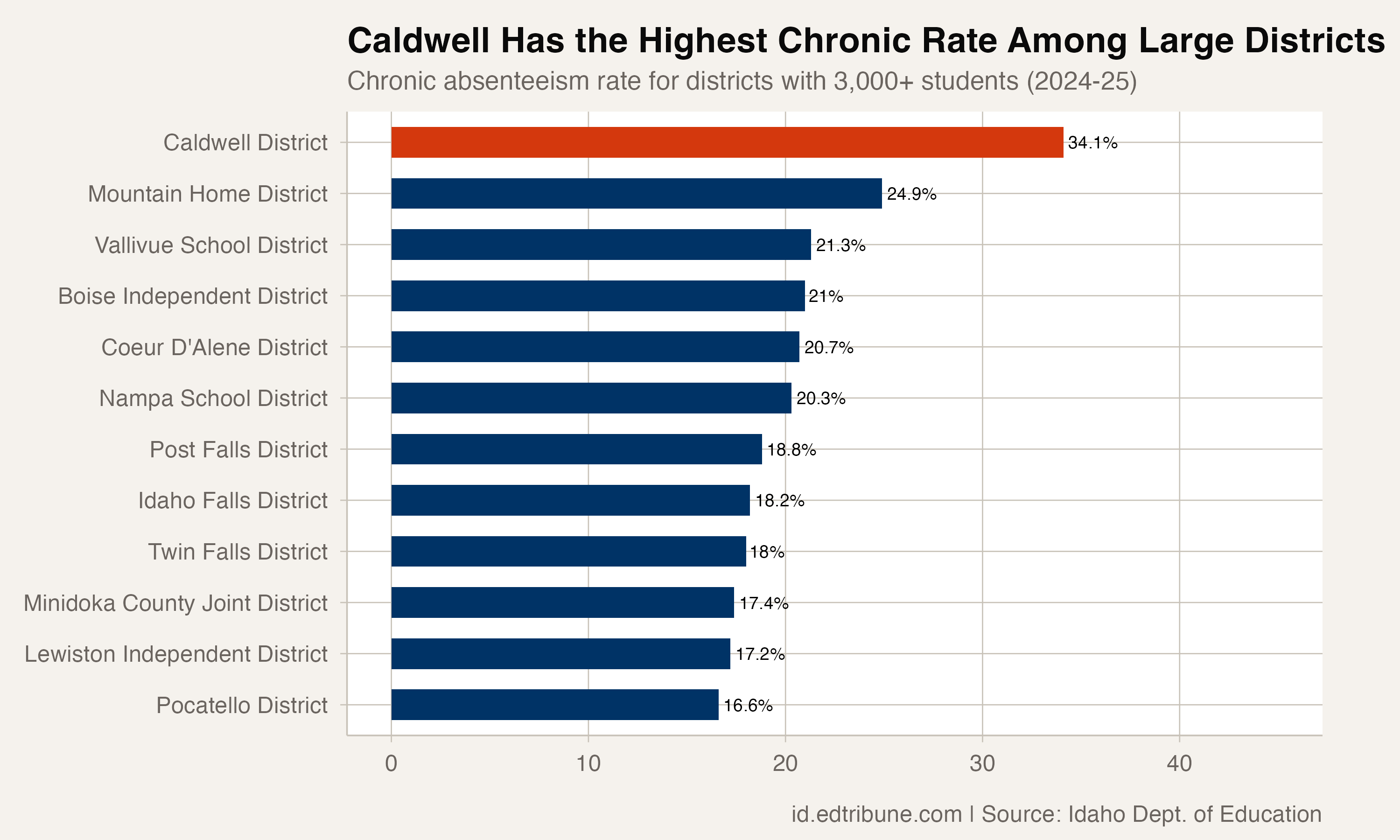
Caldwell District↗, with 4,931 students in Canyon County's agricultural heartland, has the highest chronic absenteeism rate among Idaho's 25 large districts: 34.1%. That is more than double the state average of 14.6%, and it is higher than the district's rate when Idaho first began publishing this data in 2020-21.
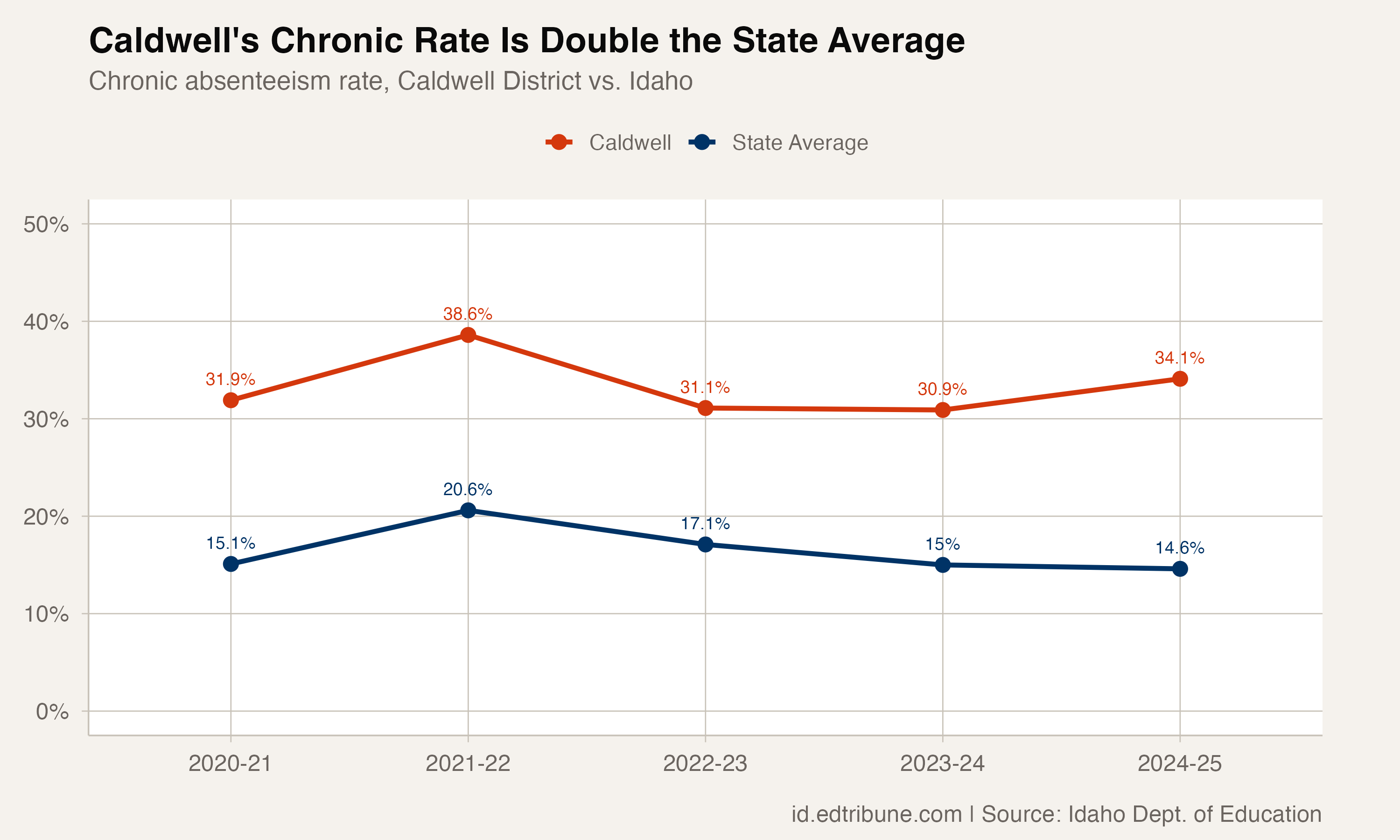
Getting worse, not better
Most Idaho districts can point to some improvement from the pandemic peak. Caldwell cannot. Its rate stood at 31.9% in 2020-21, spiked to 38.6% in 2021-22, fell back to 30.9% in 2023-24 — then climbed again to 34.1% in 2024-25. The W-shaped trajectory suggests the district faces structural attendance barriers that brief improvement periods cannot overcome.
The scale of the problem sets Caldwell apart from its peers. Mountain Home, the next-worst large district at 24.9%, is nine percentage points lower. Vallivue — a neighboring Canyon County district of similar demographics — sits at 21.3%. The statewide median for large districts is roughly 14%.
Across every subgroup, the rates are high
Caldwell's attendance problem is not confined to one population. Hispanic students — roughly 64% of the district's enrollment — face a 35.6% chronic rate. White students are at 30.6%. English learners, at 34.8%, mirror the district-wide pattern.
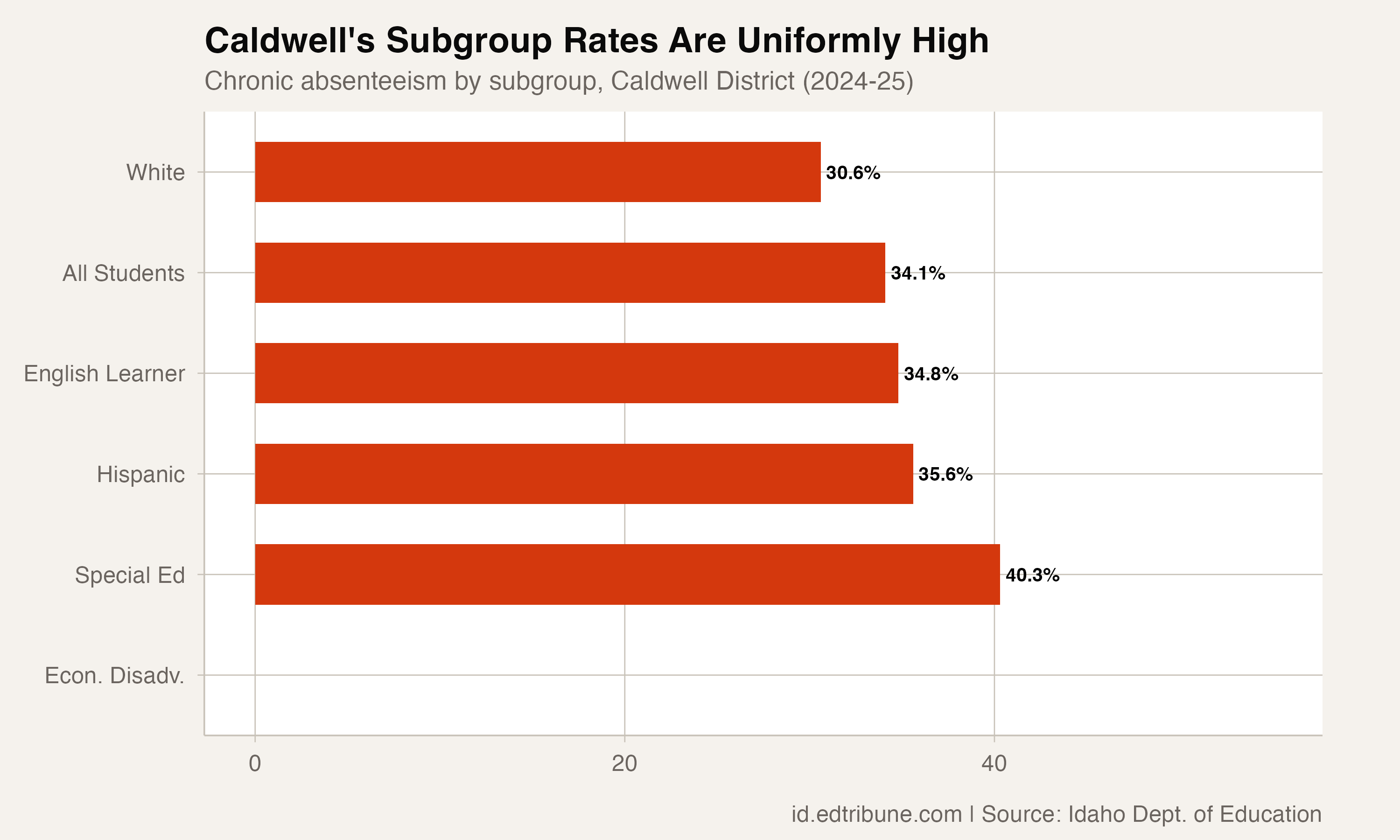
The consistency across subgroups points to community-wide factors rather than any single demographic driver. Caldwell sits at the center of Canyon County's agricultural economy, where seasonal work patterns, limited public transportation, and rural health care access create attendance barriers that school-level interventions struggle to overcome.
The district launched an "Every Day Matters" attendance campaign, part of a statewide push promoted by the Idaho State Department of Education. The data suggests these efforts have not reached the scale needed in a district where a third of students are habitually absent.
The school-level picture
Within Caldwell, the variation is enormous. Canyon Springs High School's 74.4% rate reflects its role as an alternative school serving students who have already disengaged from traditional settings — high absence rates are partly baked into its mission. But even removing Canyon Springs, the pattern remains:
- Jefferson Middle School: 43.7% (757 students)
- Syringa Middle School: 37.3% (671 students)
- Caldwell Senior High: 33.8% (1,343 students)
- Washington Elementary: 31.9% (492 students)
- Sacajawea Elementary: 30.1% (359 students)
Only Wilson Elementary (20.3%) and Van Buren Elementary (24.6%) fall below 25% — and even those rates would be among the worst in most Idaho districts.
The middle schools stand out. At Jefferson, nearly half the students miss at least 18 days of school. These are the years when attendance patterns often set the trajectory for high school completion.
What a 34% rate costs
Under Idaho's Average Daily Attendance funding model, every empty seat is a revenue loss. Roughly 1,680 of Caldwell's 4,931 students cross the chronic threshold, each missing at least 18 days a year. The cumulative attendance losses represent millions in foregone state funding for a district that, by every demographic measure, needs the money most.
Caldwell's rate has been above 30% in every year of available data. The district has never known a period where chronic absenteeism was not a crisis: 31.9%, 38.6%, 31.1%, 30.9%, 34.1%. No sustained improvement. No downward trend. The district that needs the most help showing up is the one where showing up remains hardest.
Detailed code that reproduces the analysis and figures in this article is available exclusively to EdTribune subscribers.
Discussion
Sign in to join the discussion.
Loading comments...