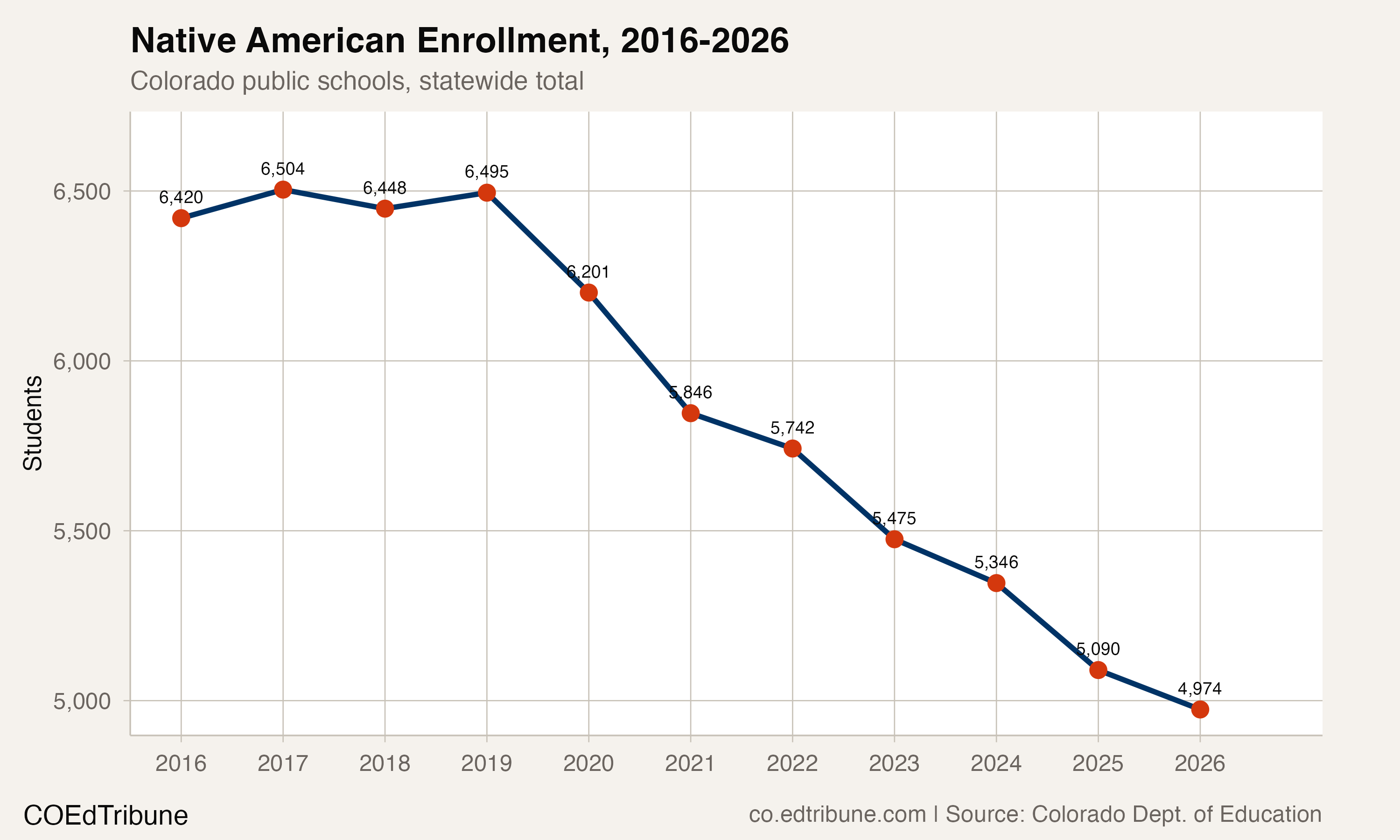
In a state named for its river by Spanish explorers and built on the ancestral lands of the Ute, Cheyenne, and Arapaho peoples, the number of Native American students enrolled in public schools has fallen to 4,974. That is 1,446 fewer than in 2015-16, a 22.5% decline over 11 years. No other racial group in Colorado has lost students at that rate.
The drop is nearly twice as steep as white enrollment's 12.4% decline over the same period, and it stands in stark contrast to total statewide enrollment, which fell just 3.1%. Native American students now represent 0.57% of Colorado's public school population, down from 0.71%. In absolute terms, the group that was already among the state's smallest is getting smaller, and fast.
Seven straight years of loss
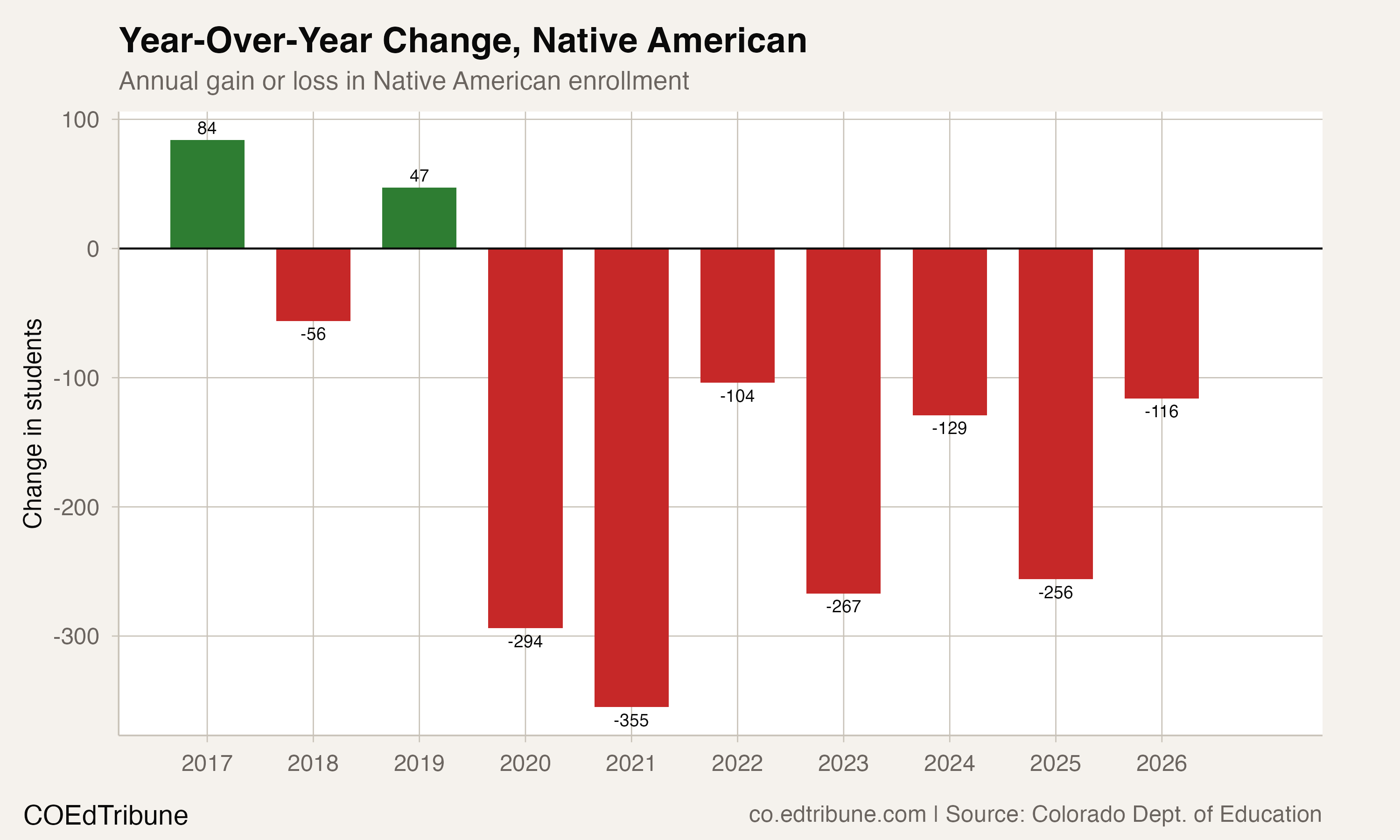
From 2015-16 through 2018-19, Native American enrollment in Colorado hovered around 6,400 to 6,500, fluctuating within a narrow band. That stability broke in 2019-20, when the count dropped by 294 students, a 4.5% single-year loss. The COVID-19 pandemic year of 2020-21 brought the worst single-year decline: 355 students, or 5.7%.
The losses have not recovered. Every year since 2019-20 has been negative, producing seven consecutive annual declines. The cumulative post-2019 loss of 1,521 students erased years of stability and then some, pushing the 2025-26 count well below any level in the dataset.
The fastest-shrinking group
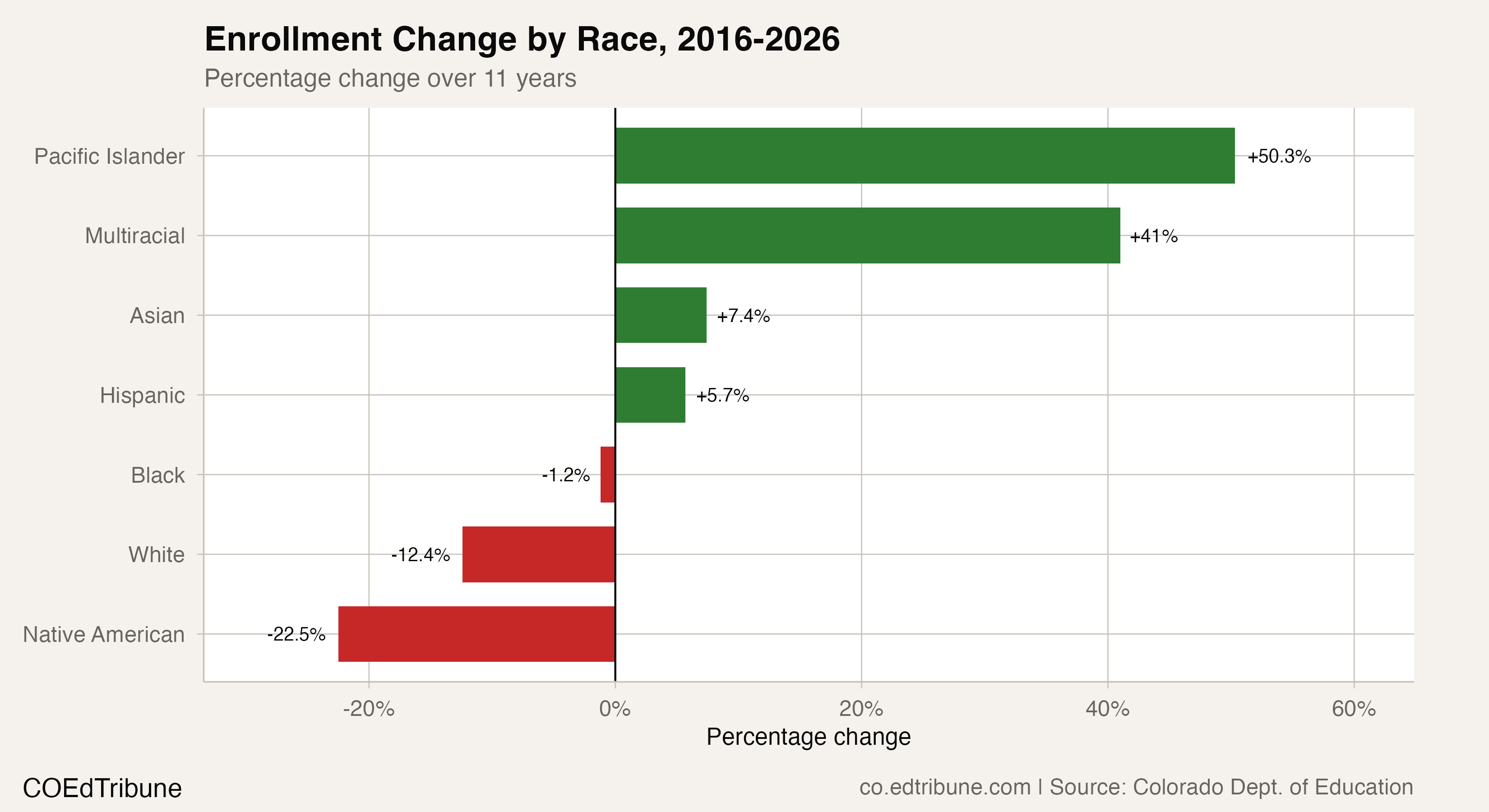
When placed alongside Colorado's other racial and ethnic categories, the trajectory stands alone. Over the 11-year window from 2016 to 2026, multiracial enrollment surged 41.0% and Pacific Islander enrollment grew 50.3%. Hispanic enrollment, the state's largest minority group, added 17,029 students, a 5.7% increase. White enrollment fell by 60,365 students, a 12.4% decline that dominates headline enrollment losses.
Native American enrollment's 22.5% decline is the steepest of any group. On a percentage basis, it fell nearly twice as fast as white enrollment, though white students' absolute losses were orders of magnitude larger (60,365 vs. 1,446). Black enrollment dipped just 1.2%.
Concentrated in two corners of the state
Native American enrollment in Colorado is not evenly distributed. It concentrates heavily in two places: Southwest Colorado's reservation-adjacent districts and the Denver metro area's large suburban systems.
Montezuma-Cortez RE-1↗, which borders the Ute Mountain Ute Reservation near Towaoc, enrolled 560 Native American students in 2025-26, making them 25.7% of the district. That is down from 722 in 2015-16, a loss of 162 students, or 22.4%. Ignacio 11 JT↗, adjacent to the Southern Ute Reservation, enrolled 179 Native American students, 27.8% of the student body, down from 215 in 2015-16.
Together these two districts account for 14.9% of all Native American public school students in Colorado despite representing a fraction of the state's total enrollment. Durango 9-R↗ is the one exception in the region: its Native American enrollment grew from 203 to 245 over the same period, a 20.7% increase.
In the Denver metro area, the losses have been steeper in percentage terms but spread across larger systems. Jefferson County R-1↗ lost 280 Native American students, a 51.6% decline. Cherry Creek 5↗ lost 134 (43.4%). Colorado Springs 11↗ lost 122 (55.5%). Denver County 1↗ lost 149 (25.7%). Adams-Arapahoe 28J↗ lost 23 (8.1%), a comparatively modest decline.
Across all districts, 100 lost Native American students, 30 gained, and 11 were flat. Among all 130 districts enrolling at least one Native American student, the losses are pervasive.
The multiracial mirror
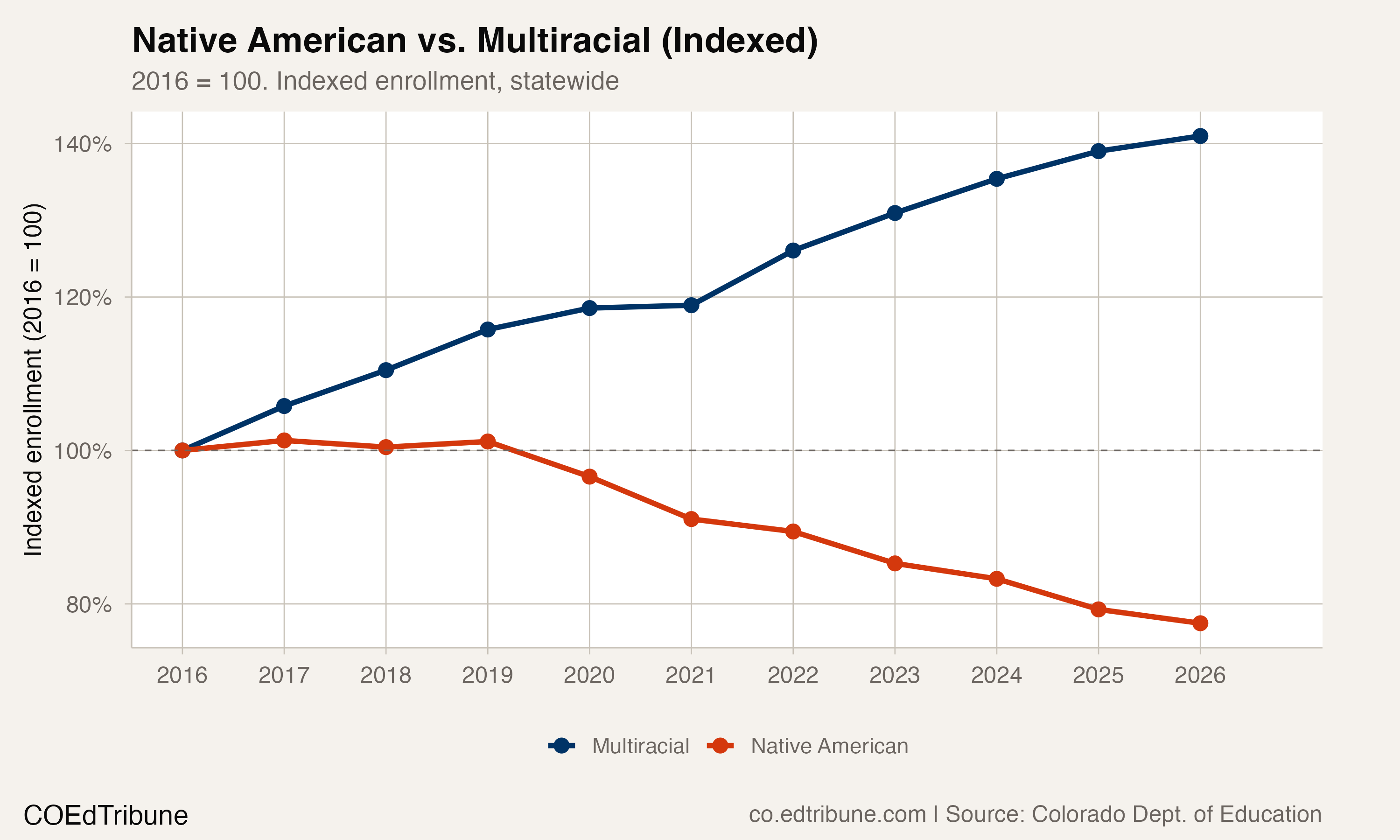
One pattern that complicates interpreting Native American enrollment loss is the simultaneous growth in students identifying as multiracial. Colorado's multiracial enrollment rose from 34,389 in 2015-16 to 48,485 in 2025-26, a gain of 14,096 students, or 41.0%. That growth has been monotonic, increasing every year of the dataset.
Federal education data collection uses a system where a student identifying as both Native American and another race is classified as "two or more races" rather than as Native American. This classification practice, documented by the Brookings Institution, has been shown to reduce Native American counts across education datasets. The Brookings analysis found that only 39% of American Indians and Alaska Natives nationally are classified as one race alone, far lower than for any other major racial group, and that this practice disproportionately affects Native communities.
It is not possible to determine from enrollment data alone how much of Colorado's Native American decline reflects actual departures from public schools and how much reflects families checking a different box on enrollment forms. Both are likely occurring. But the inverse trajectories of the two categories, diverging at roughly the same time and accelerating after 2019, suggest that reclassification is a meaningful contributor.
Birth rates and demographic pressure
A second structural factor is fertility decline. Native American women nationally experienced the steepest fertility drop among all racial groups from 2008 to 2016, falling from 1.62 to 1.23 births per woman, according to the Institute for Family Studies. That 15% decline in expected fertility represents roughly 83,000 missing births nationally. The cohorts entering kindergarten between 2016 and 2026 would reflect children born from approximately 2010 to 2020, a period squarely within this fertility downturn.
Colorado's own birth data shows that American Indian/Alaska Native births represent just 0.5% of all live births in the state, a share even smaller than their current 0.57% enrollment share. Fewer births a decade ago translate directly to fewer kindergarteners today.
On the reservation, a new model
The enrollment pressure is felt most directly in Southwest Colorado, where the two Ute tribes have responded by building alternatives to the public school system rather than trying to reverse losses within it.
Kwiyagat Community Academy, Colorado's first charter school located on a Native reservation, opened on the Ute Mountain Ute Reservation in 2021. It served 48 students in kindergarten through second grade during 2022-23 and plans to expand through fifth grade. The school offers 40 minutes of daily cultural instruction, including Ute language classes, in a community where Towaoc is Colorado's poorest zip code and 37% of families live below the poverty line.
"We knew we had to act a different way... different values and acceptable thoughts." — A Kwiyagat graduate, describing the experience of attending public schools in Cortez
The Southern Ute Indian Montessori Academy near Ignacio enrolls roughly 80 students and has similarly embedded Ute language preservation into its curriculum. Neither school has a fully fluent Ute speaker on staff, a reality that measures how much has already been lost. Between them, these two tribal schools serve about 130 students, roughly 2.6% of the state's total Native American enrollment.
A district-level divergence
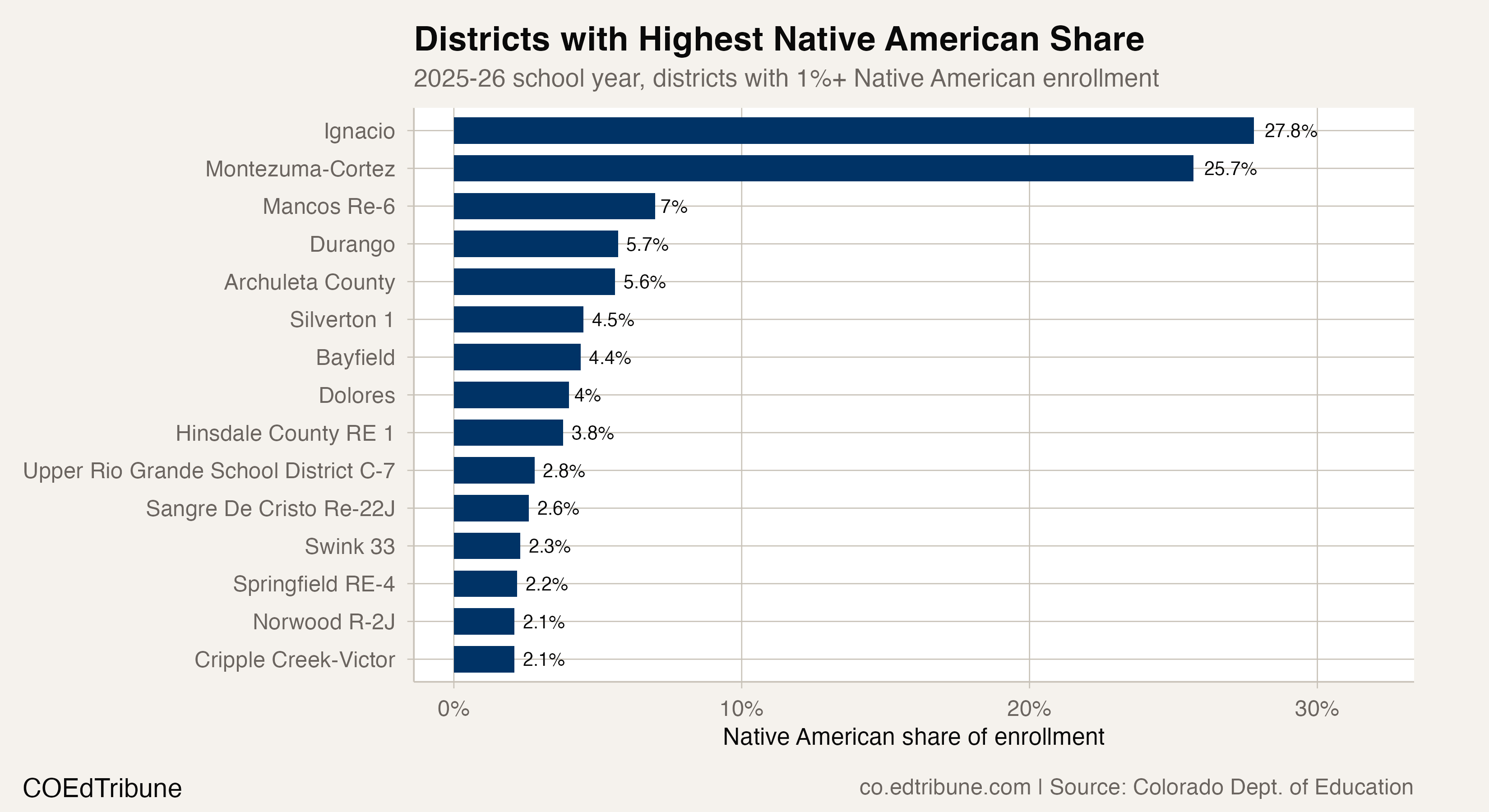
The geographic concentration of Native American enrollment creates a paradox. In the districts where these students represent a significant share of the student body, the losses carry outsized weight. Montezuma-Cortez's 162-student loss, applied to a district with 2,178 total students, represents a fundamentally different fiscal and programmatic challenge than Jefferson County's 280-student loss within a system of 75,000.
At Montezuma-Cortez, Native American students accounted for 52% of suspensions at the elementary level, 55% at the middle school, and 51% at the high school as of 2022, despite making up roughly a quarter of enrollment. These discipline disparities were among the motivations for the Ute Mountain Ute tribe's decision to open its own school.
In the suburban metro districts, the Native American population was already a fraction of a percent, and the losses, while proportionally steep, are absorbed into much larger enrollment shifts. The practical question is whether any district outside Southwest Colorado has enough Native American students to sustain targeted programming. Only 15 districts in the state have a Native American enrollment share above 1%.
4,000 by 2031
The Colorado Department of Education's most recent enrollment release noted the 4.8% Native American decline in 2024-25 alongside broad demographic diversification but offered no explanation for the pattern. The state does not publicly report on tribal enrollment or cross-reference enrollment data with tribal membership records.
At the current rate of decline, Colorado's Native American enrollment will fall below 4,000 within five years. For Montezuma-Cortez and Ignacio, where these students make up a quarter of the student body, that trajectory is an existential question about programming, staffing, and whether the public school system remains the institution that serves this community. Kwiyagat and the Southern Ute Montessori Academy are already providing an answer from outside it.
Detailed code that reproduces the analysis and figures in this article is available exclusively to EdTribune subscribers.
Discussion
Sign in to join the discussion.
Loading comments...