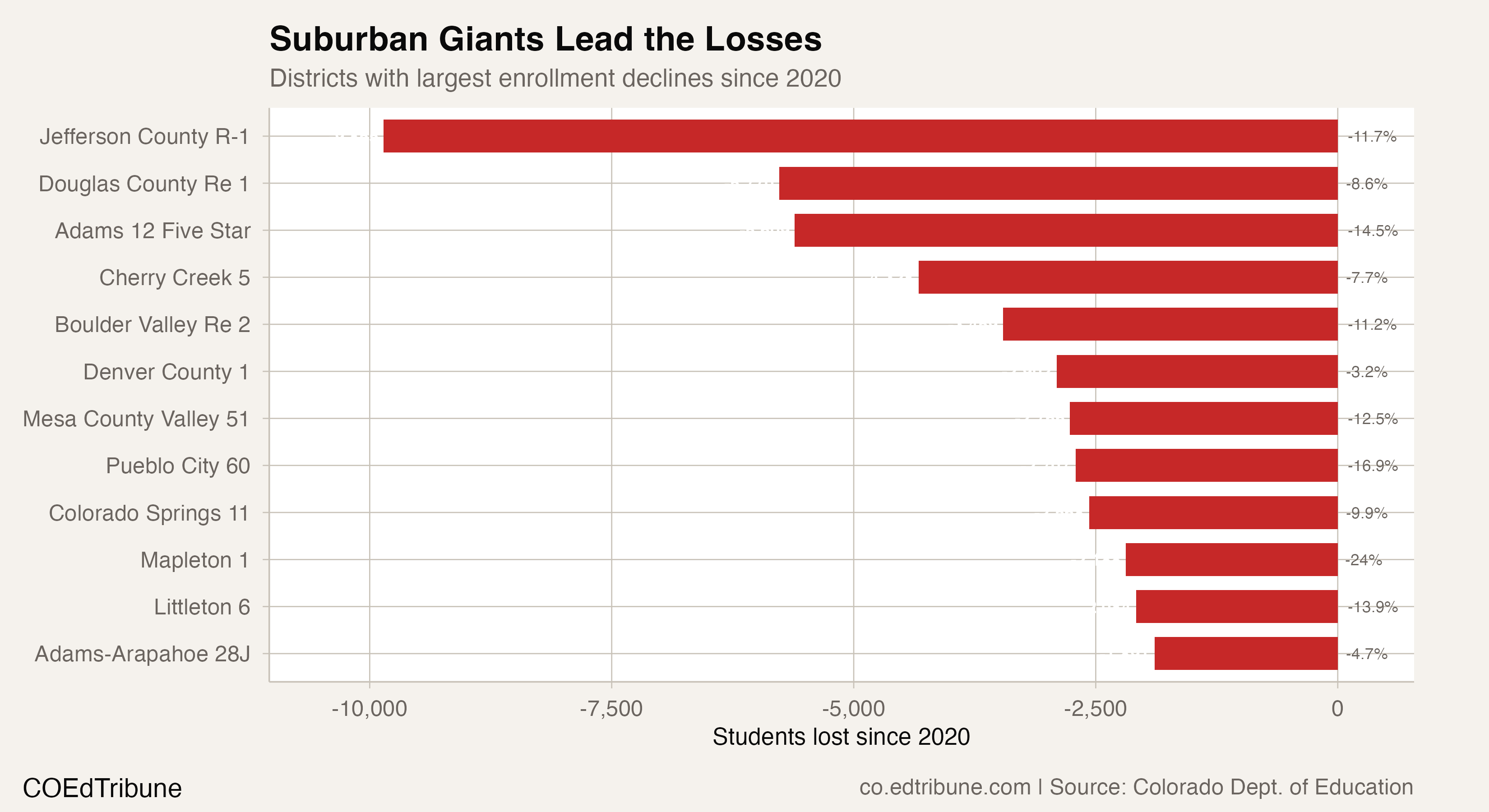
Five years after the pandemic emptied classrooms across the Front Range, Jefferson County R-1↗ has 9,855 fewer students than it did in 2019-20. Douglas County Re 1↗ is down 5,770. Adams 12 Five Star Schools↗ has lost 5,609. These are not small, rural districts struggling with population loss. They are Colorado's affluent suburban anchors, and none of them has recovered.
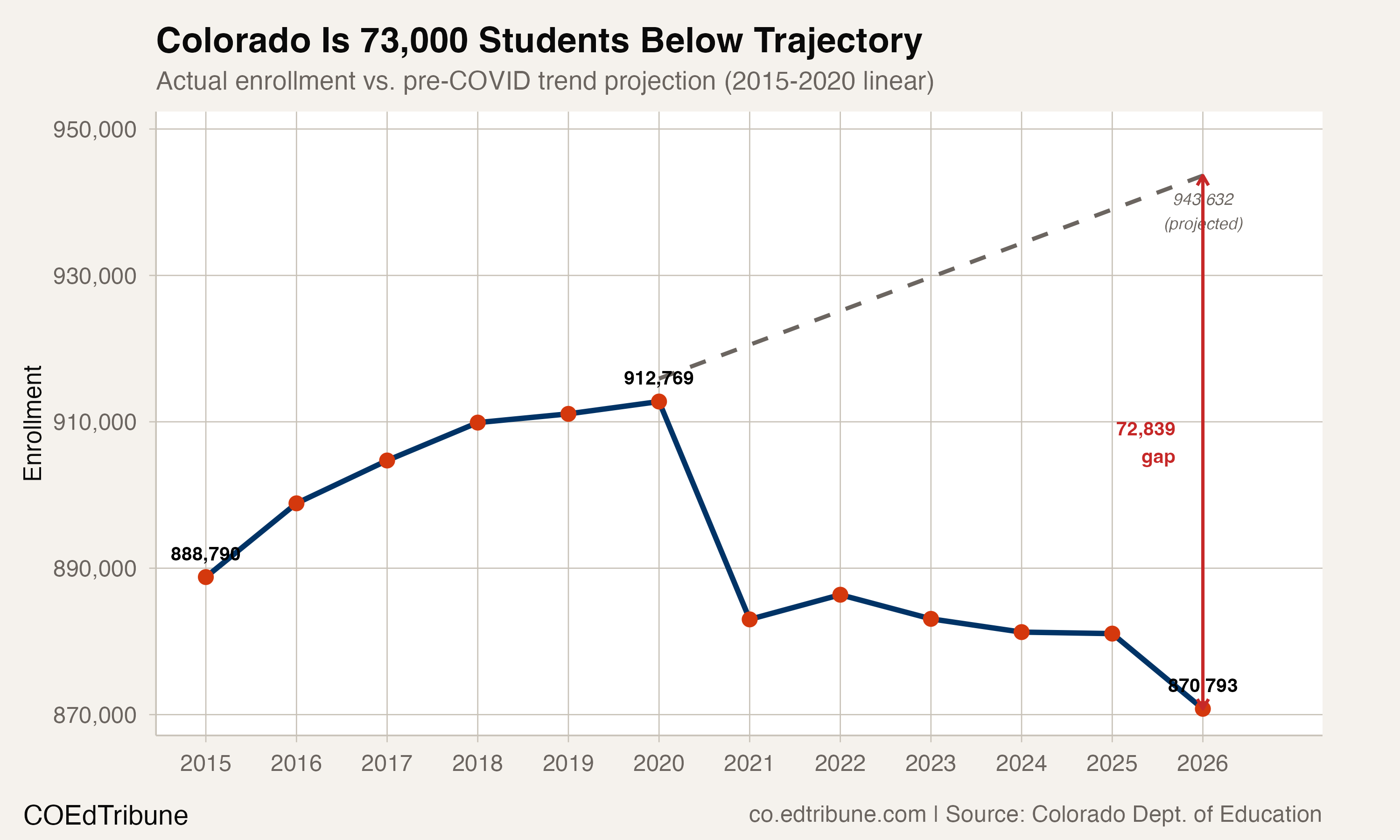
Statewide, only 49 of 184 districts, 26.6%, have returned to their pre-COVID enrollment levels. Colorado enrolled 870,793 students in 2025-26, down 41,976 from the 2019-20 peak of 912,769, a 4.6% decline. The state is now 72,839 students below where its pre-pandemic growth trend would have placed it, a gap that has nearly doubled in three years.
The recovery that never came
The initial COVID-year loss was staggering: 29,762 students vanished between 2019-20 and 2020-21. A partial rebound in 2021-22, when 3,369 students returned, briefly suggested recovery was underway. It was not.
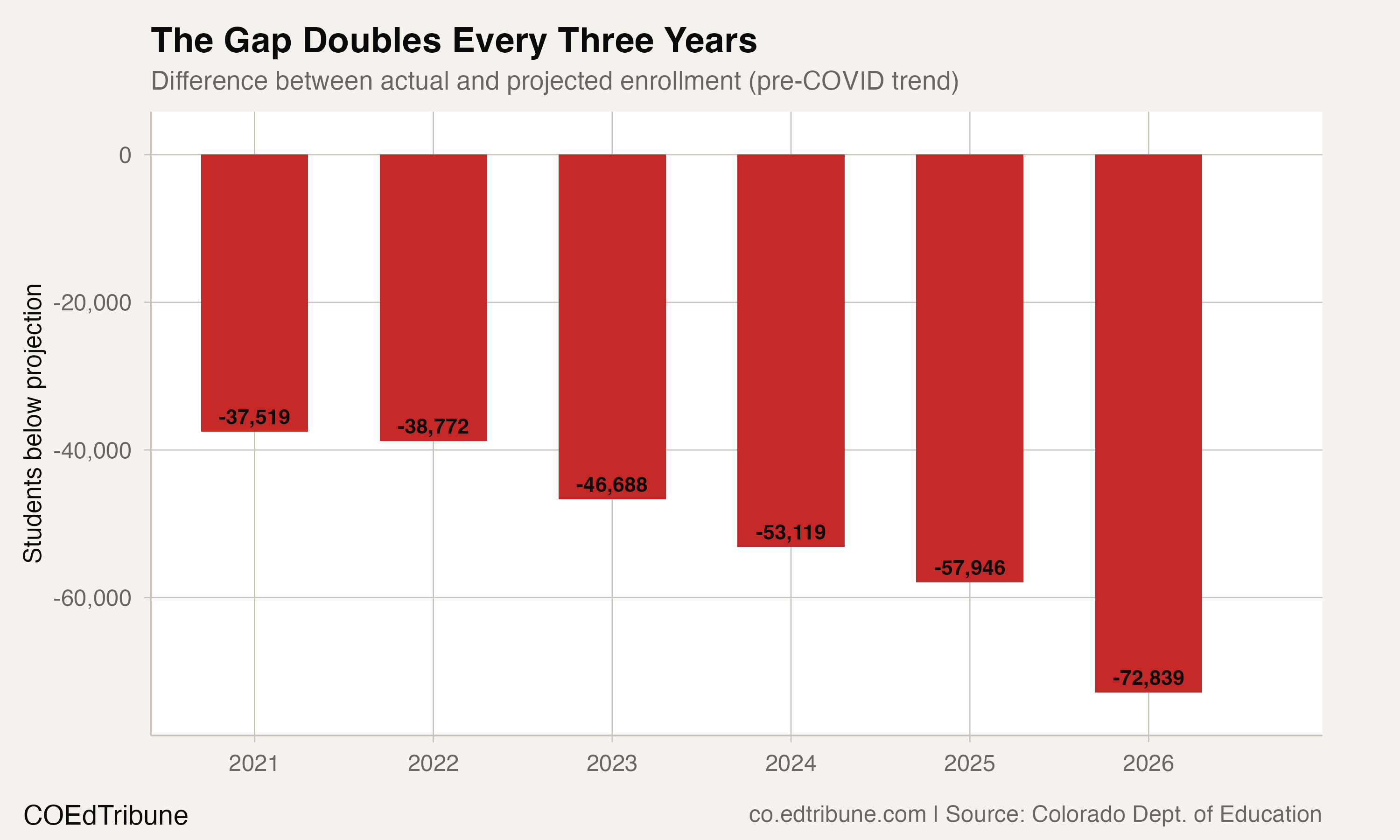
Enrollment has declined in four of the five years since that bounce, including a loss of 10,272 students in 2025-26, the largest single-year drop since the pandemic year itself. Each year the state fails to recover, the gap between actual enrollment and where the pre-2020 trajectory projected it would be grows wider: 37,519 below projection in 2020-21, 53,119 by 2023-24, and 72,839 by 2025-26.
Who recovered, who didn't
The pattern is stark by district size. Among Colorado's 14 largest districts, those with 20,000 or more students in 2019-20, only two have recovered: District 49↗ in the Colorado Springs metro area (+2,533, or 10.6%) and Greeley 6↗ (+311, or 1.4%). Every other major district on the Front Range is smaller than it was five years ago.
The 12 largest non-recoverers have collectively shed more than 45,000 students. Jefferson County alone accounts for nearly a quarter of that total.
| District | 2019-20 | 2025-26 | Change | % Change |
|---|---|---|---|---|
| Jefferson County R-1 | 84,032 | 74,177 | -9,855 | -11.7% |
| Douglas County Re 1 | 67,305 | 61,535 | -5,770 | -8.6% |
| Adams 12 Five Star | 38,648 | 33,039 | -5,609 | -14.5% |
| Cherry Creek 5 | 56,172 | 51,844 | -4,328 | -7.7% |
| Boulder Valley Re 2 | 31,000 | 27,541 | -3,459 | -11.2% |
| Denver County 1 | 92,112 | 89,210 | -2,902 | -3.2% |
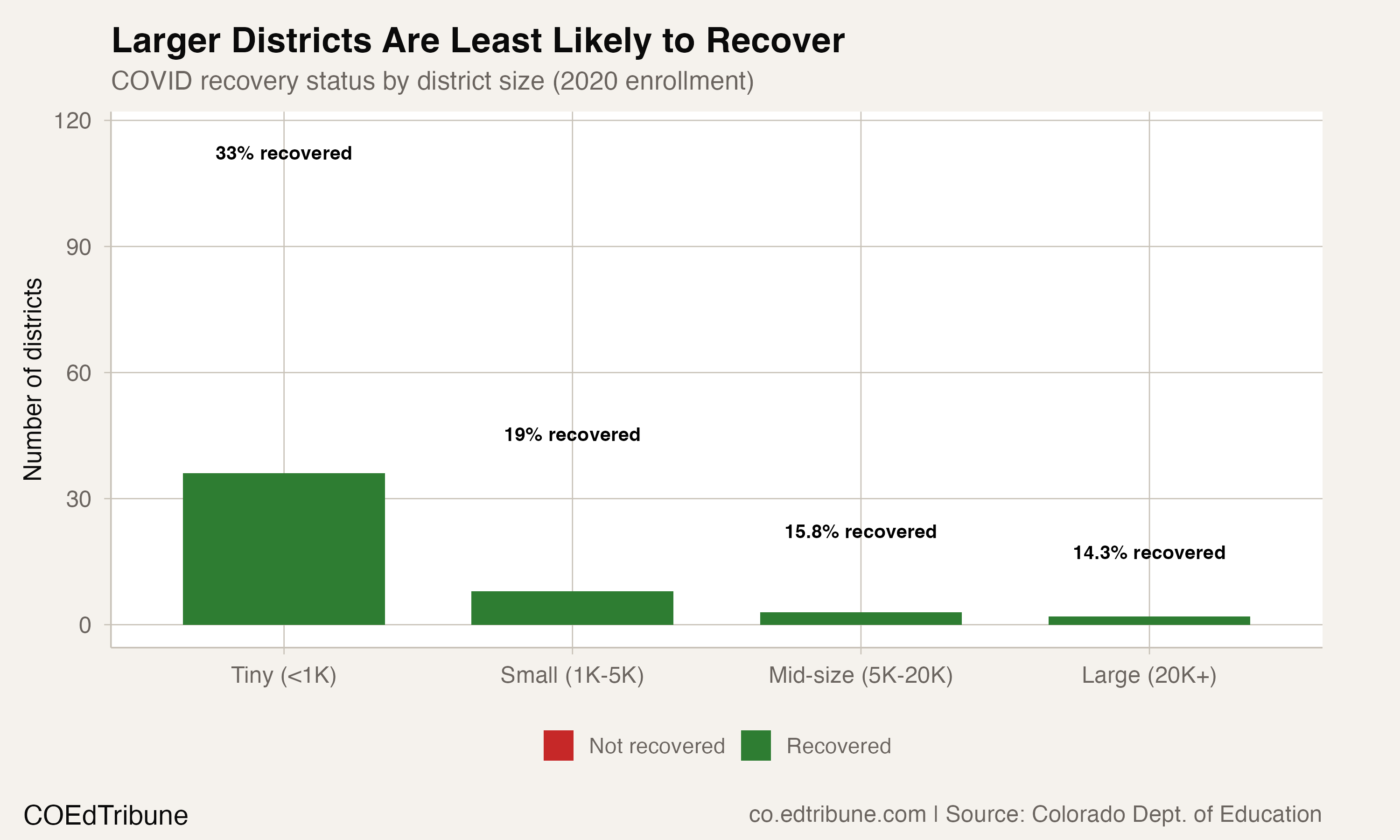
Recovery rates drop as district size increases. One in three tiny districts (those under 1,000 students) have returned to pre-COVID levels. Among mid-size districts, 15.8%. Among the largest, 14.3%.
The virtual mirage
The 49 districts that did recover deserve closer scrutiny, because the two largest gains belong to online operators, not traditional school systems.
Education reEnvisioned BOCES↗, a virtual school consortium, grew from 2,836 students in 2019-20 to 13,502 in 2025-26, a gain of 10,666 students, or 376%. Byers 32J↗, which hosts a virtual academy, added 5,246 students, growing 224%. Together, these two entities account for more than half of all enrollment gains among recovering districts.
The Charter School Institute, Colorado's statewide charter authorizer, added 2,691 students. School District 27J↗, centered on Brighton and the rapidly growing northeast metro corridor, gained 5,042, a genuine brick-and-mortar success story. But below these top performers, the recovery thins quickly: the remaining 44 recovering districts gained a combined 3,318 students, an average of 75 each.
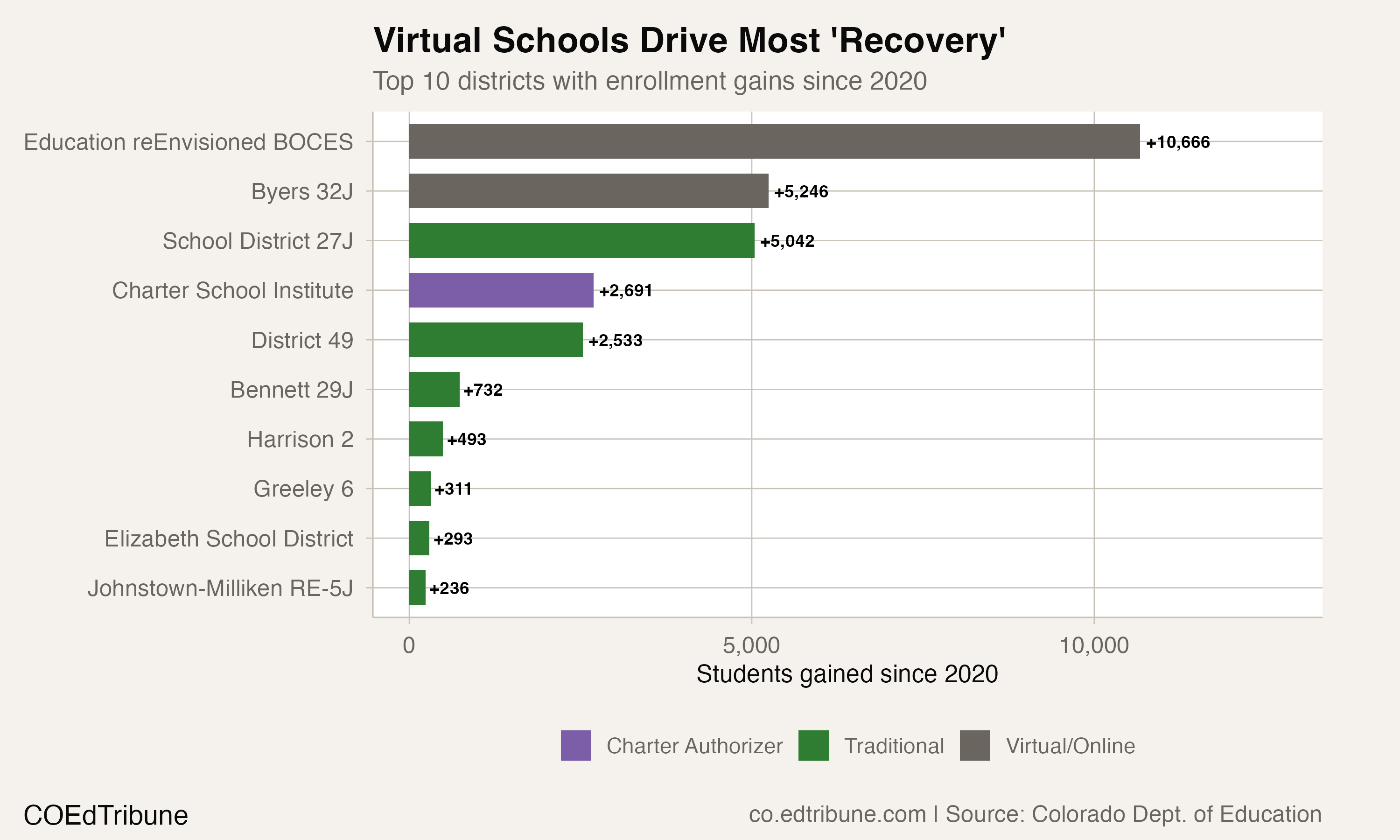
Strip out the virtual operators and the Charter School Institute, and just 46 of 181 traditional districts, 25.4%, have recovered. The aggregate numbers tell the story in another way: non-recovering districts lost 73,226 students while recovering districts gained 29,496, a net loss across all districts of 43,730.
Birth rates and the leaky pipeline
The most likely driver of Colorado's sustained decline is demographic. A May 2025 analysis by the Common Sense Institute found Colorado has experienced a 25.1% reduction in its general fertility rate compared to the 2001-2010 average, the third-largest decline in the nation. Fewer babies born in the mid-2010s are now reaching kindergarten age.
Housing costs compound the problem, particularly in the suburban districts absorbing the deepest losses. In Jefferson County, home values have jumped 76% since 2015, according to Census data presented at a school board meeting. The district's finance team tracked the consequences precisely:
"We lost 12.8% of our under 5-year-olds in three years. They're moving out of Jefferson County." -- Seanin Rosario, Executive Director of Finance, Canyon Courier
A decade ago, 91% of children born within Jefferson County boundaries eventually enrolled in Jeffco kindergarten. That figure has fallen to 75%, meaning one in four families is leaving the county, choosing private school, or homeschooling before their child reaches school age.
A separate contributor is the growth of alternatives to traditional public schooling. Colorado Education Commissioner Susana Cordova attributed the 2025-26 decline to "a range of factors, including fewer births in the last 20 years, population decreases over the past decade in 30% of Colorado counties, and more students pivoting to part-time and online schooling as well as home school programs." Between fall 2024 and fall 2025, online enrollment grew by nearly 1,000 students to 34,617. Homeschool counts rose by roughly 550 to 10,367, and part-time homeschoolers increased by about 2,750 to 18,740.
Immigrant students: a buffer that thinned
Immigration had been partially offsetting the enrollment decline in Colorado's urban core. Denver's enrollment data shows that for the first time in three years, more immigrant students left the city's schools than entered in summer and fall 2025. Statewide, the 2025-26 count showed 4,395 fewer Hispanic students after several years when Hispanic enrollment growth had helped cushion overall losses. English learner enrollment fell from over 105,000 to roughly 99,400.
Whether this reflects enforcement-driven departures, families relocating to other states, or simply a return to pre-immigration-wave baselines is not yet clear from the data. What is clear is that the one countervailing force against the enrollment slide has weakened.
School closures follow the students
The fiscal math is straightforward: Colorado funds schools based on per-pupil counts. Fewer students means less money. Jefferson County is preparing to cut $45 million from its budget, with 150 to 160 employees receiving position elimination notices. Denver Public Schools leaders have warned of a potential financial "catastrophe" as enrollment losses compound alongside threatened federal funding cuts. The district closed seven schools in 2024-25 and a board presentation stated bluntly: "This trend means more school closures will be needed."
Across the state, 138 districts or BOCES experienced enrollment declines in 2025-26, up from 119 the prior year. The shrinkage is spreading.
What happens when the gap keeps growing
The 72,839-student gap between Colorado's actual enrollment and its pre-COVID trajectory is not a number that self-corrects. The pre-pandemic trend was built on modest annual growth, roughly 4,600 students per year from 2014-15 through 2019-20. The post-pandemic reality is a decline of about 7,000 students per year on average, and accelerating.
Denver Public Schools projects losing an additional 6,005 students by 2029, roughly 8% of its current enrollment. The Common Sense Institute projects 15,035 fewer children statewide between ages 0-17 by 2030. Because the birth rate decline that drives kindergarten enrollment will not reverse for several years even under optimistic scenarios, the pipeline of incoming students will continue to shrink.
Colorado built its school infrastructure for 912,000 students. It now serves 870,000 and falling. Communities that have already absorbed school closures, layoffs, and service reductions are about to be asked to absorb more.
Detailed code that reproduces the analysis and figures in this article is available exclusively to EdTribune subscribers.
Discussion
Sign in to join the discussion.
Loading comments...