Jefferson County R-1↗ has closed 21 schools since 2021, cut 139 positions from next year's budget, and still cannot outrun the math. In 2025-26, the state's second-largest district enrolled 74,177 students, 12,521 fewer than its 2016 peak, a 14.4% decline. It is not alone. Across Colorado, 81 of 186 school districts just recorded their lowest enrollment in at least 12 years of available data.
These are not struggling rural outposts. The list includes Douglas County Re 1↗ (61,535), Cherry Creek 5↗ (51,844), Adams 12 Five Star Schools↗ (33,039), and Boulder Valley Re 2↗ (27,541). Together, the 81 districts at all-time lows account for 390,091 students, 44.8% of Colorado's total public school enrollment.
The 2026 cliff
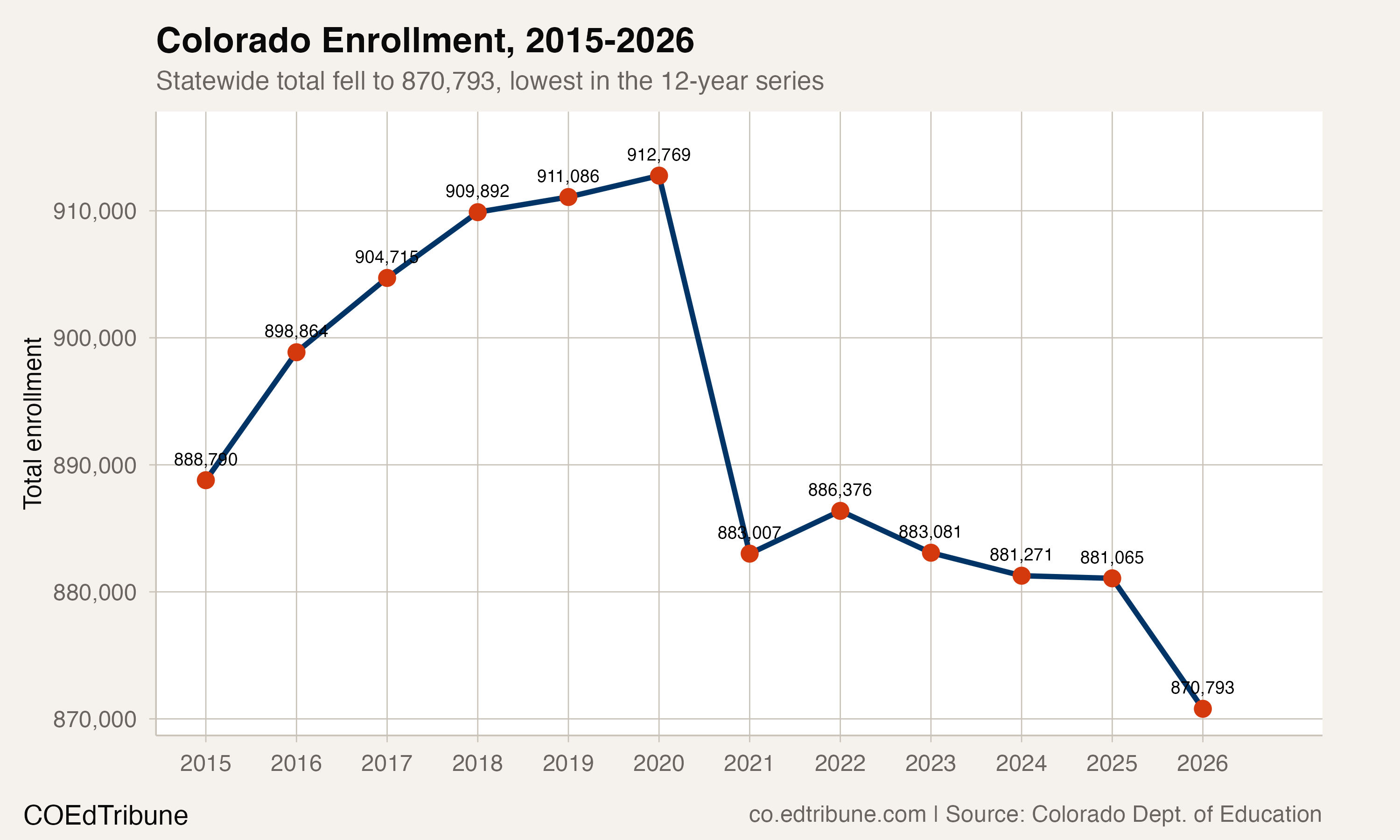
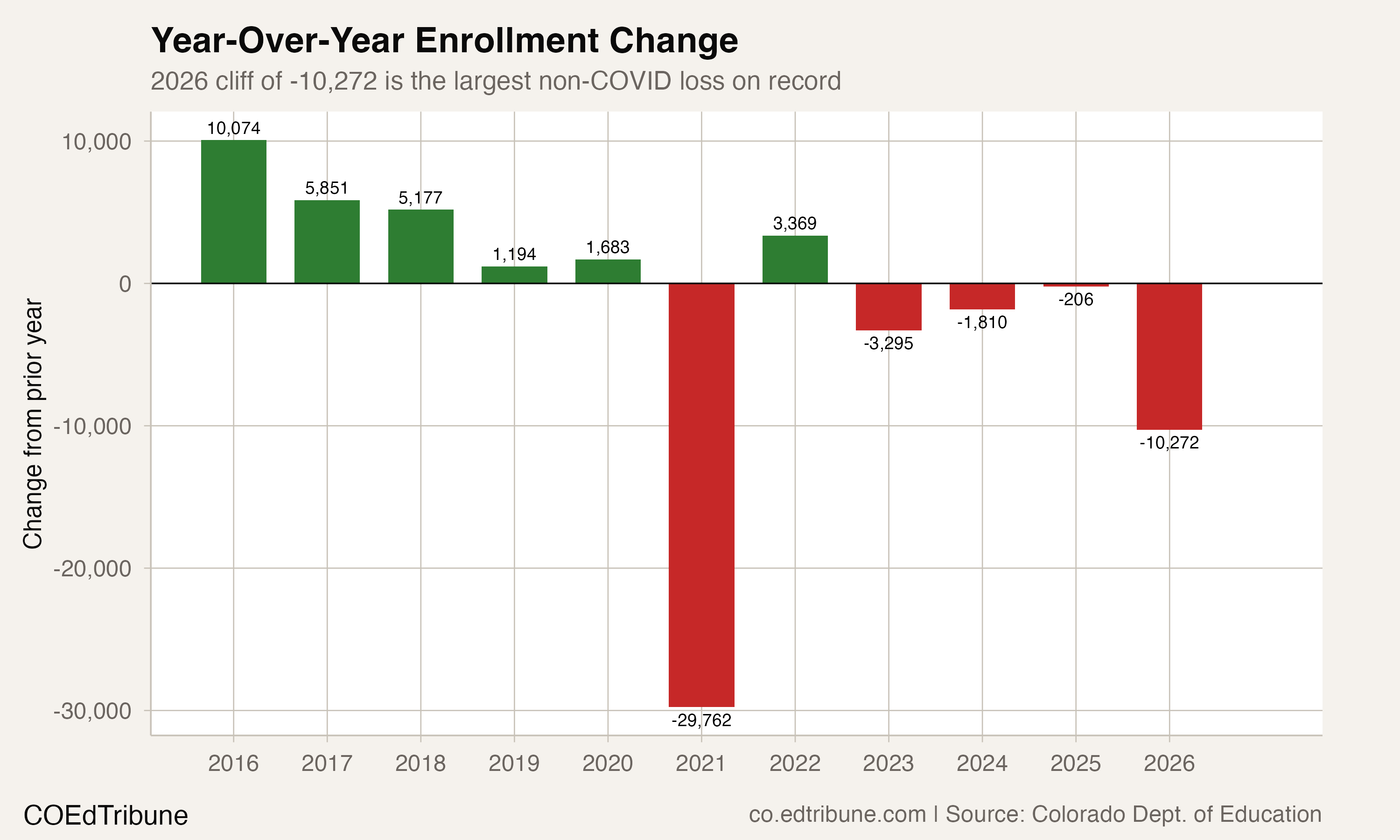
Colorado enrolled 870,793 students in 2025-26, down 10,272 from the prior year, a 1.2% drop. That makes 2026 the largest single-year non-COVID decline in the 12-year series, and it arrived after three years of gradual bleeding that appeared to be stabilizing. In 2024-25, the state lost just 206 students, barely a rounding error. One year later, the floor gave way.
The pattern since the pandemic is unmistakable. Colorado peaked at 912,769 students in 2019-20, lost 29,762 during COVID, clawed back 3,369 in 2021-22, and then resumed declining. The state has now shed 41,976 students from its peak, a 4.6% loss. The 2021-22 bounce-back of 3,369 students recovered just 11.3% of the pandemic loss before the decline resumed.
Not just a small-district story
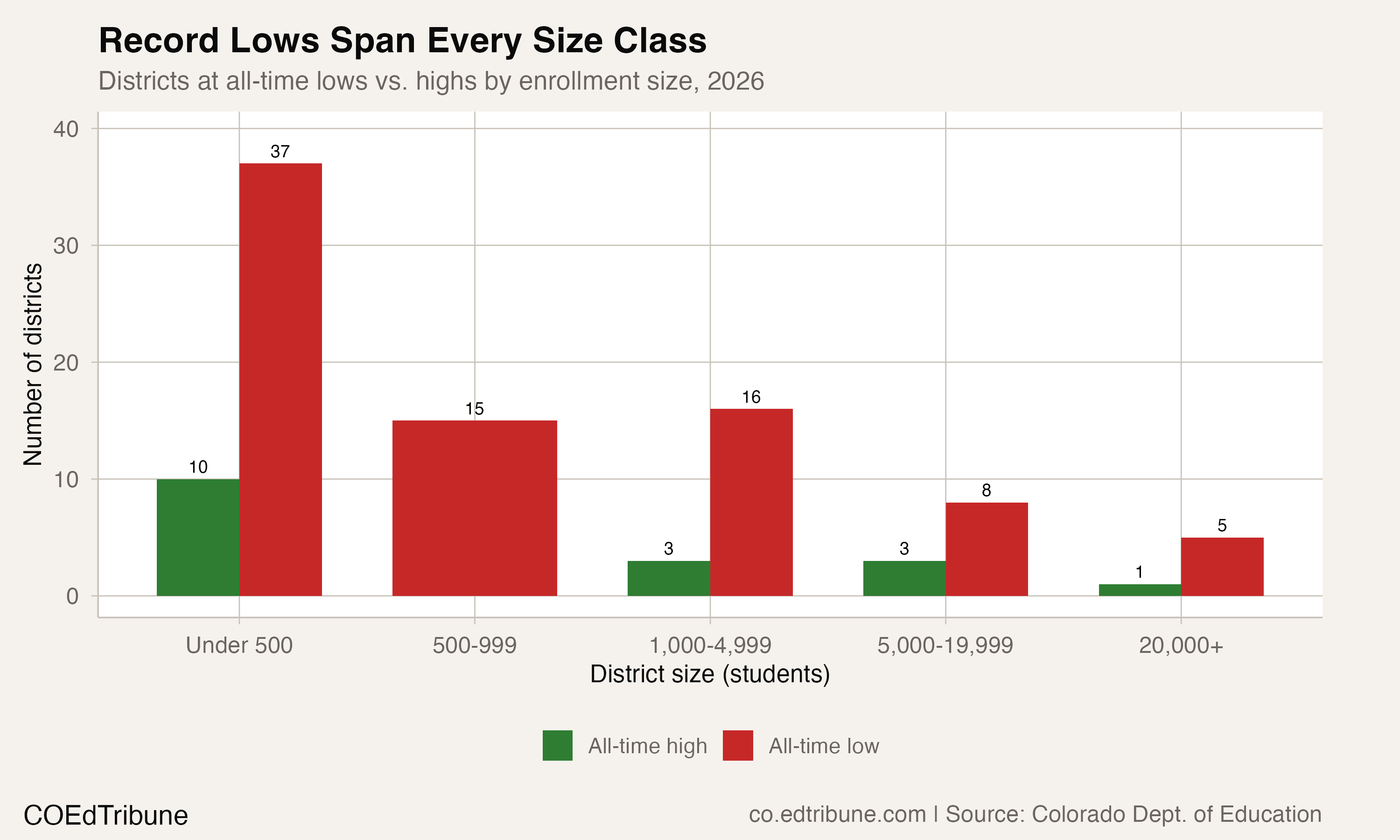
The instinct when 81 districts hit record lows is to assume they are tiny places where a single family moving away shifts the numbers. That is partially true: 37 of the 81 enroll fewer than 500 students. But the pattern does not stop at the small end. Eight districts over 5,000 students are at all-time lows. Five districts over 20,000 students are at all-time lows. Every size class, from micro-rural to large suburban, is represented.
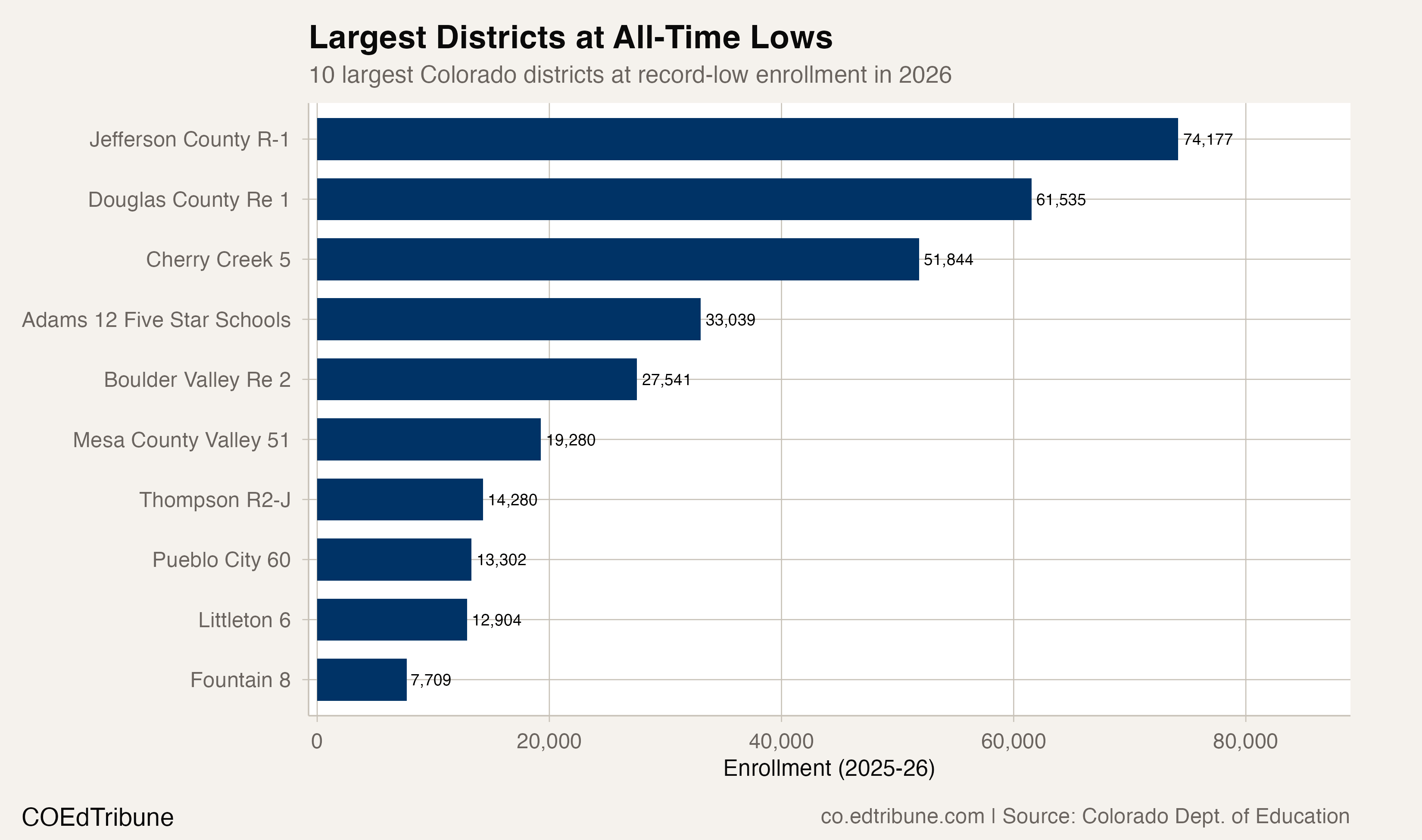
The losses at the top of the list carry outsize fiscal weight. Jefferson County's 12,521-student decline from peak represents roughly $125 million in annual per-pupil funding at current rates. Pueblo City 60↗, down 25.9% from its 2015 peak, has lost more than a quarter of its enrollment. Westminster Public Schools↗, down 28.3%, has lost more than that. Adams County 14↗ has shed a third of its students since 2015.
Meanwhile, the districts at all-time highs paint a different Colorado. Of the 17 districts at record enrollment, the largest is School District 27J↗ in Brighton (24,290), followed by Education reEnvisioned BOCES (13,502, a virtual operator), Weld RE-4 (8,883), and Byers 32J (7,590, also virtual). Strip out the virtual operators and the list is dominated by fast-growing Weld County exurbs.
The acceleration nobody expected
The share of districts at record lows has been climbing steadily since the post-COVID bounce of 2022, when only 21.6% of districts were at their floor. By 2024, that figure reached 35.7%. By 2025, 36.6%. Then 2026 jumped to 43.5%, approaching the 50.3% spike of the pandemic year itself.
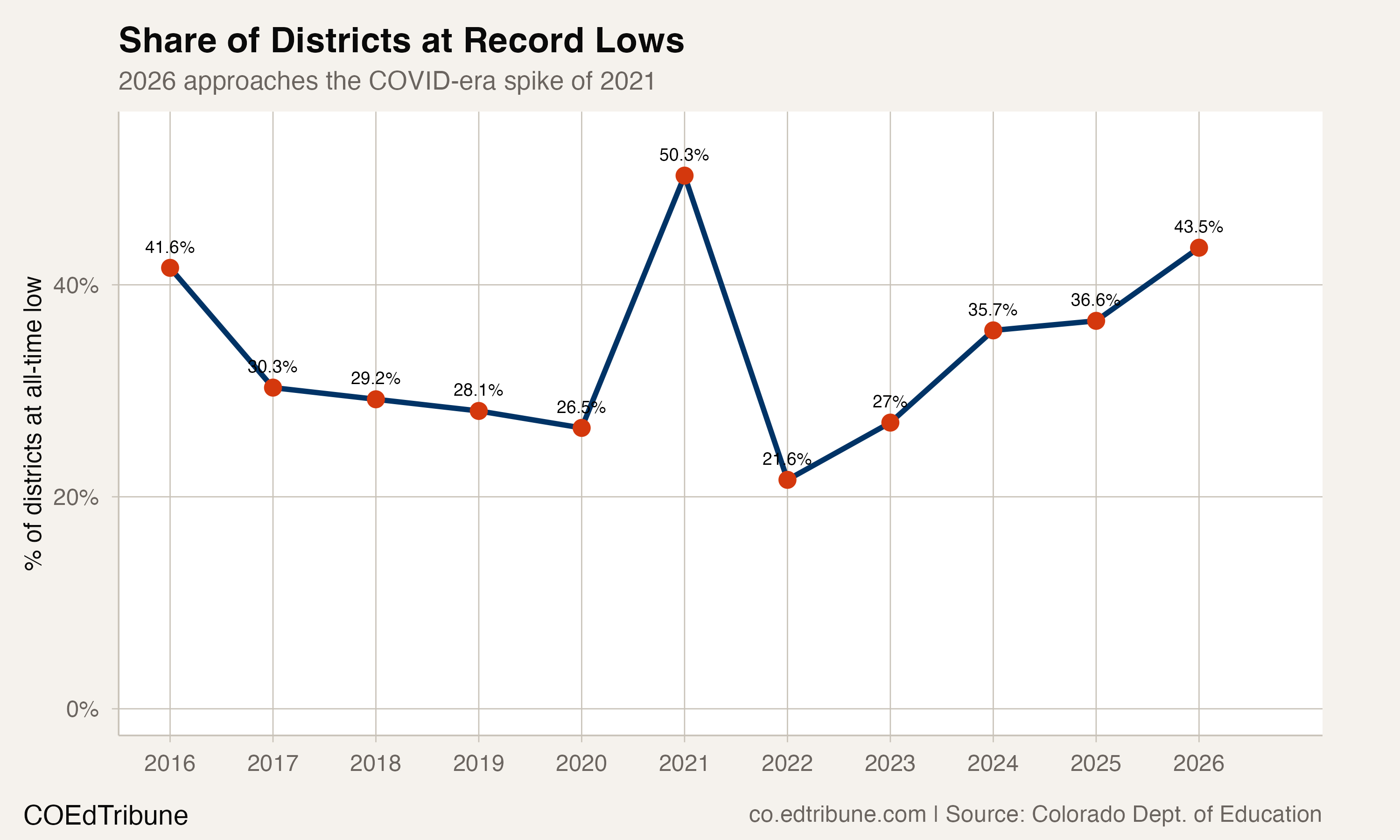
That COVID-era comparison is the most telling detail. In 2020-21, half of Colorado's districts hit their then-lowest point because a pandemic emptied classrooms overnight. Five years later, nearly the same share of districts is at record lows, and this time there is no pandemic to blame.
What is driving this
The most direct explanation is demographic. Colorado's general fertility rate has fallen 25.1% from its 2001-2010 average, the third-largest decline nationally. Fewer babies born in 2019 and 2020 means fewer kindergartners arriving in 2025 and 2026. The Common Sense Institute's analysis of state demography data found that the school-age population peaked in 2019-20 and will not return to that level until 2035.
A second factor is migration. Colorado's post-pandemic immigration wave, which brought thousands of South American families and temporarily swelled Hispanic enrollment, has reversed. Hispanic enrollment fell by approximately 4,400 students in 2025-26 after peaking the prior year, and English learner enrollment dropped from over 105,000 to 99,400. Federal immigration enforcement and the high cost of living in the Front Range corridor likely contributed, though the data cannot distinguish departures from non-arrivals.
A shift toward homeschooling and online alternatives has also contributed, though its scale is modest relative to the overall decline. State data shows a notable increase in online and homeschool enrollment, part of a national post-pandemic trend. Virtual operators like Education reEnvisioned BOCES and Byers 32J, both at all-time-high enrollment, are absorbing some of these students within the public system.
The funding squeeze
The timing of this enrollment cliff collides with a restructuring of how Colorado funds its schools. Governor Polis proposed shifting from a multi-year enrollment average to a single-year count, meaning districts with falling headcounts would see funding adjustments immediately rather than being cushioned by prior years' higher numbers.
"I think it will be extremely challenging to go from four years of averaging to zero overnight." — House Speaker Julie McCluskie, Colorado Sun, Jan. 2025
Jefferson County estimated the formula change could cost it $20 million in a single year. Adams 12 Five Star Schools projected a $13 million hit. For smaller districts already at record lows, the arithmetic is existential. A district enrolling 300 students cannot absorb even a 5% funding cut without eliminating positions.
Durango Superintendent Karen Cheser called the potential impact a "sudden and catastrophic change" that could cost her district approximately $1 million. A revised proposal from Speaker McCluskie would soften the transition, but the structural problem remains: when enrollment declines, per-pupil funding follows students out the door, but fixed costs do not.
Only 11.5% have recovered from COVID
Of the 130 Colorado districts that lost students during the pandemic, only 15 had recovered to their pre-COVID enrollment by 2025-26, a recovery rate of 11.5%. That figure understates the problem: many districts that "recovered" briefly in 2022 or 2023 have since resumed declining. The pandemic did not interrupt a growth trajectory. For most of Colorado's districts, it accelerated a contraction that was already underway, and the contraction has not reversed.
In 2025-26, 138 of 186 districts lost students compared to the prior year. Just 46 grew. The ratio, three-to-one declining versus growing, is the widest in the 12-year series.
Where the growth is
The 17 districts at all-time highs cluster in two categories. The first is Weld County's northern Front Range corridor, where School District 27J↗, Weld RE-4, and Johnstown-Milliken RE-5J are absorbing residential development that continues to outpace the statewide trend. The second is virtual and alternative operators like Education reEnvisioned BOCES and Byers 32J, which are growing by offering online instruction to families who might otherwise homeschool.
The geographic split is stark. Colorado's suburbs and cities are contracting. Its exurbs and virtual schools are expanding. The state's enrollment future depends on which of those forces proves more durable.
Denver Public Schools projects losing approximately 6,338 more students by 2028, the equivalent of 19 elementary schools. Jefferson County is exploring whether to close or restructure Jefferson Jr./Sr. High, where enrollment is projected to fall to 372 students by 2027-28. The state demographer says enrollment will not stabilize for another decade. For 81 districts already at record lows, that means more closures, more layoffs, and more consolidation — with no clear bottom in sight.
Detailed code that reproduces the analysis and figures in this article is available exclusively to EdTribune subscribers.
Discussion
Sign in to join the discussion.
Loading comments...