Something happened in Colorado Springs District 11↗ last year that no other large Colorado district experienced. The chronic absenteeism rate nearly doubled, jumping from 29.2% in 2023-24 to 45.8% in 2024-25, a 16.6 percentage point swing that added 3,955 students to the chronically absent rolls in a single school year.
The 45.8% rate is the highest D11 has ever recorded, surpassing even the 2021-22 pandemic peak of 45.5%. Nearly half of the district's 23,546 students now miss more than 10% of their school days. Among Black students, the rate hit 55.3%. Among Hispanic students, 53.0%. Among students from economically disadvantaged families, 55.6%.
This is not a data error. Local media confirmed the spike, and D11 itself has acknowledged the problem alongside more than 200 behavioral incidents per 1,000 students during the same period.
A trajectory unlike any peer
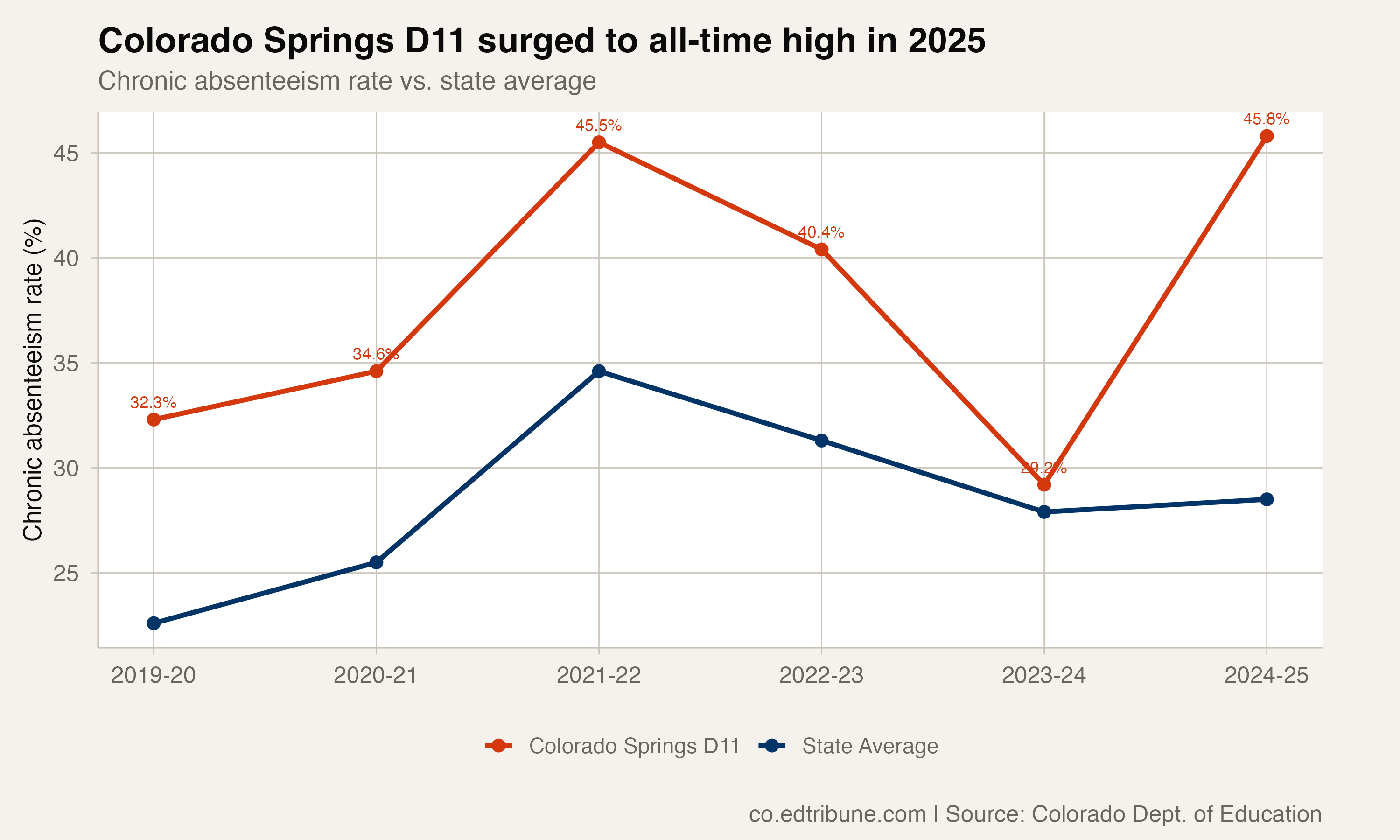
D11's trajectory looks nothing like Colorado's other large districts. Most followed a similar arc after 2021-22: a pandemic surge, then steady improvement. D11 appeared to follow this pattern too, plunging from 45.5% to 29.2% in just two years, the sharpest recovery of any large district in the state. Then the floor dropped out.
The 16.6 point single-year increase dwarfs anything else in the dataset. The next-largest worsening among districts with more than 5,000 students was a fraction of that. D11 didn't just worsen. It erased two years of recovery in a single year and set a new record in the process.
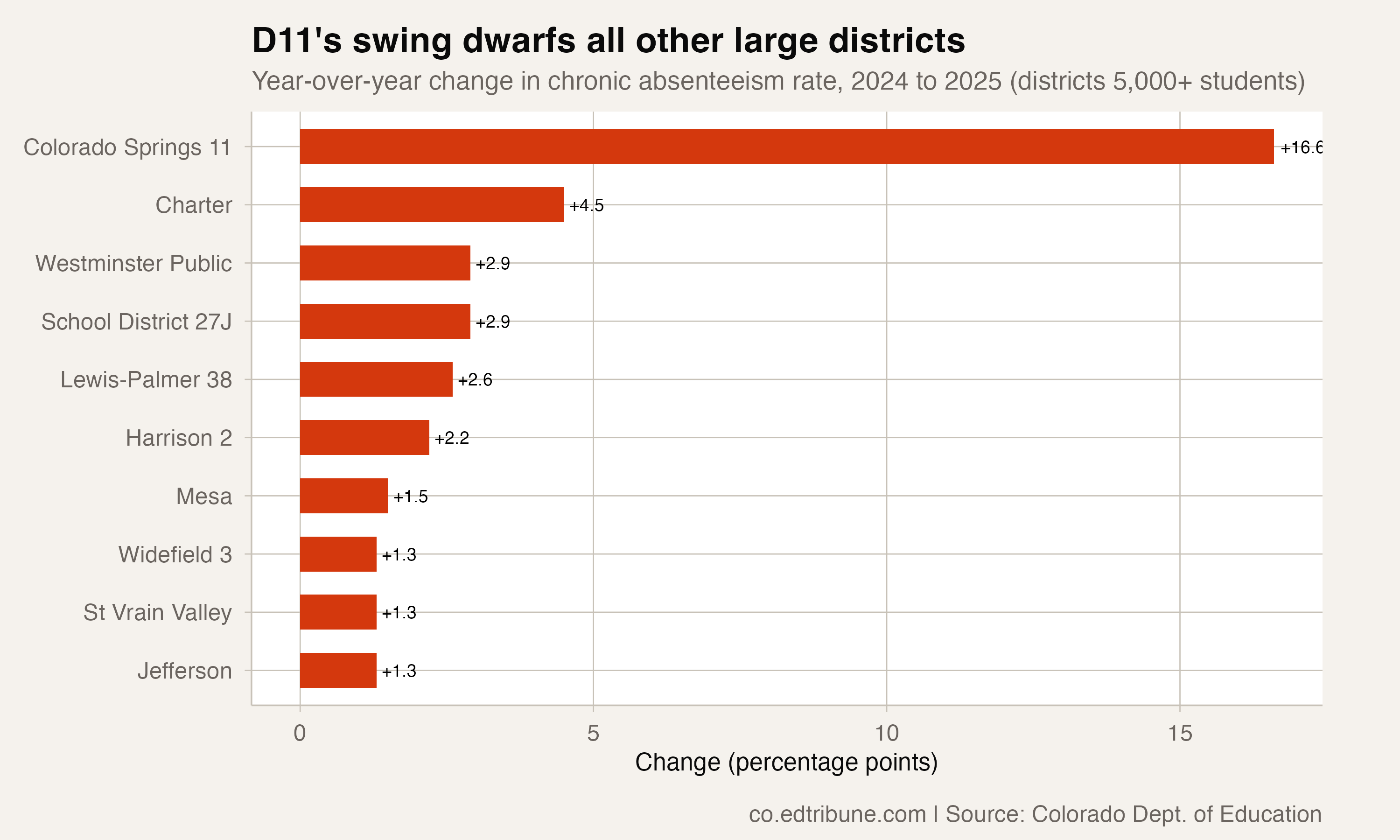
The reversal is particularly striking given D11's size. As one of the state's largest districts, it enrolls enough students to move the statewide average. D11 alone accounted for the majority of the 4,005 additional chronically absent students statewide in 2024-25. Without D11's collapse, Colorado's statewide rate would likely have continued improving.
The equity dimension
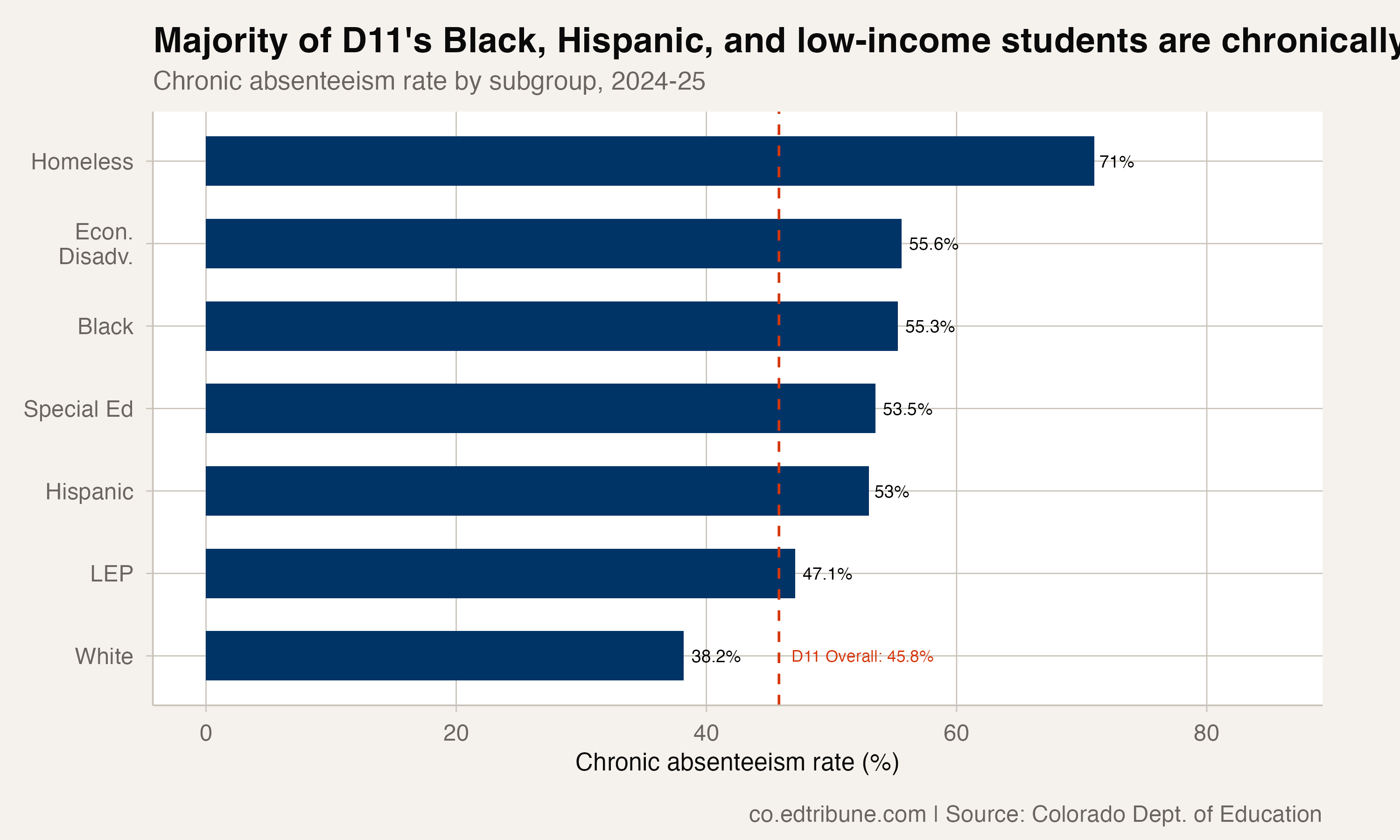
The crisis within D11 is not distributed evenly. Every subgroup worsened dramatically from 2023-24, but the increases hit hardest among students already facing the greatest barriers.
Black students saw the largest jump: from 35.2% to 55.3%, a 20.1 point increase that left more than half chronically absent. Hispanic students went from 33.6% to 53.0%, a 19.4 point increase. Economically disadvantaged students climbed from 36.5% to 55.6%, up 19.1 points. Homeless students, already at elevated rates, rose from 56.2% to 71.0%.
White students also worsened significantly, from 24.0% to 38.2%, but the 14.2 point increase was the smallest among tracked subgroups. The gap between the white rate and the Black rate widened from 11.2 points to 17.1 points in a single year.
D11's LEP students sit at 47.1% and its special education students at 53.5%. Across virtually every demographic slice, a majority or near-majority of D11 students are chronically absent.
Where D11 stands among peers
For context, D11's 45.8% rate is the highest of any Colorado district with more than 10,000 students. Pueblo City 60↗ is the next closest at 41.6%, followed by Adams-Arapahoe 28J↗ (Aurora) at 38.9% and Denver↗ at 38.1%. But Pueblo and Aurora have both been improving. D11 moved sharply in the opposite direction.
Among the 22 Colorado districts enrolling more than 10,000 students, D11's rate is 17.3 percentage points above the median. Only four others exceed 35%.
The question now is whether 2024-25 was an anomaly or the beginning of a structural shift. D11 showed it could recover quickly once before, cutting its rate by 16.3 points in two years between 2021-22 and 2023-24. Whether it can do so again with the behavioral and attendance challenges the district is now confronting will determine whether this year's data becomes a footnote or a turning point.
Detailed code that reproduces the analysis and figures in this article is available exclusively to EdTribune subscribers.
Discussion
Sign in to join the discussion.
Loading comments...