For the first time in the history of Colorado's public school system, no single racial or ethnic group constitutes a majority of students. White enrollment fell to 49.2% in 2024-25, then slipped further to 49.0% in 2025-26, completing a decade-long shift that has remade the demographic profile of Colorado's 870,793-student system.
The crossing is not the result of a single year's disruption. White enrollment has declined every year but one since 2016, shedding 60,365 students, a 12.4% drop. Hispanic enrollment grew by 17,029 over the same period, and the number of multiracial students surged 41.0%. Colorado now joins Texas, California, Nevada, and a growing list of states where public school classrooms have no demographic majority.
A decade of converging lines
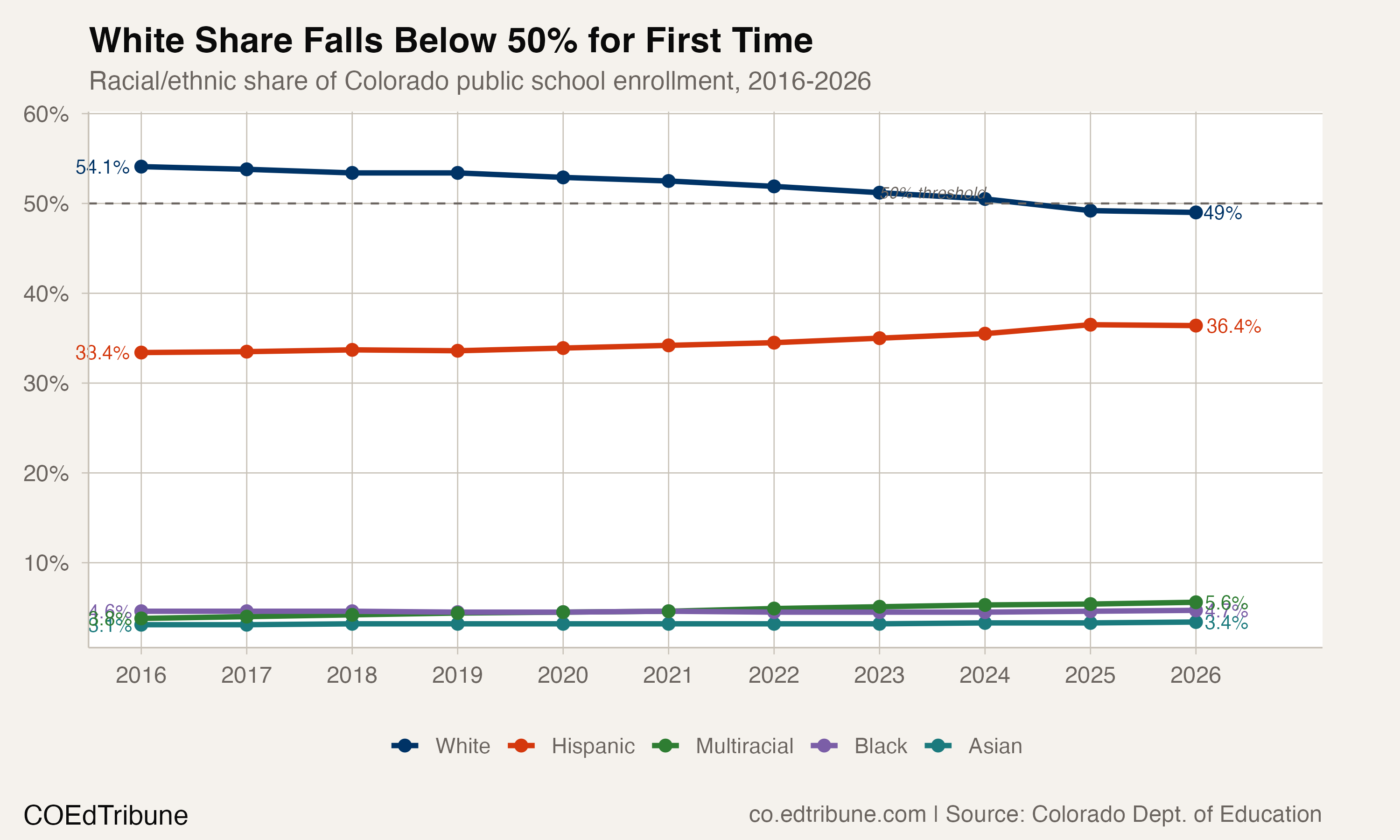
In 2015-16, white students made up 54.1% of Colorado's public school population. Hispanic students were the second-largest group at 33.4%, followed by Black students at 4.6%, multiracial students at 3.8%, and Asian students at 3.1%.
By 2025-26, white share had fallen 5.1 percentage points to 49.0%. Hispanic share rose to 36.4%. Multiracial students nearly doubled their share from 3.8% to 5.6%. Black (4.7%) and Asian (3.4%) shares held roughly steady.
The white decline accelerated sharply after 2022. Between 2021-22 and 2025-26, Colorado lost 33,760 white students in four years, an average annual loss of 8,440. From 2016 to 2022, the average annual loss was 4,434, barely half that pace.
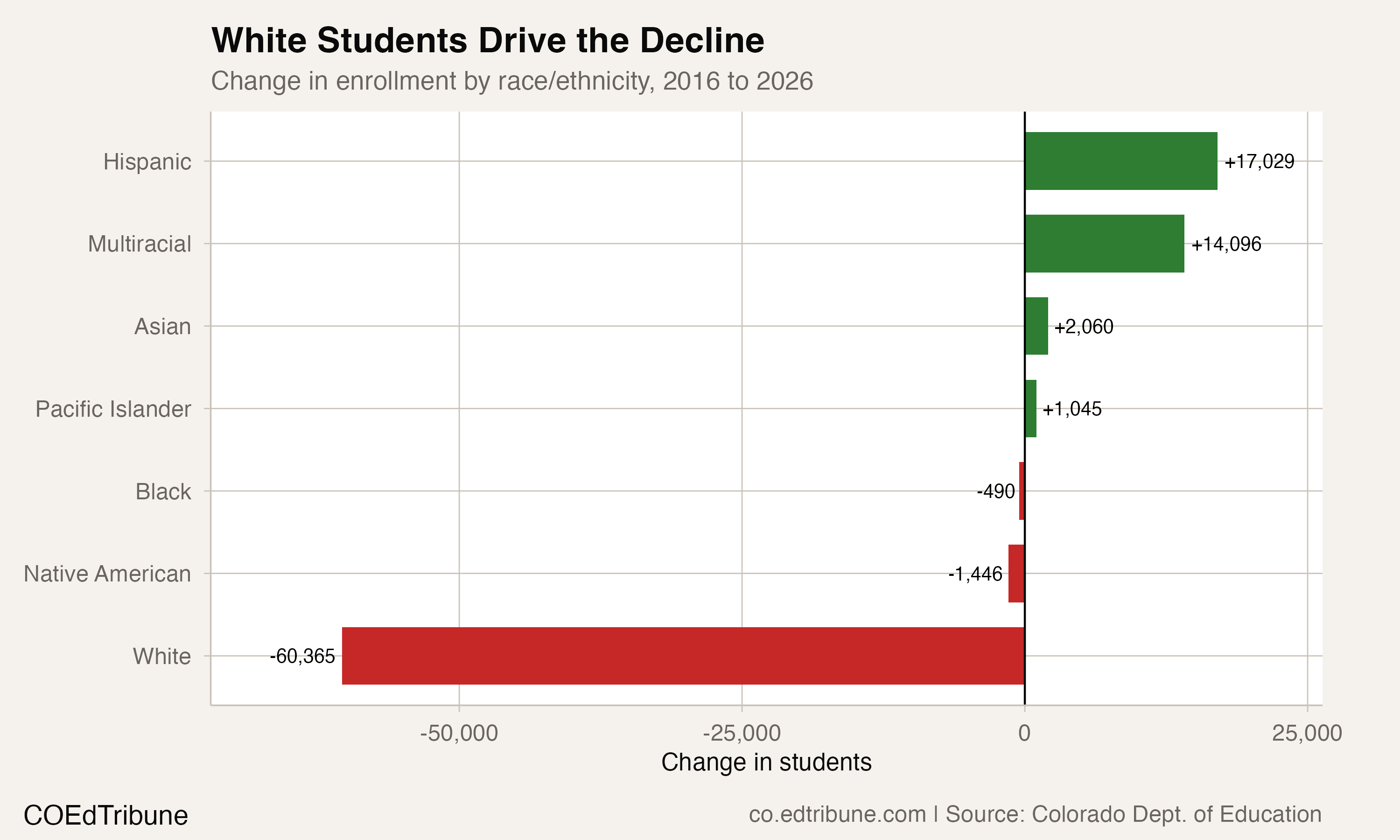
The raw numbers reveal how lopsided the shift has been. White enrollment dropped by 60,365 students since 2016. Hispanic enrollment added 17,029, but the overall student population shrank by 28,071 over the same period, meaning the net gains from Hispanic, multiracial, Asian, and Pacific Islander students only partially offset the white departure.
Births, not borders
The most likely driver is Colorado's declining birth rate. The state has experienced a 25.1% reduction in its general fertility rate since 2001-2010, the third-largest decline in the nation. Colorado's birth rate has been falling since 2005 and at a faster pace than the national average since 2011.
The birth decline has disproportionately reduced the white school-age population. The result shows up clearly in the kindergarten pipeline: white K enrollment dropped 21.3% between 2015-16 and 2025-26, falling from 34,785 to 27,385. Total kindergarten enrollment fell 11.1% over the same period, meaning white losses accounted for the majority of the K decline.
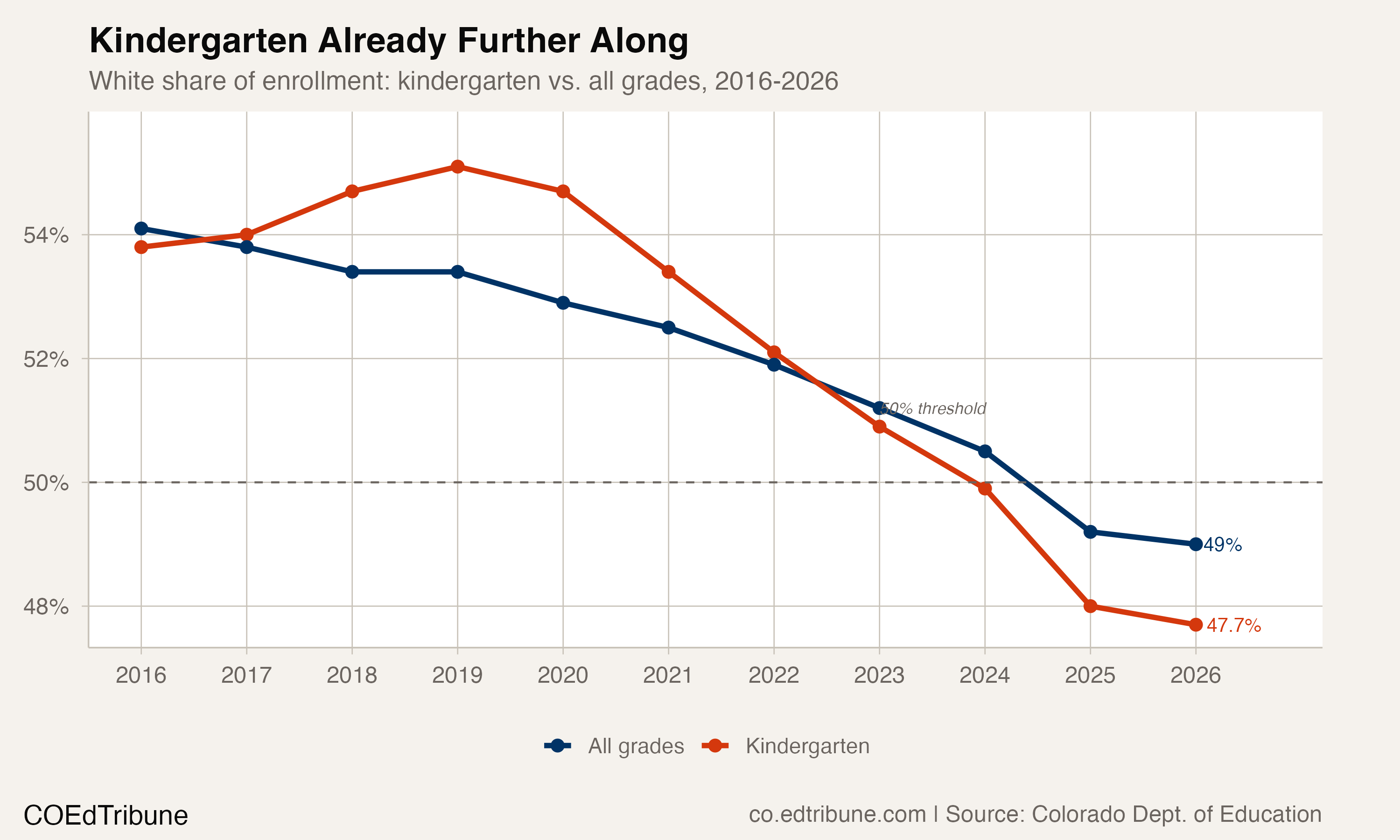
White kindergartners already make up just 47.7% of the K class, 1.3 percentage points below the all-grades average of 49.0%. That gap signals where the overall numbers are heading: as these smaller, more diverse cohorts advance through the grades, the statewide white share will continue to fall even if no additional families leave the system.
An alternative explanation, that white families are choosing private schools or homeschooling at higher rates, is plausible but harder to quantify. The number of Colorado students reported as homeschooled full-time rose by about 550 to 10,367 in 2025-26, continuing a consistent increase since fall 2022. The demographic breakdown of homeschooling families is not tracked at the state level, so the extent to which this draws disproportionately from white families remains unknown.
The suburban flip
The statewide crossing masks a more varied district-level picture. In 2015-16, 43 of Colorado's 185 districts had white enrollment below 50%. By 2025-26, that number had risen to 59 of 186, or 31.7%.
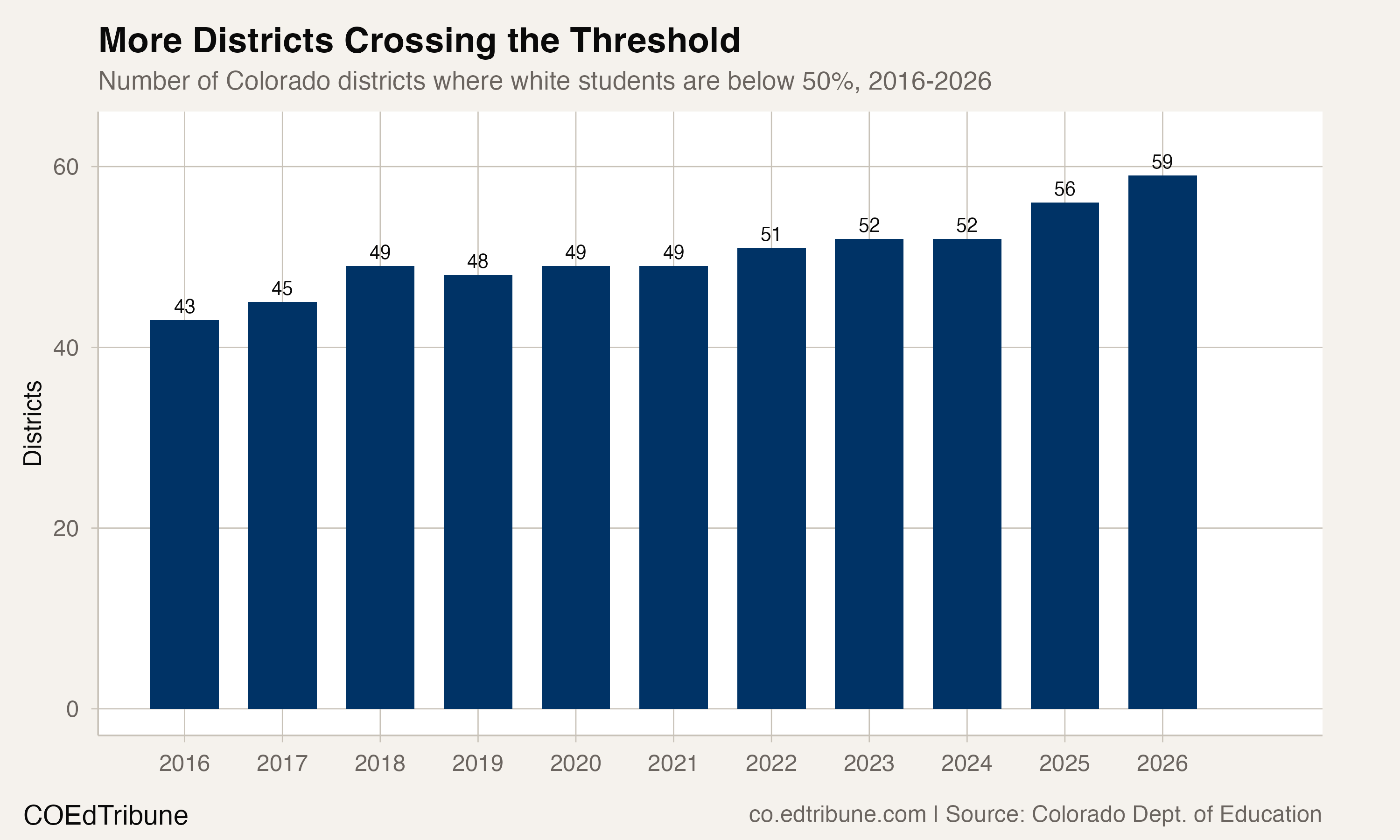
Seventeen districts flipped from white-majority to majority-minority over the decade. The most consequential is Cherry Creek 5↗, the state's second-largest district with 51,844 students. Cherry Creek's white share dropped from 54.3% to 44.4%, a 9.9 percentage-point swing driven by growth in its Hispanic, Asian, and multiracial populations.
Adams 12 Five Star Schools↗, with 33,039 students, saw an even steeper shift: white share fell from 50.9% to 38.6%, a 12.2-point decline. Colorado Springs 11 (52.2% to 45.8%) and District 49 in Falcon (59.7% to 49.0%) also crossed the threshold.
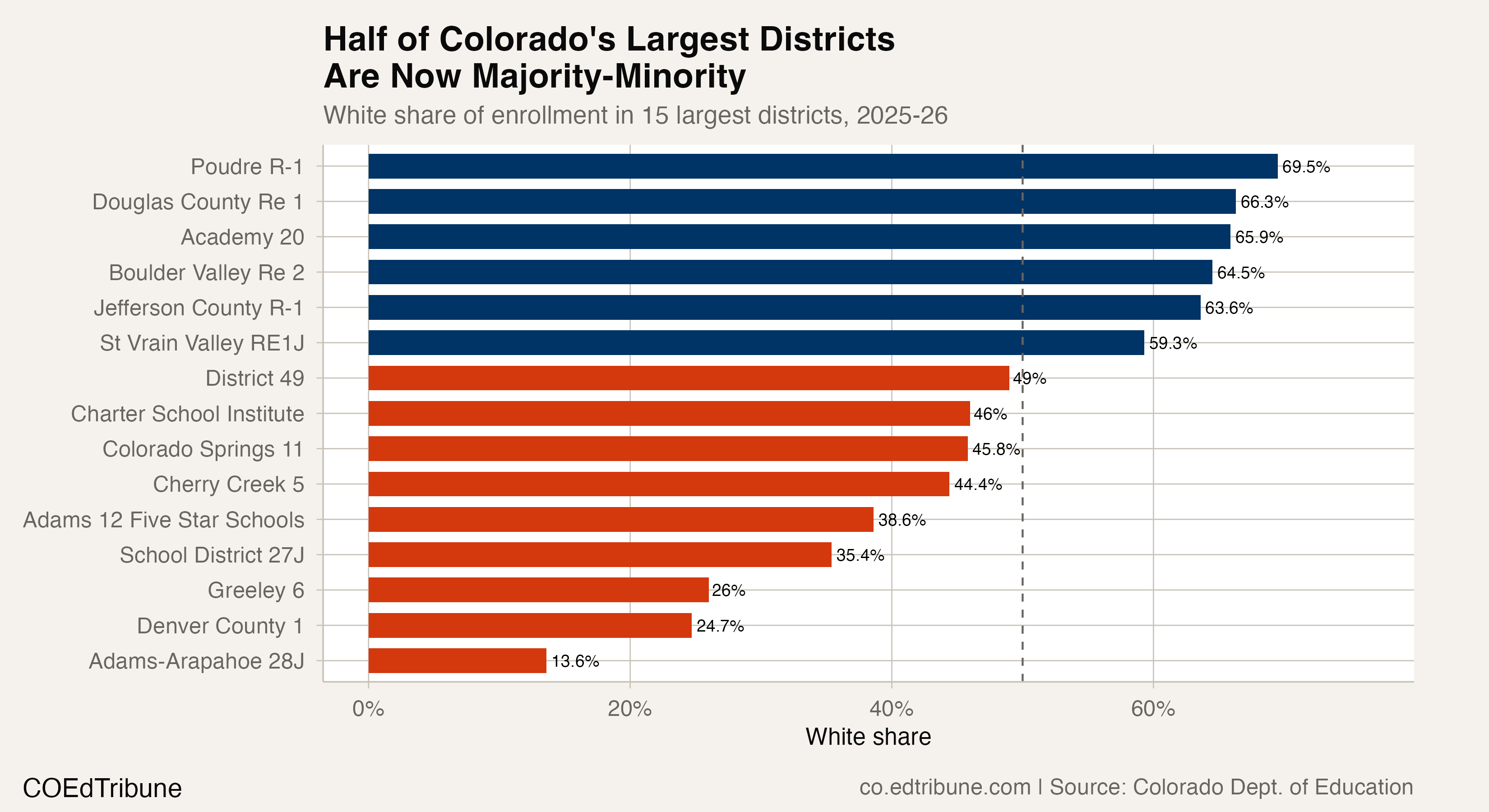
Among the state's 15 largest districts, nine now have white enrollment below 50%. Adams-Arapahoe 28J↗ (Aurora) sits at 13.6% white. Denver County 1↗ is at 24.7%. Greeley 6 is at 26.0%. The suburban ring around Denver, once overwhelmingly white, increasingly mirrors the city's diversity.
Only the outer-ring and exurban districts remain predominantly white. Douglas County Re 1↗ is 66.3% white, down from 75.5% a decade ago. Poudre R-1 (Fort Collins) is 69.5%. Even these districts are trending downward. Douglas County's white share dropped 9.2 percentage points in a decade.
The Hispanic plateau
Hispanic enrollment, the largest non-white group at 36.4% of the statewide total, presents a more complicated picture than its rising share might suggest. In absolute terms, Hispanic enrollment peaked in 2024-25 at 321,409, then fell by 4,395 students in 2025-26 to 317,014.
Colorado Education Commissioner Susana Cordova attributed the enrollment decline in part to fewer births over the past two decades, population decreases in 30% of Colorado's counties, and increased enrollment in online and homeschool programs. The state's English learner population also fell from more than 105,000 to about 99,400, a reversal from the prior year's surge. Some recent arrivals from South America left the state, contributing to the Hispanic enrollment dip.
"DPS is set to close seven schools and partially restructure three others, impacting thousands of students." -- Common Sense Institute, January 2025
Denver and Jefferson County, the state's two largest districts, experienced losses of roughly 1,200 and 1,300 students respectively in 2025-26.
Multiracial growth, the quiet driver
The fastest-growing racial category in Colorado's schools is multiracial students, who rose from 34,389 (3.8% share) in 2015-16 to 48,485 (5.6%) in 2025-26, a gain of 14,096 students, or 41.0%. This growth has been steady and uninterrupted across all 11 years of available data.
The multiracial surge is partly demographic — intermarriage rates in metro Denver run well above the national average, and the children of those marriages are now filling classrooms. But some of the growth is almost certainly reclassification: families who a generation ago would have checked a single box now choosing "two or more races." The enrollment form records both the same way.
What to watch
The kindergarten pipeline makes one thing clear: the shift toward a no-majority student body is self-reinforcing. White K enrollment fell to 47.7% of the entering class in 2025-26. By the time today's kindergartners are seniors, the statewide white share will likely be closer to 45% than 50%.
The question for Colorado's school districts is whether their staffing, curriculum, and family engagement practices are keeping pace with students who have already arrived. Nine of the state's 15 largest districts are now majority-minority. For Cherry Creek, Adams 12, and Colorado Springs 11, the crossing happened within the last decade — and their staffing, curriculum, and family engagement practices are still catching up.
Detailed code that reproduces the analysis and figures in this article is available exclusively to EdTribune subscribers.
Discussion
Sign in to join the discussion.
Loading comments...