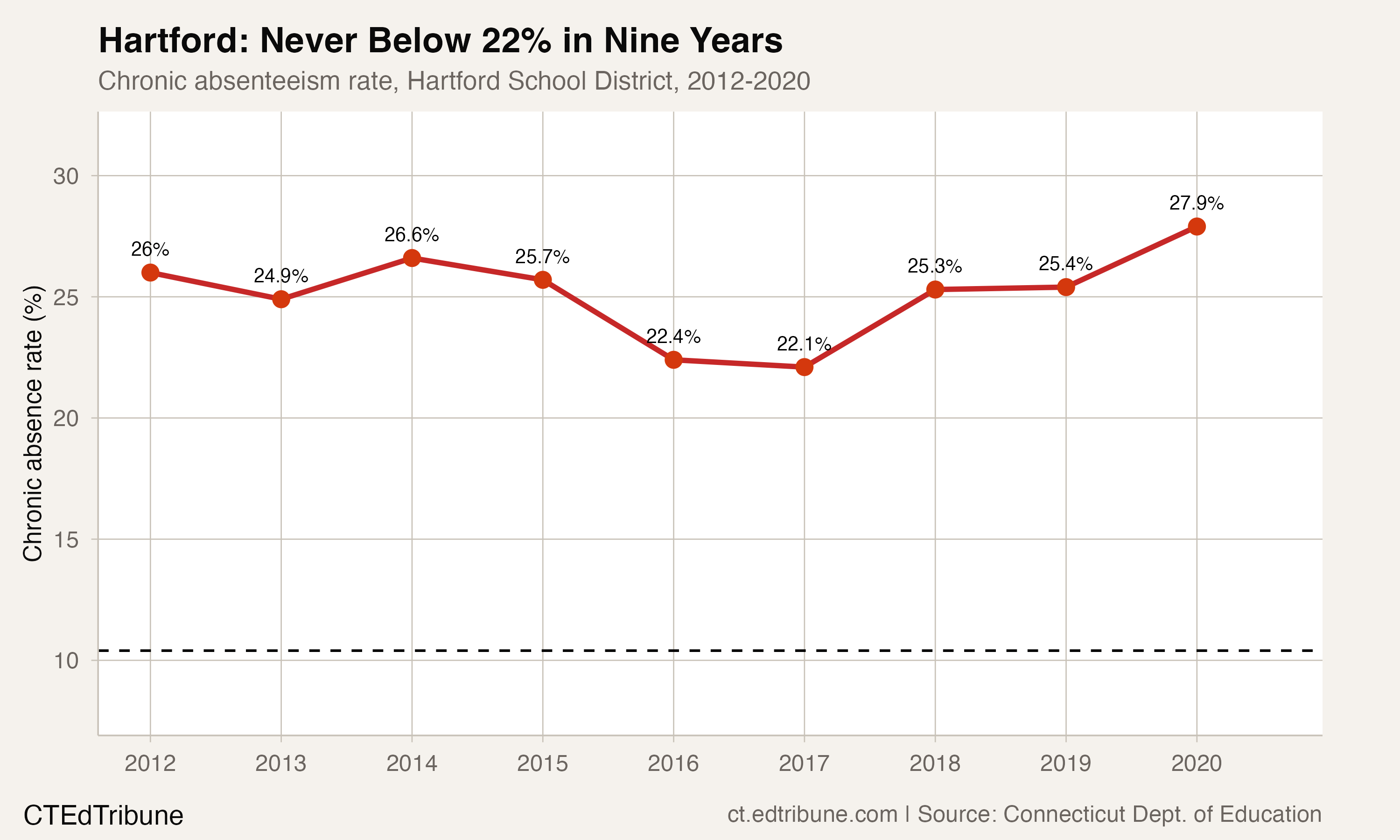
In nine years of chronic absenteeism data, HartfordET School District never achieved a rate below 22.1%. The best year, 2017, still meant more than one in five students missing 10% or more of school days. The worst, 2020 at 27.9%, meant more than one in four.
The average across all nine years: 25.1%. Not a spike. Not a crisis that emerged from the pandemic. A permanent condition.
A rate that runs 2.3 times the state average
Hartford's chronic absence rate has consistently run 2.2 to 2.5 times the statewide figure. In 2017, when the state hit its second-lowest mark of 9.9%, Hartford posted 22.1% — a gap of 12.2 percentage points. In 2020, when the state climbed to its worst-ever 12.2%, Hartford hit 27.9% — a gap of 15.7 points.
The ratio barely moves. Hartford is not gradually converging with the state or gradually falling behind. It occupies a fixed orbit roughly two and a half times higher, year after year. Whatever forces drive statewide chronic absenteeism (flu season severity, winter weather, policy changes) drive Hartford's rate in the same direction but from a vastly higher baseline.
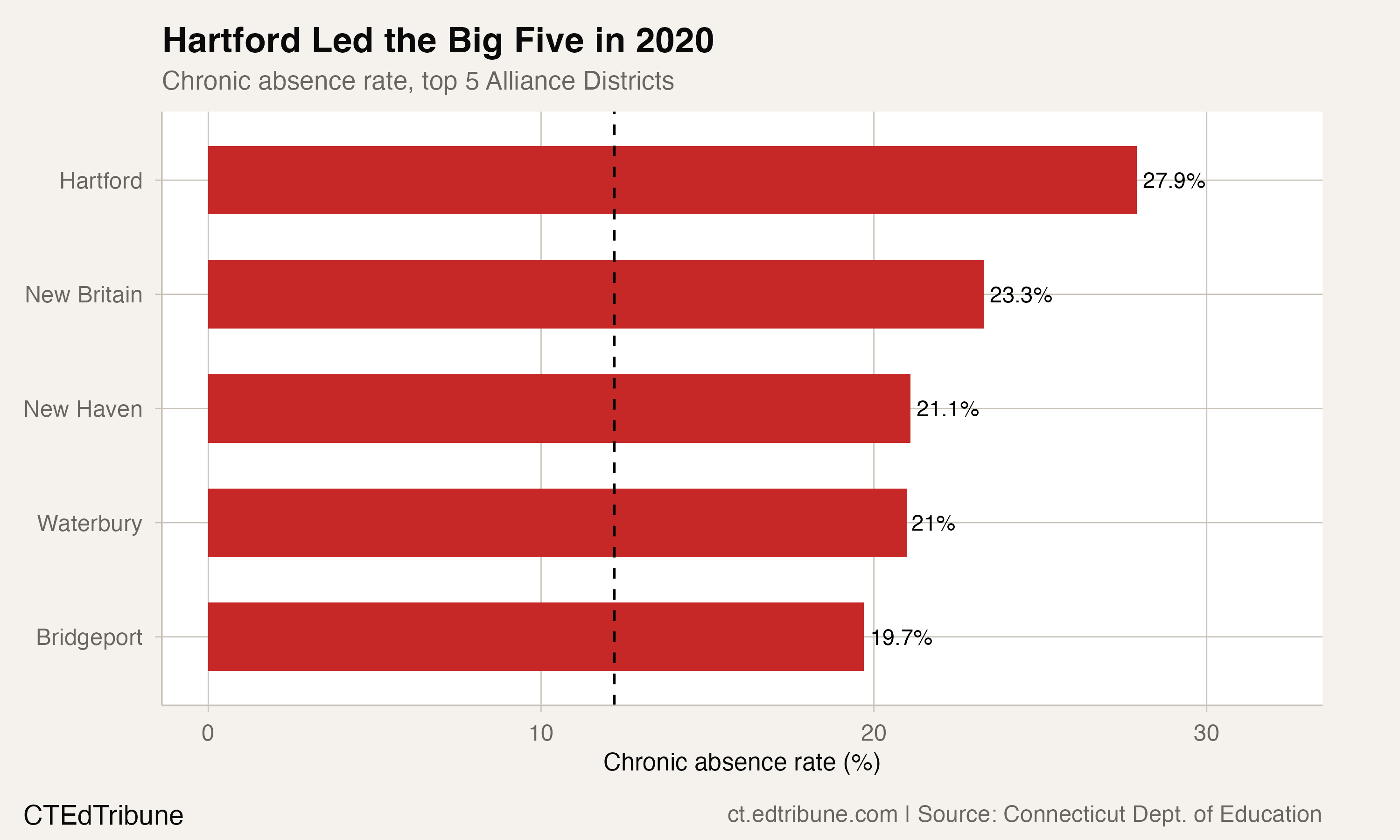
Among the state's five largest Alliance Districts in 2020, Hartford led New BritainET at 23.3%, New HavenET at 21.1%, WaterburyET at 21.0%, and BridgeportET at 19.7%. Hartford's rate was 8.2 percentage points higher than Bridgeport's — a wider gap than many states see between their best and worst districts.
The 2018 spike that nobody saw coming
Hartford's trajectory is not a steady line. It is volatile in ways that defy easy explanation. The district dropped from 24.9% in 2013 to 22.1% in 2017, nearly 3 percentage points of progress over four years, though the path included a spike to 26.6% in 2014 before the sustained decline began. Then in 2018, the rate jumped 3.2 points to 25.3%, erasing all improvement in a single year.
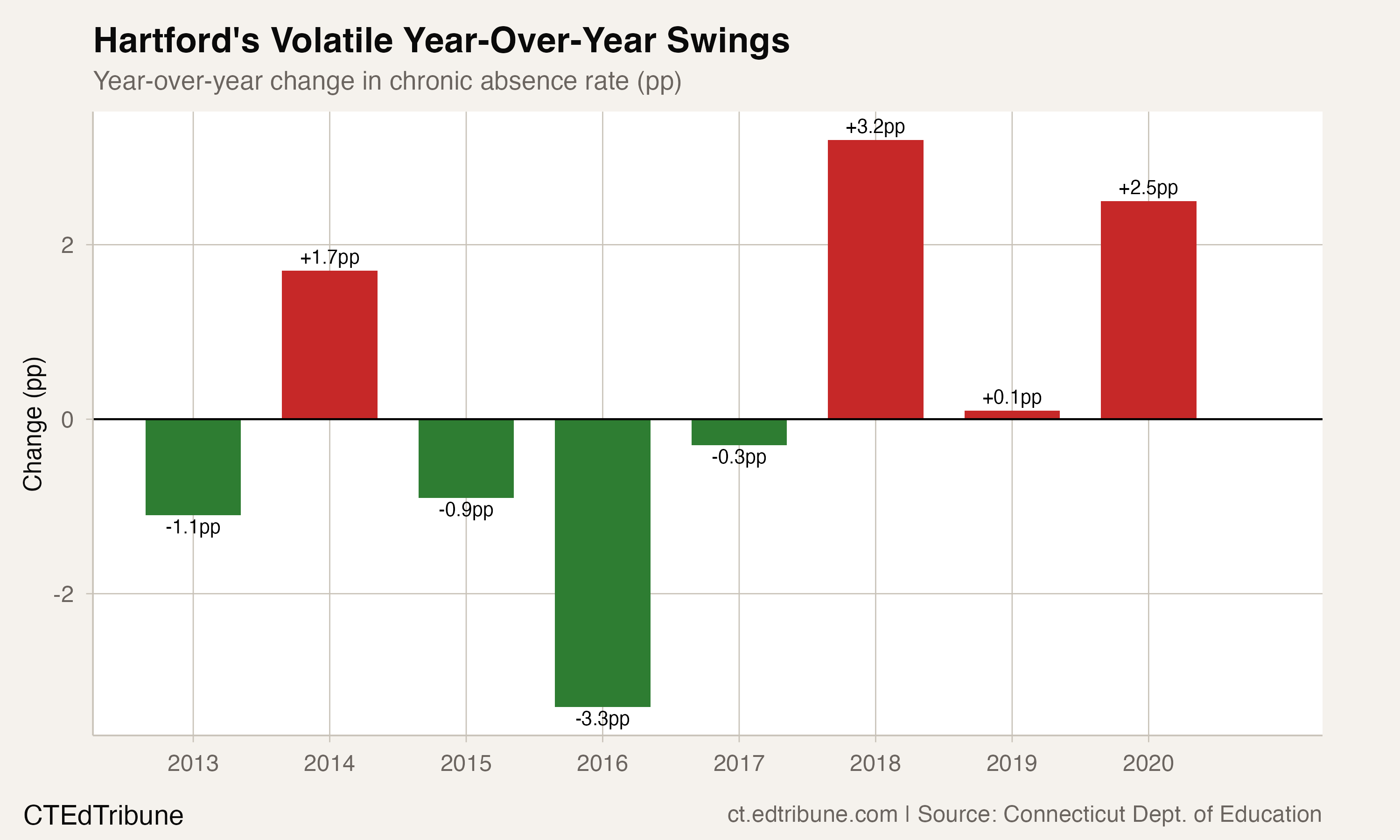
The 2018 spike came during a normal school year — no pandemic, no closures, no obvious external shock. The state average rose 0.8 points that year, from 9.9% to 10.7%, but Hartford's jump was four times larger. Something specific happened in Hartford's attendance ecosystem, and the publicly available data does not reveal what.
The Hartford Courant has documented the district's multi-faceted approach to the problem in recent years, noting that Hartford's Attendance Climate and Engagement (ACE) Teams meet weekly to review data and develop interventions. But these structures were largely built during and after the pandemic. The pre-COVID data suggests the problem was already at crisis levels without them.
What 10,120 home visits accomplished
The post-COVID trajectory shows what intensive intervention can achieve, and what it cannot. Hartford's chronic absence rate peaked at 46% in 2021, nearly doubling from the already-alarming 27.9% pre-COVID baseline. The state's LEAP home-visitation program, which paired community members with chronically absent families, produced dramatic results: Hartford teams conducted 10,120 visits in a single year, and participating families saw attendance improve by nearly 30 percentage points.
By 2024-25, Hartford's rate had fallen to 36.2% — a remarkable 9.8 percentage-point improvement from the 46% peak. But 36.2% is still higher than Hartford's worst pre-COVID year. The district has not yet recovered to its own pre-pandemic baseline, let alone approached the statewide average.
"Hartford Public Schools' approach begins with root cause identification and interventions that promote student attendance, such as overcoming transportation challenges, health concerns, or competing family needs." — UHSS Times, Hartford Public Schools coverage
Boys miss more, but the gap is small
Hartford's gender data reveals a consistent but modest disparity: boys have higher chronic absence rates than girls in every year, but the gap is narrow, ranging from 1.2 to 2.2 percentage points. In 2020, boys were at 28.5% and girls at 27.2%, a 1.3-point difference.
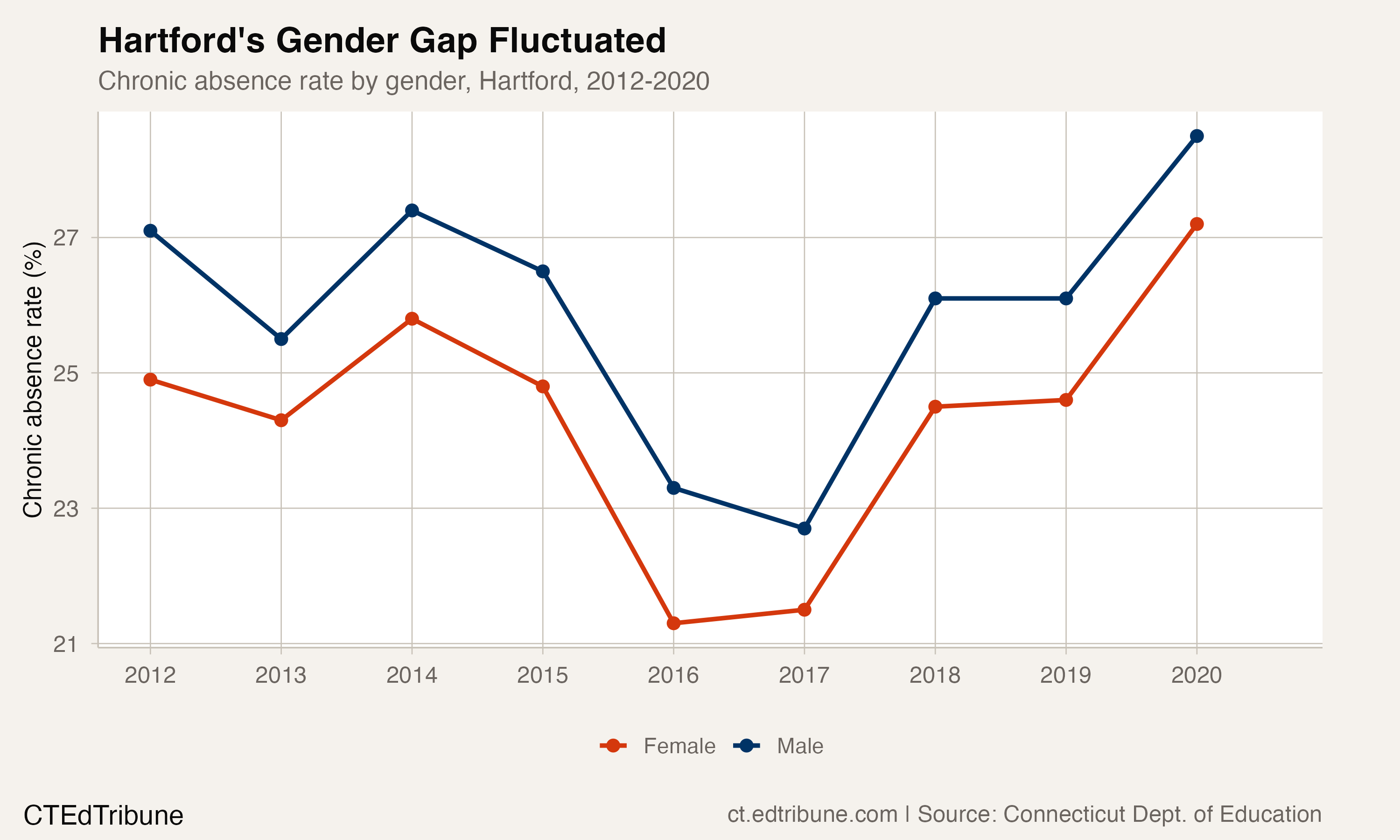
The gender gap is too small to be the story. Both genders in Hartford experience chronic absence at rates that would constitute a crisis in any other Connecticut district. The gap between Hartford's girls (27.2%) and the statewide average (12.2%) is 15 points, larger than the gap between Hartford's boys and girls.
The structural question
Hartford is the fourth-poorest city over 100,000 residents in the United States, with a 34.4% poverty rate. The city's attendance crisis exists within a constellation of poverty, housing instability, health access challenges, and transportation barriers that a school district cannot solve alone.
The Yankee Institute has raised questions about whether the district's accountability structures extend to staff attendance alongside student attendance — a point that highlights the institutional complexity of the problem.
The pre-COVID data establishes that Hartford's attendance crisis is not a pandemic artifact. It is a structural condition with a floor that has never dropped below 22%. The pandemic drove the rate to 46%, and LEAP is driving it back down.
The question is simple: can LEAP and Hartford's ACE teams break through 22%? That is the floor the data shows -- the best Hartford managed in nine years, and it took four consecutive years of improvement to get there. Everything above 22% is a city reverting to its baseline. Breaking below it would be something Hartford has never done.
Detailed code that reproduces the analysis and figures in this article is available exclusively to EdTribune subscribers.
Discussion
Sign in to join the discussion.
Loading comments...